局部火烤对Q355B钢板抗拉性能的影响规律研究
doi: 10.11951/j.issn.1005-0299.20240147
程震1 , 于敏2 , 缑瑞宾1 , 贾盛康1
1. 安徽科技学院机械工程学院,安徽 凤阳 233100
2. 安徽科技学院建筑学院,安徽 蚌埠 233000
基金项目: 安徽省教育厅科学研究重点项目(2022AH051630)
Study on the influence of local fire baking on the tensile properties of Q355B steel plate
CHENG Zhen1 , YU Min2 , GOU Ruibin1 , JIA Shengkang1
1. College of Mechanical Engineering, Anhui Science and Technology University, Fengyang 233100 , China
2. College of Architecture, Anhui Science and Technology University, Bengbu 233000 , China
摘要
为了揭示局部火烤对Q355B钢板抗拉性能的影响规律,通过火烤处理、拉伸实验、组织与断口分析,结合铁素体平均晶粒尺寸测量结果,对受火后Q355B钢板抗拉性能的变化规律进行研究。结果表明,吸热功率对钢板铁素体晶粒尺寸影响显著,当峰值温度不超过600 ℃时,吸热功率使钢板的铁素体晶粒尺寸减小;吸热功率使各板的强度升高,与母材相比,屈服强度和抗拉强度最大增幅分别为15.7%和6.5%,这是由于铁素体晶粒尺寸减小所致。火源点处抗拉强度与吸热功率呈负相关,火源点外抗拉强度与吸热功率无明显关联;各板的屈服强度都随着距火源点距离的增加呈现先降低后平稳的趋势,但各板抗拉强度的变化规律不同,当吸热功率低于0.27 J/min时,抗拉强度对距离不敏感,而当吸热功率超过0.27 J/min时,抗拉强度则与距离正相关。本文的研究结果可为改善钢板的力学性能和火灾后钢板的重复利用提供参考。
Abstract
To reveal the influence of local fire baking on the tensile properties of Q355B steel plates, the changes in the tensile properties of Q355B steel plates after exposure to fire are studied through fire heating treatment, tensile testing, microstructure and fracture analysis, combined with the measurement results of ferrite average grain size. The results show that the heat flux has a significant effect on the ferrite grain size of the steel plate. When the peak temperature is lower than 600 ℃, the endothermic power leads to the ferrite grain size of the steel plate to decrease. The endothermic power increases the strength of each plate, and the maximum increases in yield strength and tensile strength are 15.7% and 6.5% respectively compared with the base material. The tensile strength at the fire source is negatively correlated with the endothermic power, while the tensile strength outside the fire source is not significantly correlated. The yield strength of each plate decreases first and then stabilizes with the increase of the distance from the fire source point, but the variation of tensile strength of each plate is different. When the endothermic power is less than 0.27 J/min, the tensile strength is not sensitive to distance. And when it exceeds 0.27 J/min, the tensile strength is positively correlated with distance. The experimental results provide a reference for improving the mechanical properties of steel plates and reusing steel plates after fire.
随着双碳目标的推进和经济高质量发展,低合金钢板在机械、石油化工和农业装备等领域的需求不断增加,如起重机械、压力容器和钢板仓等大型钢制对象。这些制品通常具有大型化、高承载和长服役周期等特征,所以对钢板力学性能要求日趋苛刻。服役过程中常面临局部应力过高的安全问题,在工程上通常采用局部电阻丝加热或火烤来改善性能,但是局部加热和火烤等处理方式必然对钢板的组织产生影响[1-4],导致其力学性能发生未知变化。因此,精确评价受火处理后钢板抗拉性能的变化规律,对改善钢板力学性能和实现火灾后重复利用具有重大意义。
近年来,大量学者采用高温炉对结构钢进行高温处理,研究材料力学性能的变化规律,例如低碳钢[5]、低合金钢[6-10]、高强度钢[11-18]、特种设备用钢[19-20]等。在低碳钢方面,Ren等[5]发现Q235冷弯型钢受火温度超过600℃水冷后,极限强度显著增加。在低合金钢方面,温度低于600℃时,高温后Q355钢力学性能的变化幅度不超过10%;超过600℃时,浸水冷却的屈服和抗拉强度随温度升高而增大,而空冷则相反[6-10]。在高强钢方面,Jiang等[11]发现高强钢Q460的强度随着实验温度的增加整体呈下降趋势。宋林昕等[12]发现温度超过600℃时Q550钢的屈服和抗拉强度开始折减。高温水冷后,Q690钢的屈服和抗拉强度以700℃为分界值,都呈现先减小后增大的变化规律[14-17]。在特种用钢方面,吕晶等[19]发现温度高于600℃时,空冷后S280GD+Z钢材强度随受火温度提高而降低,而水冷则相反。在受火后力学模型方面,部分学者对不同钢材高温后力学性能进行研究,提出了火灾温度的应力-应变模型[21-22]。综上所述,学者们通过高温炉内的均匀温度场模拟火灾处理,进行了大量高温处理后钢材力学性能的研究。然而,火灾或局部火烤时产生的非均匀温度场会导致材料力学性能发生非均匀变化。因此,开展局部火烤过程中形成的非均匀温度场对钢板抗拉性能的影响规律研究,对于维护大型钢制对象的服役安全性能与实现钢材的持续利用具有重大的研究意义和应用价值。
鉴于此,本文以大型钢制对象常用钢Q355B为研究对象。首先,研究局部火烤下钢板的非均匀温度场分布特征;其次,通过微观组织观测和拉伸实验,获取受火后的微观组织和抗拉性能数据,并利用SEM分析局部火烤对材料失效断口的影响;最后,探讨局部火烤后材料组织、强度与温度场的关系,揭示局部火烤对钢板抗拉性能的影响机制,为提升钢板的服役安全性能提供数据支撑。
1 实验
1.1 局部火烤测试板
以Q355B钢板为研究对象,材料的化学成分如表1所示。火灾测试板的尺寸为1 500 mm(轧向)×210 mm(宽度)×6 mm(厚度)。
1Q355B钢的化学成分(质量分数/%)
Table1Chemical composition of Q355B steel (wt.%)

1.2 拉伸试样
图1为拉伸试样尺寸,试样长度方向与板的轧向垂直。
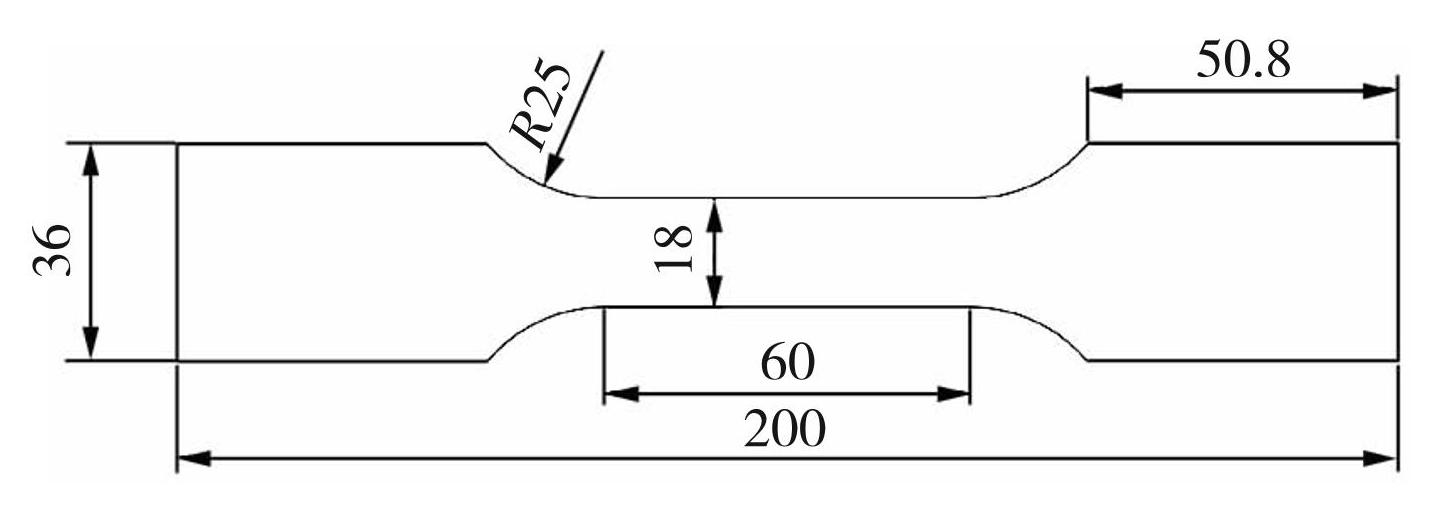
1拉伸试样尺寸图(单位:mm)
Fig.1Size diagram of tensile specimen
1.3 局部火烤实验方法
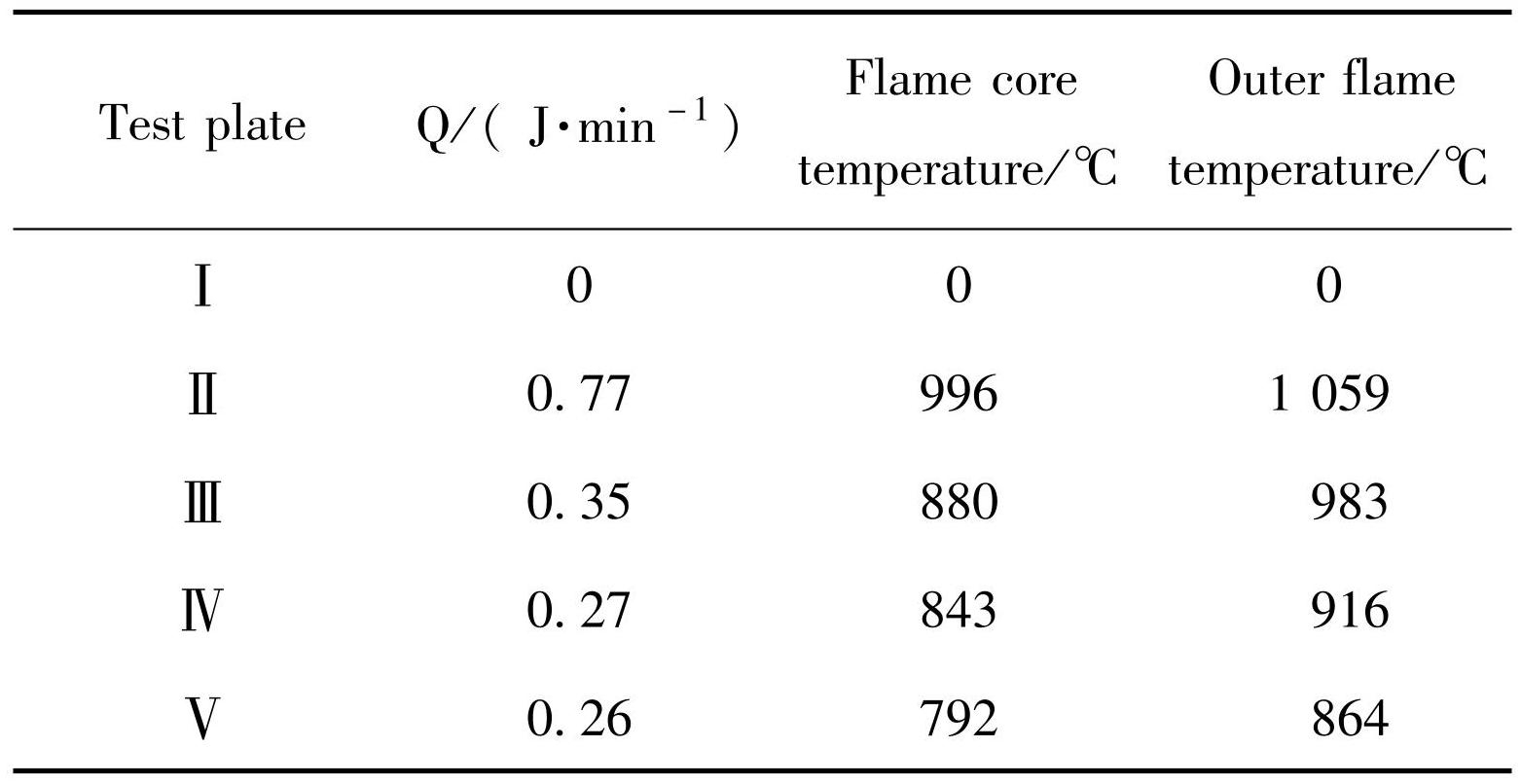
为了揭示局部火烤后Q355B钢板的力学性能变化规律,采用燃气火焰对测试板进行局部火烤实验,实验过程分为加热20 min和空冷两个阶段。各板热源处钢板的吸热功率Q由公式(1)得到[23],吸热功率和燃气火焰的温度如表2所示。
Q=CρVv
(1)
式中试板的比热容C取600 J/(kg·℃);密度ρ取7.85×103 kg/m3;升温速率v根据热源处20 min平均升温速率确定;体积V根据热电偶探头的直径(1 mm)和钢板厚度(6 mm)计算,为4.71×10⁻⁹ m3
2局部火烤热流和燃气火焰温度
Table2Local fire baking heat flux and gas flame temperature
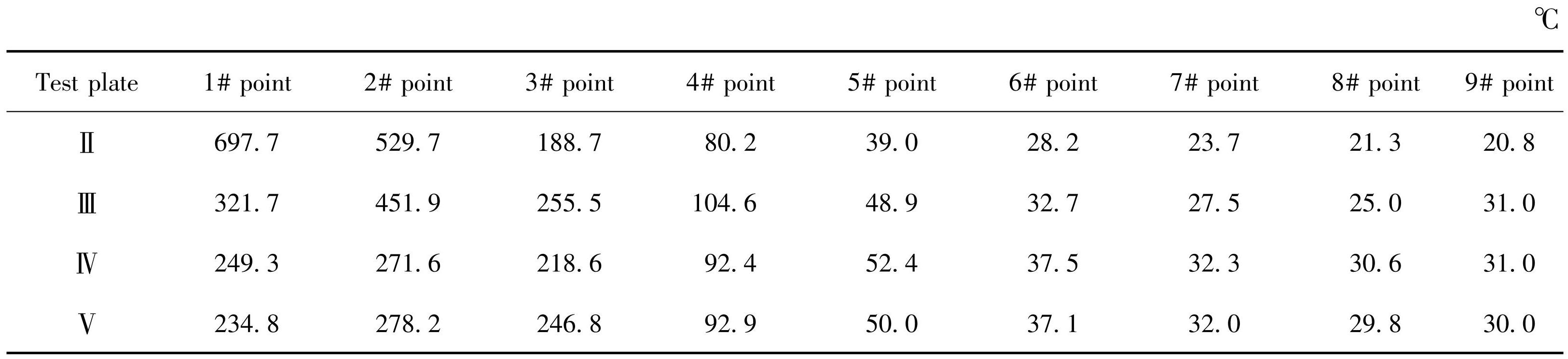
实验是利用燃气火焰的外焰对钢板进行加热,为了揭示受火后材料力学性能的变化机理,采用热电偶监测火烤过程中试板上的温度分布,沿轧向均匀布置9个测温点;火烤实验后,在每个测温点两侧取2个标准板状拉伸试样,进行单轴拉伸实验。测温点和拉伸试样布置见图2。Ⅱ~Ⅴ板上各测温点的峰值温度统计结果如表3所示。
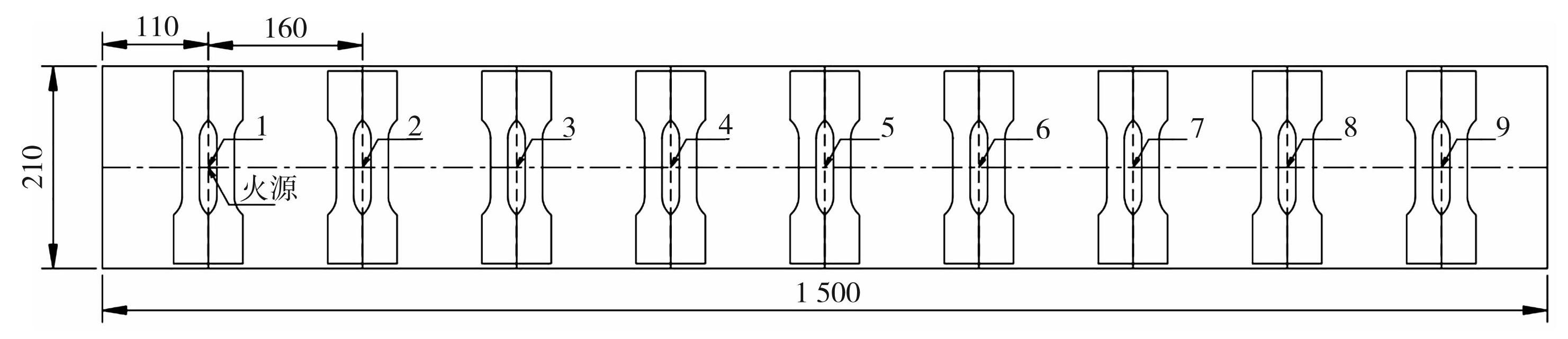
2火源和测温点分布图(单位:mm)
Fig.2Distribution of fire source and temperature measurement point
3各板测温点峰值温度测量结果
Table3Peak temperature measurement results of each plate temperature measurement point
1.4 局部火烤实验的火焰形貌与热量扩散
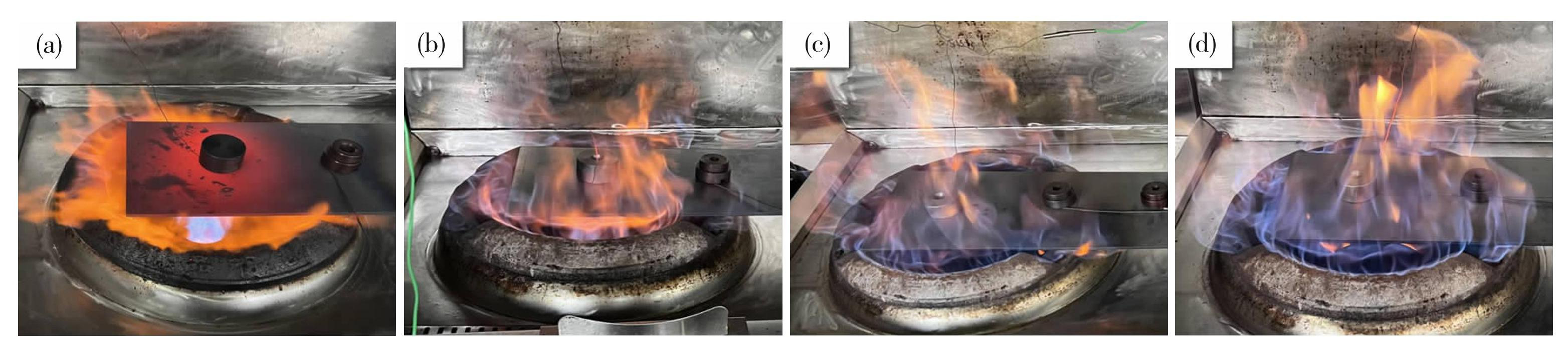
为了揭示吸热功率和距火源点距离对钢板的抗拉强度影响,明确不同吸热功率下的火焰形貌和局部火烤过程中热量扩散至关重要。本文的燃气火焰形貌与火烤过程中热量扩散情况分别如图3图4所示。
3不同吸热功率下的火焰形貌
Fig.3Flame morphology of different endothermic power: (a) 0.77 J/min; (b) 0.35 J/min; (c) 0.27 J/min; (d) 0.26 J/min
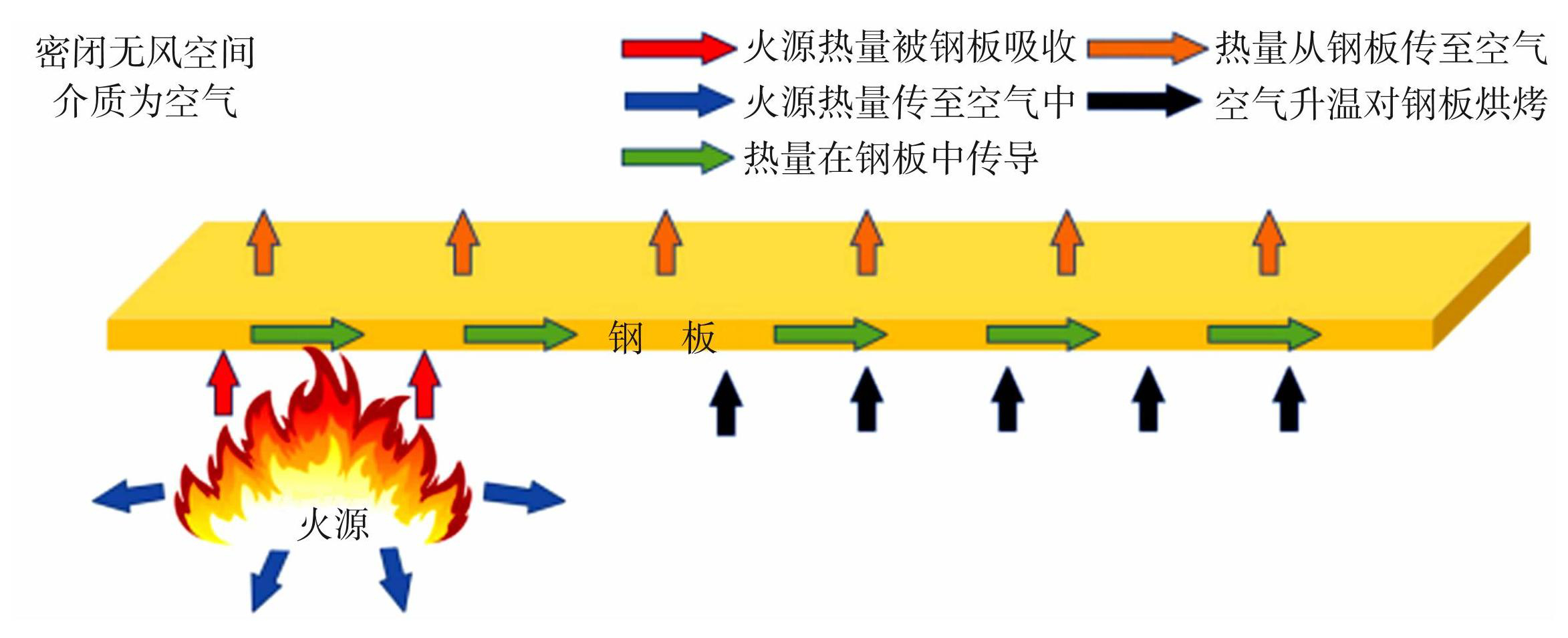
4局部火烤实验过程中的热量扩散示意图
Fig.4Schematic diagram of heat diffusion during local fire baking test
2 实验结果及分析
2.1 各板微观组织观测结果
不同吸热功率下5#~9#测温点温度均低于52.4℃,其组织相同,因此为了揭示局部火烤吸热功率对Q355B钢板微观组织的影响,对不同吸热功率下1#~4#和7#测温点的(距火源点0、160、320、480和960 mm)微观组织进行观测,观测结果如图5~9所示,根据GB / T6394—2017《金属平均晶粒度测定方法》,采用截线法对各测温点处铁素体晶粒的平均尺寸进行统计,统计结果如图10所示。

5不同吸热功率下火源点的微观组织形貌
Fig.5Microstructure morphology of fire source under different heat flux: (a) 0 J/min; (b) 0.77 J/min; (c) 0.35 J/min; (d) 0.27 J/min; (e) 0.26 J/min

6不同吸热功率下距火源点160 mm处的微观组织形貌
Fig.6Microstructure morphology of 160 mm from the fire source under different heat flux: (a) 0 J/min; (b) 0.77 J/min; (c) 0.35 J/min; (d) 0.27 J/min; (e) 0.26 J/min

7不同吸热功率下距火源点320 mm的微观组织形貌
Fig.7Microstructure morphology of 320 mm from the fire source under different heat flux: (a) 0 J/min; (b) 0.77 J/min; (c) 0.35 J/min; (d) 0.27 J/min; (e) 0.26 J/min

8不同吸热功率下距火源点480 mm的微观组织形貌
Fig.8Microstructure morphology of 480 mm from the fire source under different heat flux: (a) 0 J/min; (b) 0.77 J/min; (c) 0.35 J/min; (d) 0.27 J/min; (e) 0.26 J/min

9不同吸热功率下距火源点960 mm的微观组织形貌
Fig.9Microstructure morphology of 960 mm from the fire source under different heat flux: (a) 0 J/min; (b) 0.77 J/min; (c) 0.35 J/min; (d) 0.27 J/min; (e) 0.26 J/min
图5~9可知,未受火的Q355B钢微观组织由铁素体和珠光体组织构成,吸热功率为0.26~0.77 J/min时,受火处理后各板的组织均未发生相变,但高温会导致铁素体晶粒尺寸d改变、部分珠光体溶解。
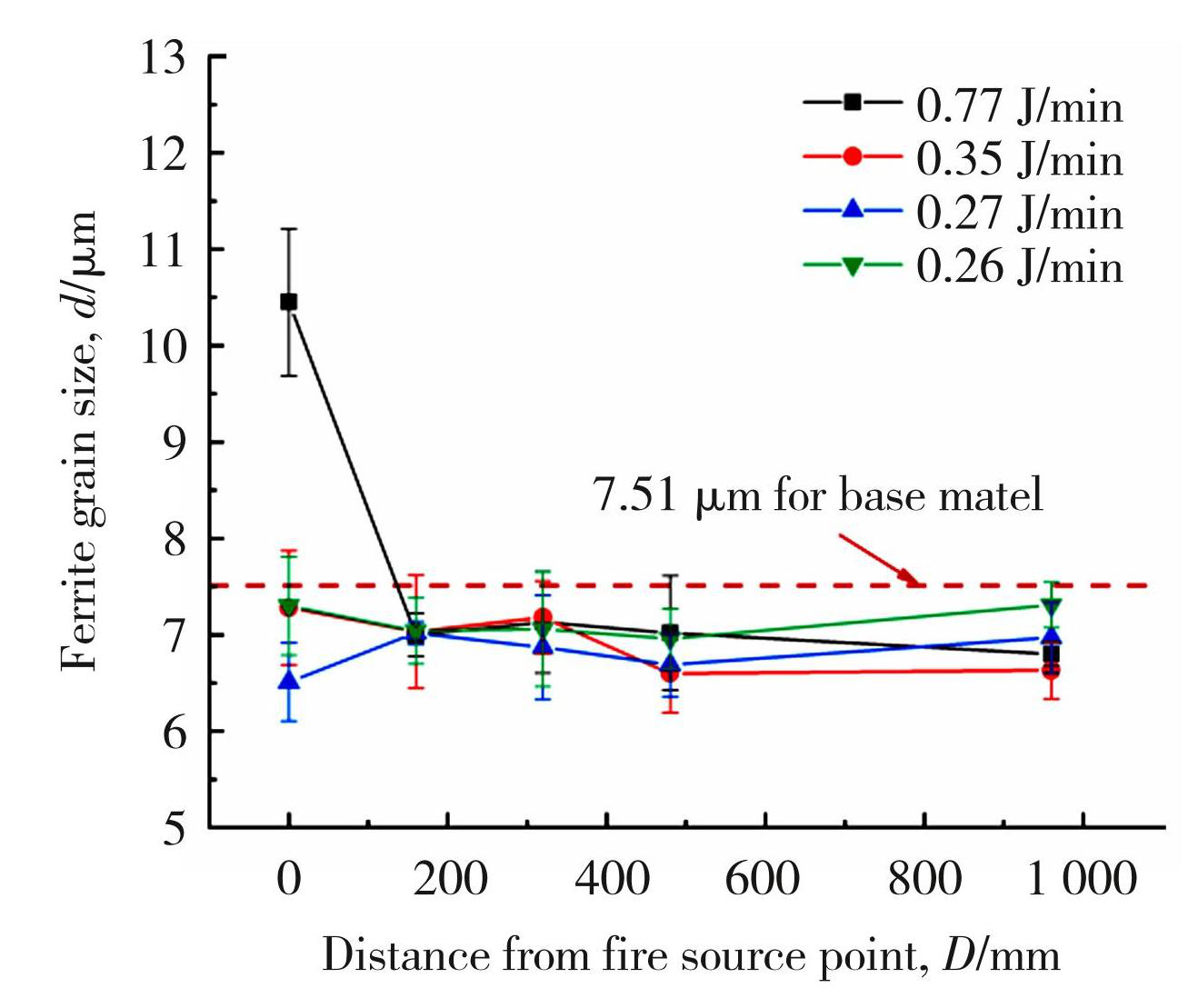
10局部火烤后各板材不同位置处的铁素体晶粒尺寸统计结果
Fig.10Statistical results of ferrite grain size at different positions of each plate after local fire baking
根据图10可知,母材(未受火)铁素体晶粒尺寸d的均值为7.51 μm,与母材相比,除了 0.77 J/min时火源点处铁素体晶粒尺寸d增大39.1%外,其余各处铁素体晶粒尺寸d均降低,最大降幅为12.1%。晶粒尺寸变大的原因是Q355B钢再结晶温度在600~800℃,这一温度范围内钢材的晶粒会重新结晶并长大;受火温度低于500℃并空冷至室温,钢材出现晶粒细化现象使其晶粒尺寸变小。非火源点的铁素体晶粒尺寸d与吸热功率的关系不明确。Q为0.77和0.35 J/min时,随着距火源点距离的增加,d总体呈减小的趋势;钢板吸热功率为0.27和0.26 J/min时,随着距离的增加,d的波动不大。
2.2 应力-应变曲线
局部火烤后在每个温度监测点两侧各取2个标准板状拉伸试样,进行单轴拉伸实验,实验结果作为各测点的抗拉性能测试结果,各测点典型应力-应变曲线如图11所示。由图11可知,Q为0.26和0.27 J/min时各测温点的屈服和强化阶段无明显变化;Q为0.35和0.77 J/min时,靠近火源点强度有明显变化,其原因是Q大于0.35 J/min时温度梯度大、热量传导快,导致靠近火源点的测温点的温度急剧上升。
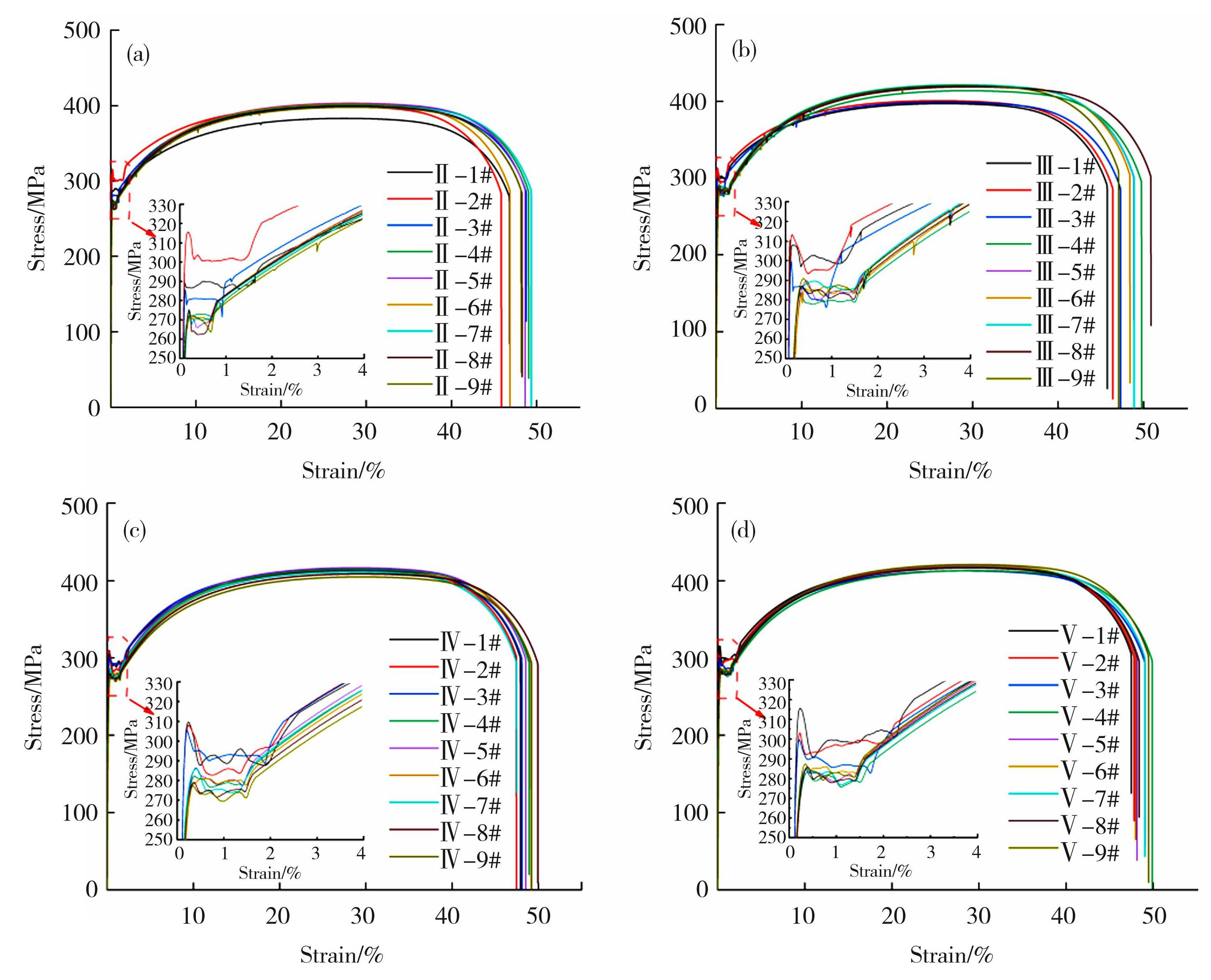
11不同热流下各板材的应力-应变曲线
Fig.11Stress-strain curves of each plate under different heat flux: (a) 0.77 J/min; (b) 0.35 J/min; (c) 0.27 J/min; (d) 0.26 J/min
2.3 局部火烤后Q355B抗拉强度结果分析
对每块板上各测温点的2侧标准板状拉伸试样进行测试,将2个试样的抗拉强度均值作为该测点的抗拉强度测试结果,对不同吸热功率下的抗拉强度Rm、峰值温度T与距火源点距离进行统计,结果如图12所示。
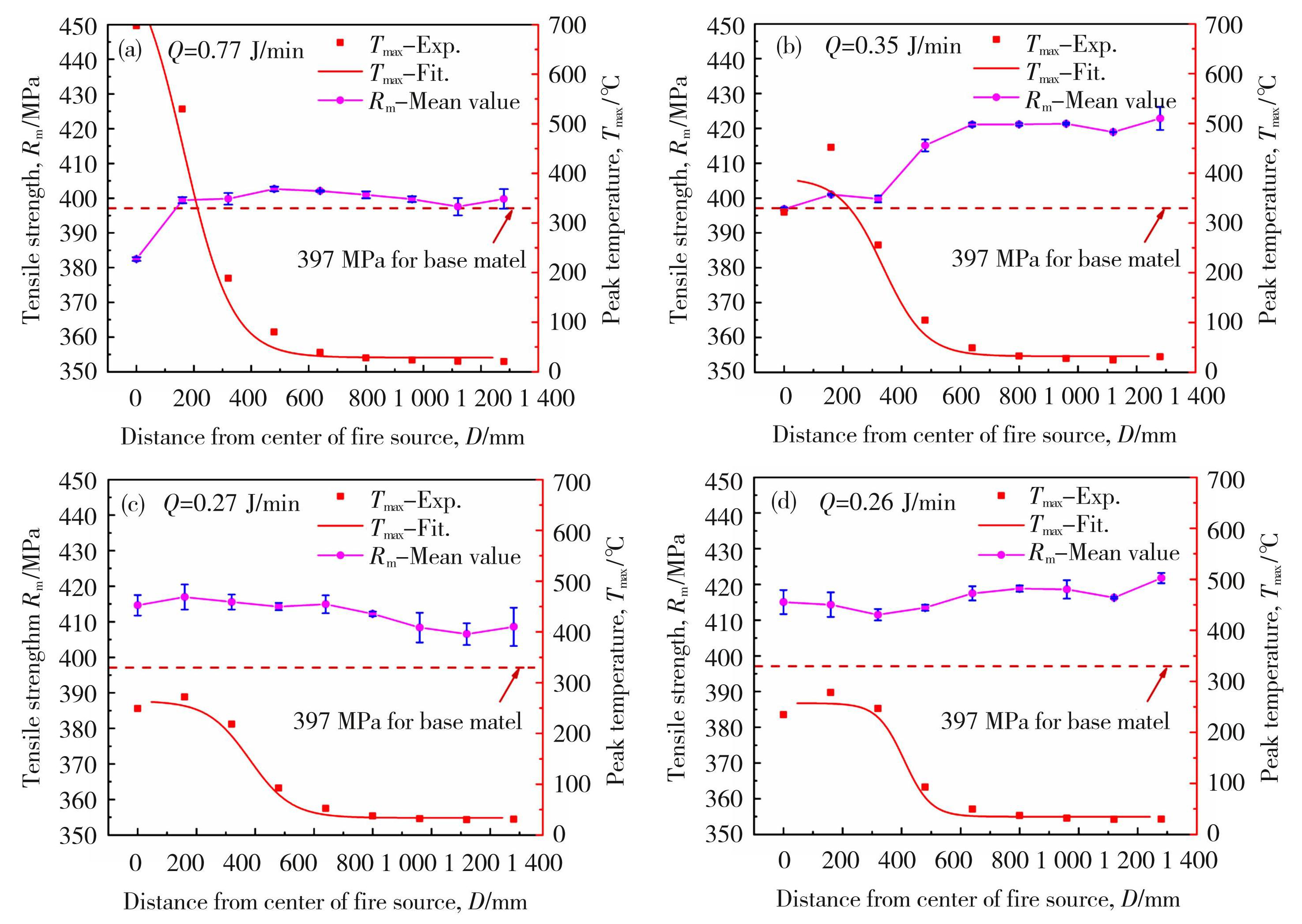
12不同热流下各板材的RmTD的统计结果
Fig.12Statistical results of Rm, T and D of each plate under different heat flux: (a) 0.77 J/min; (b) 0.35 J/min; (c) 0.27 J/min; (d) 0.26 J/min
图12可知,各板材局部火烤形成的温度场具有典型的非均匀性特征,距离小于600 mm时,随着距离的增大,测温点的T急剧降低,并接近室温;距离超过600 mm时,各测点T基本相同。火源点的抗拉强度以吸热功率0.35 J/min为临界值先升高后降低;Q为0.77 J/min时火源点的抗拉强度降低3.7%,距离大于160 mm时抗拉强度无明显变化;Q为0.35 J/min时抗拉强度在距火源点320 mm内无明显变化,320 mm外增幅4.6%~6.5%。根据图12(c)、(d)可知,局部火烤时各试样峰值温度均不超过300℃,各测温点的抗拉强度均高于母材,Q为0.27和0.26 J/min时,两块板材抗拉强度的平均升高幅度分别为3.9%和4.9%。
2.4 局部火烤后Q355B屈服强度结果分析
对不同吸热功率下各板的屈服强度ReL、峰值温度T与距火源点距离D进行统计,统计结果如图13所示。由图13可知,局部火烤后,各板材的屈服强度相较常温均有所升高。Q在0.26~0.77 J/min时,火源点屈服强度随吸热功率增大而升高。根据图13(a)Q为0.77 J/min时,屈服强度在距火源点320 mm内平均升高14.4%,在320~1 400 mm内则无明显变化;图13(b)表明当Q为0.35 J/min时,屈服强度在距火源点160 mm内增幅12.7%~15.6%,而160 mm外的增幅为4.9%~7.4%。由图13(c)、(d)可知,Q为0.27和0.26 J/min时,当距离小于320 mm时,两板材的屈服强度平均升高幅度分别为7.7%和8.0%, D大于320 mm时的平均升高幅度分别为3.4%和4%。
2.5 热流与RmReL及距离关系
为揭示吸热功率与RmReL及距离之间的内在关系,采用多项式拟合的方法,分别对不同吸热功率条件下的抗拉强度和屈服强度进行拟合,拟合结果如图14、公式(2)~(5)所示。由图14可知不同Q下随着D增加ReL总体呈现先下降后稳定的趋势;Q低于0.35 J/min时随着D增加Rm波动不明显; Q超过0.35 J/min时随着D增加Rm呈上升趋势。
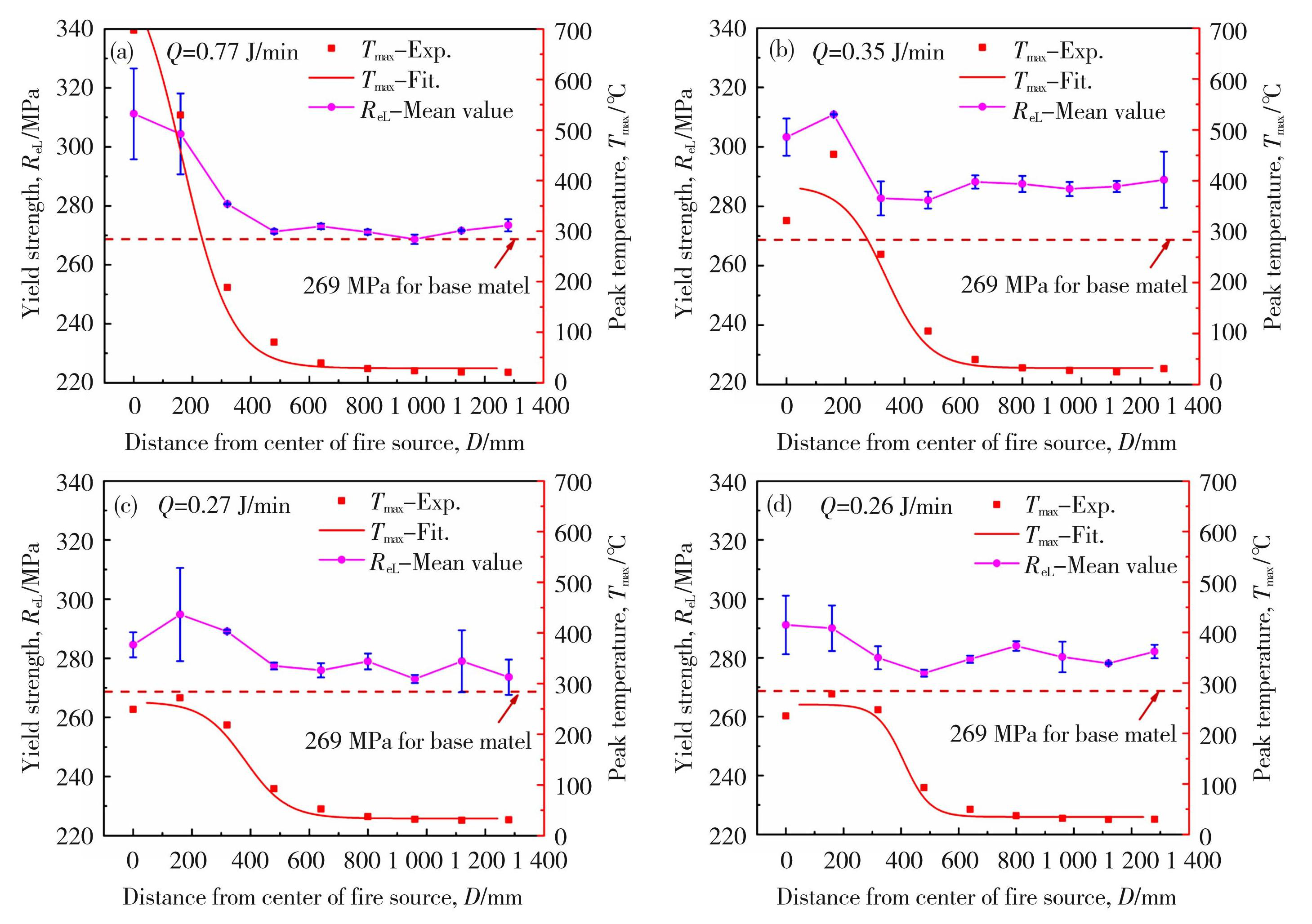
13不同热流下各板材的ReLTD的统计结果
Fig.13Statistical results of ReL, T and D of each plate under different heat flux: (a) 0.77 J/min; (b) 0.35 J/min; (c) 0.27 J/min; (d) 0.26 J/min
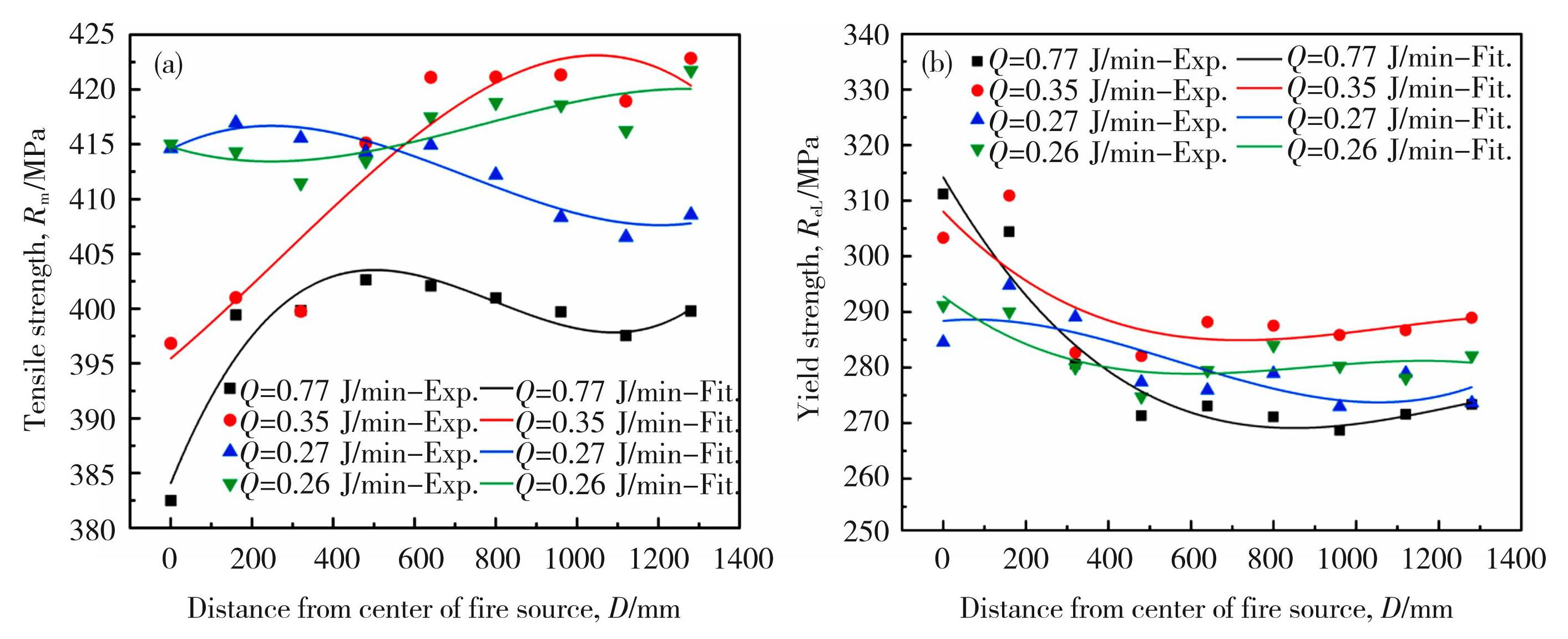
14不同热流下各板的Rm(a)、ReL(b)的拟合结果
Fig.14Fitting results of Rm (a) and ReL (b) of each plate under different heat flux
Rm=5.59×10⁻⁸D3-1.33×10⁻⁴D2+0.09D+384.08ReL=-2.94×10⁻⁸D3+1.12×10⁻⁴D2-0.13D+314.22Q=0.77J/min
(2)
Rm=-1.97×10⁻⁸D3+1.61×10⁻⁵D2+0.03D+395.47ReL=-2.50×10⁻⁸D3+8.06×10⁻⁵D2-0.08D+308.06Q=0.35J/min
(3)
Rm=2.06×10⁻⁸D3-4.50×10⁻⁵D2+0.02D+414.56ReL=3.15×10⁻⁸D3-5.53×10⁻⁵D2+0.01D+288.37Q=0.27J/min
(4)
Rm=-1.24×10⁻⁸D3+2.81×10⁻⁵D2-0.01D+414.78ReL=-2.65×10⁻⁸D3+7.02×10⁻⁵D2-0.06D+292.79Q=0.26J/min
(5)
2.6 局部火烤后Q355B断口形貌
为研究局部火烤后各板材的失效形式,对各板材峰值温度处试样的断口形貌进行观测,如图15所示。
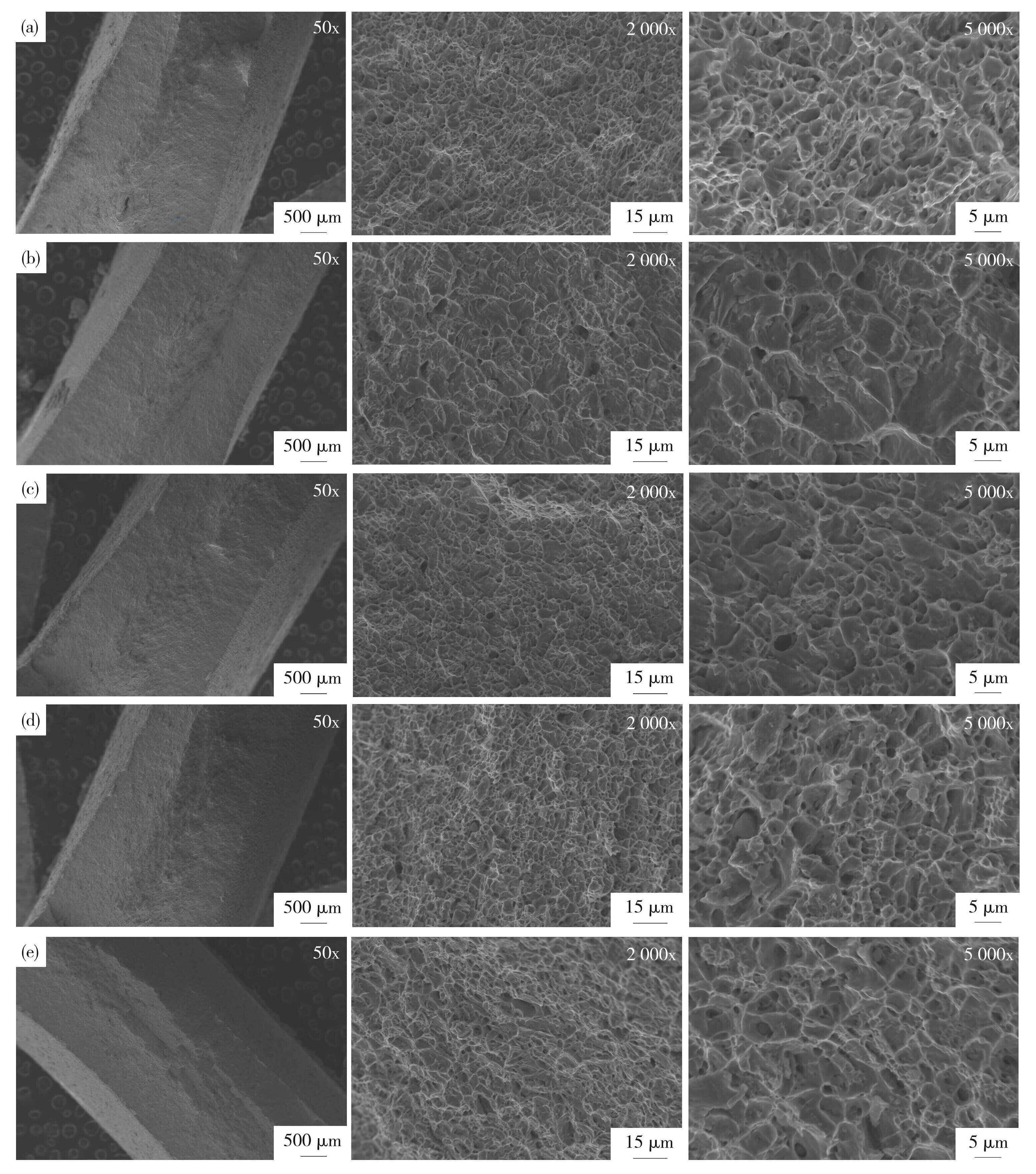
15不同热流下断口微观组织形貌
Fig.15Fracture microstructure morphology under different heat flux: (a) 0 J/min; (b) 0.77 J/min; (c) 0.35 J/min; (d) 0.27 J/min; (e) 0.26 J/min
图15可知,局部火烤后钢的断裂形式表现出韧性断裂,断口以韧窝(Dimple)和微空洞(Microvoid)为主。由图15(a)可知,未火烤的断口上有大量韧窝且周边伴有微空洞,材料表现出韧性断裂的形式。图15(b)表明,Q为0.77 J/min时(最大峰值温度697.7℃)断口的韧窝尺寸变大且韧窝周围的微空洞消失,只有极少数的韧窝和微空洞保存,此时材料韧性大幅下降。根据图15(c)Q为0.35 J/min时3#板的峰值温度为451.9℃,韧窝和微空洞比2#板增多,明显表现为韧性断裂的形式。根据图15(d)、(e),Q为0.27(271.6℃)和0.26 J/min(278.2℃)时,断口的韧窝和微空洞数量增多,同时韧窝尺寸变小。由此可知,局部火烤后Q355B钢断裂形式为韧性断裂,随Q的增加,峰值温度处断口的韧窝和微空洞数量减少,韧窝尺寸增大。
3 局部火烤后材料的强度与其晶粒尺寸之间关系讨论
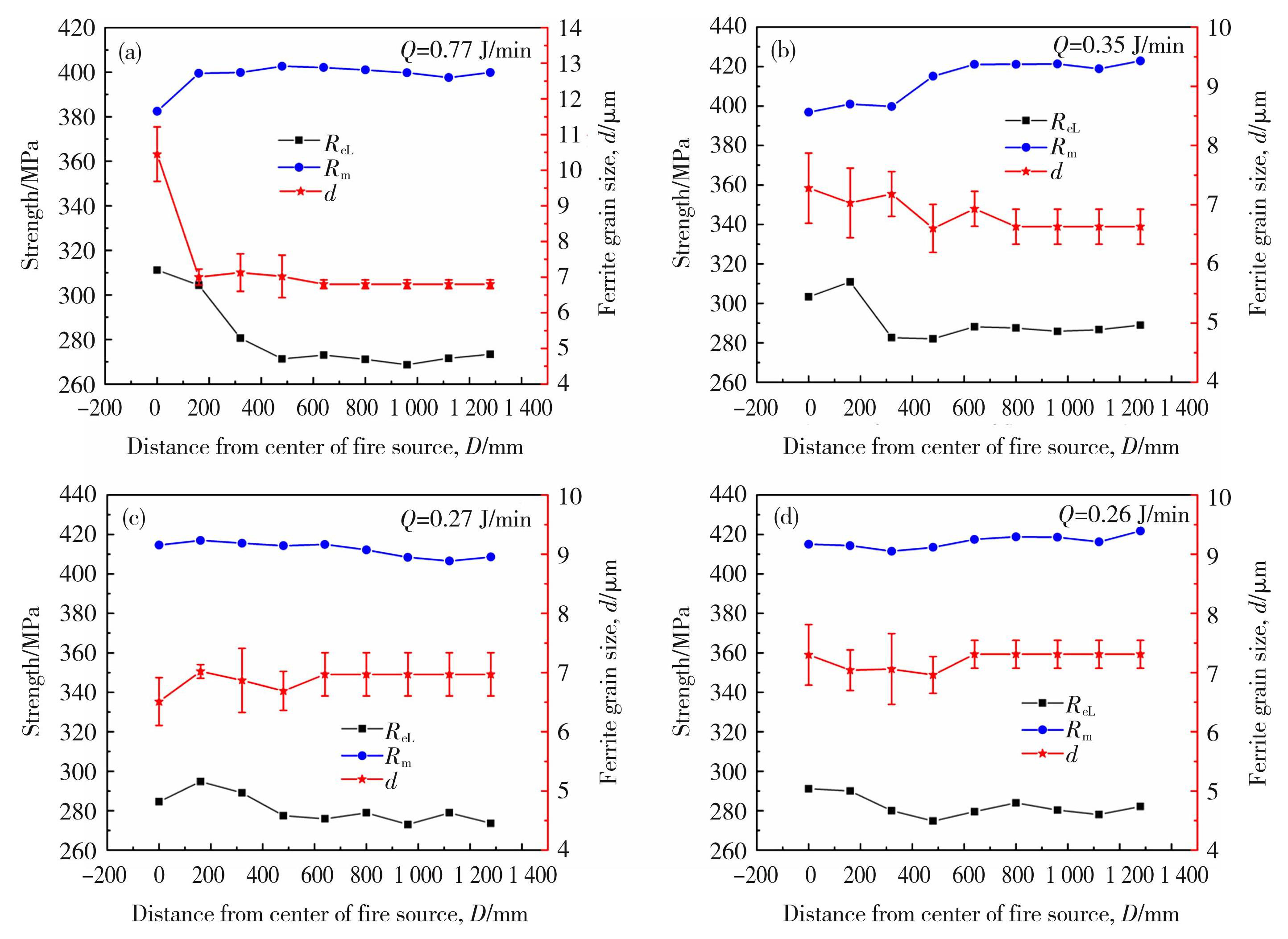
为了揭示吸热功率对钢板抗拉性能的影响规律,对不同吸热功率下钢板抗拉强度Rm、屈服强度ReL、铁素体晶粒尺寸d与距火源点距离D之间的关系进行统计,结果如图16所示。
图16可知,局部火烤后各板的屈服强度和抗拉强度升高是由于铁素体晶粒尺寸减小导致的,这与材料细晶强化的机理相符[24]。与母板相比,距离小于320 mm时,由于受火的温度较高,导致钢板强度变化明显;当距离大于320 mm时,虽然受火温度较低,但钢板强度有所升高。鉴于本文使用的Q355B钢板的制造工艺为热轧,热轧过程中的受力不均和温度变化等原因引起的内部应力在外部载荷解除后仍然存在,在受火后钢板的内部应力会得到释放,从而使钢板的强度有所升高[25]
16不同热流下强度、晶粒尺寸与距离的关系
Fig.16The relationship between strength, d and distance under different heat flux: (a) 0.77 J/min; (b) 0.35 J/min; (c) 0.27 J/min; (d) 0.26 J/min
4 结论
根据吸热功率为0.26、0.27、0.35和0.77 J/min(对应火源点峰值温度分别为234.8、249.3、321.7和697.7℃)4种火烤条件下Q355B钢板的微观组织形貌特征、铁素体晶粒尺寸变化情况、峰值温度处的断口形貌特征以及抗拉性能测试结果,揭示了局部火烤对材料抗拉性能的影响规律,所得结论如下。
1)局部火烤吸热功率对材料铁素体晶粒尺寸d影响较大,与母材铁素体晶粒尺寸(7.51 μm)相比,0.77 J/min时火源点处铁素体晶粒尺寸增大39.1%,而其余各板铁素体晶粒尺寸均降低,最大降幅为12.1%(0.27 J/min);受火温度高于600℃时Q355B钢发生再结晶,导致其晶粒尺寸变大;受火温度低于500℃并空冷至室温,使其晶粒尺寸变小。对于非火源点,Qd的关系不明确。与母材相比,吸热功率使峰值温度处断口上的韧窝和微空洞数量减少,而且韧窝尺寸随着吸热功率的增加不断增大。
2)与母材相比,受火后各板材各测试点的屈服强度都升高,且当距离小于 320 mm时屈服强度增幅更明显,最大增幅为15.7%(0.77 J/min);局部火烤后材料的抗拉强度与母材相比总体升高,最大增幅为6.5%(0.35 J/min),这与铁素体晶粒尺寸减小有关;火源点处抗拉强度与吸热功率呈负相关,火源点外抗拉强度与吸热功率无明显关联。
3)不同局部火烤吸热功率条件下,各板材的屈服强度随着距离的增加呈先降低后平稳的趋势,而抗拉强度随距离的变化规律不同。当吸热功率为0.26和0.27 J/min时,随着距离的增加,抗拉强度基本不变;而当吸热功率为0.35和0.77 J/min时,随着距离的增大,抗拉强度增大,距离最大时的抗拉强度与火源点相比分别增大4.5%和6.6%。
1拉伸试样尺寸图(单位:mm)
Fig.1Size diagram of tensile specimen
2火源和测温点分布图(单位:mm)
Fig.2Distribution of fire source and temperature measurement point
3不同吸热功率下的火焰形貌
Fig.3Flame morphology of different endothermic power: (a) 0.77 J/min; (b) 0.35 J/min; (c) 0.27 J/min; (d) 0.26 J/min
4局部火烤实验过程中的热量扩散示意图
Fig.4Schematic diagram of heat diffusion during local fire baking test
5不同吸热功率下火源点的微观组织形貌
Fig.5Microstructure morphology of fire source under different heat flux: (a) 0 J/min; (b) 0.77 J/min; (c) 0.35 J/min; (d) 0.27 J/min; (e) 0.26 J/min
6不同吸热功率下距火源点160 mm处的微观组织形貌
Fig.6Microstructure morphology of 160 mm from the fire source under different heat flux: (a) 0 J/min; (b) 0.77 J/min; (c) 0.35 J/min; (d) 0.27 J/min; (e) 0.26 J/min
7不同吸热功率下距火源点320 mm的微观组织形貌
Fig.7Microstructure morphology of 320 mm from the fire source under different heat flux: (a) 0 J/min; (b) 0.77 J/min; (c) 0.35 J/min; (d) 0.27 J/min; (e) 0.26 J/min
8不同吸热功率下距火源点480 mm的微观组织形貌
Fig.8Microstructure morphology of 480 mm from the fire source under different heat flux: (a) 0 J/min; (b) 0.77 J/min; (c) 0.35 J/min; (d) 0.27 J/min; (e) 0.26 J/min
9不同吸热功率下距火源点960 mm的微观组织形貌
Fig.9Microstructure morphology of 960 mm from the fire source under different heat flux: (a) 0 J/min; (b) 0.77 J/min; (c) 0.35 J/min; (d) 0.27 J/min; (e) 0.26 J/min
10局部火烤后各板材不同位置处的铁素体晶粒尺寸统计结果
Fig.10Statistical results of ferrite grain size at different positions of each plate after local fire baking
11不同热流下各板材的应力-应变曲线
Fig.11Stress-strain curves of each plate under different heat flux: (a) 0.77 J/min; (b) 0.35 J/min; (c) 0.27 J/min; (d) 0.26 J/min
12不同热流下各板材的RmTD的统计结果
Fig.12Statistical results of Rm, T and D of each plate under different heat flux: (a) 0.77 J/min; (b) 0.35 J/min; (c) 0.27 J/min; (d) 0.26 J/min
13不同热流下各板材的ReLTD的统计结果
Fig.13Statistical results of ReL, T and D of each plate under different heat flux: (a) 0.77 J/min; (b) 0.35 J/min; (c) 0.27 J/min; (d) 0.26 J/min
14不同热流下各板的Rm(a)、ReL(b)的拟合结果
Fig.14Fitting results of Rm (a) and ReL (b) of each plate under different heat flux
15不同热流下断口微观组织形貌
Fig.15Fracture microstructure morphology under different heat flux: (a) 0 J/min; (b) 0.77 J/min; (c) 0.35 J/min; (d) 0.27 J/min; (e) 0.26 J/min
16不同热流下强度、晶粒尺寸与距离的关系
Fig.16The relationship between strength, d and distance under different heat flux: (a) 0.77 J/min; (b) 0.35 J/min; (c) 0.27 J/min; (d) 0.26 J/min
1Q355B钢的化学成分(质量分数/%)
Table1Chemical composition of Q355B steel (wt.%)
2局部火烤热流和燃气火焰温度
Table2Local fire baking heat flux and gas flame temperature
3各板测温点峰值温度测量结果
Table3Peak temperature measurement results of each plate temperature measurement point
ZHANG Chuntao, GONG Meiqi, ZHU Li. Post-fire mechanical behavior of Q345 structural steel after repeated cooling from elevated temperatures with fire-extinguishing foam[J]. Journal of Constructional Steel Research,2022,191:107201. DOI:10.1016/J. JCSR.2022.107201
LI Wei, CHEN Hao. Hysteretic performance of structural steels after exposure to elevated temperatures[J]. Thin-Walled Structures,2023,191:111019. DOI:10.1016/J. TWS.2023.111019
郭天阳, 罗小兵, 项重辰, 等. 两相区淬火温度对Ni-Cr-Mo-V系高强船体钢组织及性能的影响[J]. 材料科学与工艺,2024,32(3):10-17.GUO Tianyang, LUO Xiaobing, XIANG Zhongchen,et al. Effect of intercritical quenching temperature on micro-structure and properties of Ni-Cr-Mo-V high strength hull steel[J]. Materials Science and Technology,2024,32(3):10-17. DO1:10.11951/i.issn.1005-0299.20220445
江琛琛, 高秋志, 甄云乾, 等. 热处理工艺对AFA耐热钢组织和力学性能的影响[J]. 材料科学与工艺,2021,29(2):27-35.JIANG Chenchen, GAO Qiuzhi, ZHEN Yunqian,et al. Effect of heat treatment process on microstructure and mechanical properties of AFA heat-resistant steel[J]. Materials Science and Technology,2021,29(2):27-35. DOI:10.11951/i.issn.1005-0299.20190146
REN Chong, DAI Liusi, HUANG Yuner,et al. Experimental investigation of post-fire mechanical properties of Q235 cold-formed steel[J]. Thin-Walled Structures,2020,150:106651. DOI:10.1016/j.tws.2020.106651
SHI Gang, WANG Shihao, RONG Chengxiao. Experimental investigation into mechanical properties of Q345 steel after fire[J]. Journal of Constructional Steel Research,2022,199:107582. DOI:10.1016/J. JCSR.2022.107582
杨财骏, 张春涛. 高温水冷却后Q355钢材力学性能试验研究[J]. 工业建筑,2021,51(11):165-170,38.YANG Caijun, ZHANG Chuntao. Experimental research on mechanical properties of water-cooled Q355 steel after being subjected to high temperature[J]. Industrial Construction,2021,51(11):165-170,38. DOI:10.13204/j.gyjzG21022608
张其杰, 姜健, 蔡文玉, 等. 高应力三轴度下Q355钢火灾全过程断裂性能试验研究[J]. 工程力学,2023,40(12):133-147.ZHANG Qijie, JIANG Jian, CAI Wenyu,et al. Experimental study on fracture behavior of Q355 steel in the whole process of fire under high stress triaxiality[J]. Engineering Mechanics,2023,40(12):133-147. DOI:10.6052/j.issn.1000-4750.2022.02.0166
张鑫, 尹航, 赵而年, 等. 高温(火灾)后Q355qNH桥梁耐候钢的力学性能试验研究[J]. 材料导报,2023,37(23):185-190.ZHANG Xin, YIN Hang, ZHAO Ernian,et al. Experiment on post-fire mechanical properties of Q355qNH bridge weathering Steel[J]. Materials Reports,2023,37(23):185-190. DOl:10.11896/cldb.22050150
张春涛, 李海, 于伟. 国产Q355钢材高温冷却后力学性能试验研究[J]. 钢结构(中英文),2023,38(3):13-23.ZHANG Chuntao, LI Hai, YU Wei. Experimental research on post-fire mechanical properties of domestic Q355 steel after cooling from high temperature[J]. Steel Construction(Chinese& English),2023,38(3):13-23. DOI:10.13206/j.gjgS22110104
JIANG Binhui, QU Yiqiu, WANG Mengjie,et al. Mechanical properties and constitutive model of Q460 steel during the fire-cooling stage[J]. Thin-Walled Structures,2023,189:110904. DOI:10.1016/J. TWS.2023.110904
宋林昕, 李国强. 控轧控冷型Q550高强钢高温后的力学性能试验研究[J]. 防灾减灾工程学报,2021,41(2):369-375.SONG Linxin, LI Guoqiang. Experimental study on post fire mechanical properties of TMCP Q550 steel[J]. Journal of Disaster Prevention and Mitigation Engineering,2021,41(2):369-375. DOI:10.13409/j.cnki.jdpme.20191017005
CHEN Wei, YE Jihong, PENG Jixian,et al. Experimental investigation of postfire mechanical properties of Q345 and G550 cold-formed steel[J]. Journal of Materials in Civil Engineering,2019,31(7):04019116. DOI:10.1061/(ASCE)MT.1943-5533.0002791
李国强, 吕慧宝, 张超. Q690钢材高温后的力学性能试验研究[J]. 建筑结构学报,2017,38(5):109-116.LI Guoqiang, LÜ Huibao, ZHANG Chao. Experimental research on post-fire mechanical properties of Q690 steel[J]. Journal of Building Structures,2017,38(5):109-116. DOI:10.14006/j.jzjgxb.2017.05.014
华建民, 黄钦全, 薛暄译, 等. Q690高强钢板梁火灾后剩余承载性能研究[J]. 建筑钢结构进展,2022,24(11):56-71,81.HUA Jianmin, HUANG Qinquan, XUE Xuanyi.et al. Post-fire resistance of Q690 high-strength steel plate girders[J]. Progress in Steel Building Structures,2022,24(11):56-71,81. DOI:10.13969/j.cnki.cn31-1893.2022.11.006
WANG Fang, LUI E M. Experimental study of the post-fire mechanical properties of Q690 high strength steel[J]. Journal of Constructional Steel Research,2020,167:105966. DOI:10.1016/j.jcsr.2020.105966
WANG Mengjie, LOU Guobiao, LI Guoqing,et al. Mechanical properties and constitutive model of Q690 steel in the fire-cooling stage[J]. Fire Safety Journal,2023,141:103994. DOI:10.1016/J. FIRESAF.2023.103994
缑瑞宾, 徐浩, 于敏, 等. 高温暴晒和火灾服役条件下高强钢DP800的力学性能变化规律[J]. 材料热处理学报,2024,45(3):148-157.GOU Ruibin, XU Hao, YU Min,et al. Changes in mechanical properties of high strength steel DP800 under high temperature exposure and fire service conditions[J]. Transactions of Materials and Heat Treatment,2024,45(3):148-157. DOI:10.13289/j.issn.1009-6264.2023-0443
吕晶, 尹豪, 周天华, 等. 不同冷却方式下S280GD+Z钢材高温后力学性能试验研究[J]. 建筑科学,2023,39(5):124-133.LÜ Jing, YIN Hao, ZHOU Tianhua,et al. Experimental research on mechanical properties of S280GD+Z steel after high temperature under different cooling methods[J]. Building Science,2023,39(5):124-133. DOI:10.13614/j.cnki.11-1962/tu.2023.05.013
SHAKIL S, LU Wei, PUTTONEN J. Experimental studies on mechanical properties of S700 MC steel at elevated temperatures[J]. Fire Safety Journal,2020,116:103157. DOI:10.13614/j.cnki.11-1962/tu.2023.05.013
荣成骁, 施刚, 左勇志, 等. 结构钢材高温过火后性能研究[J]. 钢结构,2018,33(5):122-131.RONG Chengxiao, SHI Gang, ZUO Yongzhi,et al. Reserch on post-fire performance of structural steels[J]. Steel Construction,2018,33(5):122-131. DOI:10.13206/j.gjg201805023
DAN Wenjiao, GOU Ruibin, YU Min,et al. Experimental study on the post-fire mechanical behaviours of structural steels[J]. Journal of Constructional Steel Research,2022,199:107629.https://doi.org/10.1016/j.jcsr.2022.107629
李振兴, 李文静, 翟丽娟, 等. 中浅层同轴套管式换热器的传热能力分析[J]. 中国矿业,2022,31(9):152-161.LI Zhenxing, LI Wenjing, ZHAI Lijuan,et al. Analysis of heat transfer capacity of double-pipe heat exchangers of medium-shallow layers[J]. China Mining Magazine,2022,31(9):152-161. DOI:10.12075/j.issn.1004-4051.2022.09.015
ZHAO Liyuan, YANG Jiawei, TIAN Lei,et al. The influence of tempering parameters on the microstructure,mechanical property,and the corresponding strengthening mechanism of metastable 301 austenitic stainless steel[J]. Steel Research International,2024,95(5):230067. DOI:10.1002/SRIN.202300674
王卫卫, 胡霄雨, 肖金福, 等. 热轧板带钢轧制残余应力的研究[C]//第十四届中国钢铁年会论文集—6. 轧制与热处理, 钢铁研究总院有限公司冶金工艺研究所, 中国金属学会,2023:7.WANG Weiwei, HU Xiaoyu, XIAO Jinfeng,et al. Research on residual stress in hot rolled strip steel[C]//Proceedings of the 14th China Steel Conference—6. Rolling and Heat Treatment, Metallurgical Process Research Institute, Central Iron and Steel Research Institute, Chinese Society for Metals,2023:7. DOI:10.26914/c.cnkihy.2023.056084

友情链接LINKS