激光选区熔化TC4合金的拉伸行为研究
doi: 10.11951/j.issn.1005-0299.20240155
武亮亮1,2,3 , 许瑞达1,2,3 , 焦泽辉1,2,3 , 于慧臣1,2,3
1. 中国航发北京航空材料研究院,北京 100095
2. 中国航空发动机集团 材料检测与评价重点实验室,北京 100095
3. 航空材料检测与评价北京市重点实验室,北京 100095
基金项目: 国家重点研发计划(2017YFB0702004) ; 财政部稳定支持基础研究计划基金项目(KZ0C190727) ; 中国航发科技创新平台项目(CXPT-2023-035)
The study on tensile behavior of selective laser melting TC4 alloy
WU Liangliang1,2,3 , XU Ruida1,2,3 , JIAO Zehui1,2,3 , YU Huichen1,2,3
1. AECC Beijing Institute of Aeronautical Materials, Beijing 100095 ,China
2. Beijing Key Laboratory of Aeronautical Materials Testing and Evaluation, Beijing 100095 ,China
3. Key Laboratory of Aeronautical Materials Testing and Evaluation, Aero Engine Corporation of China, Beijing 100095 ,China
摘要
利用激光选区熔化技术(Selective Laser Melting,SLM)制备TC4合金,使用电子万能试验机、扫描电子显微镜、光学显微镜等设备研究了热等静压后SLM TC4合金不同取样方向(垂直和水平)的组织形貌与拉伸性能,并与合金的退火态进行对比分析。结果表明:TC4合金在进行热等静压处理后,沿打印方向(垂直)显示为延伸的β柱状晶结构,而在垂直打印方向(水平)显示为等轴晶形貌,柱状晶内为α集束与α+β网篮组织混合形貌,不同于退火态,热等静压后合金的α板条变宽,长径比减小;相对于退火态,热等静压后合金水平和垂直方向强度及塑性无明显各向异性,垂直和水平方向试样抗拉强度分别为965和975 MPa,断后伸长率分别为15.5%和16.5%,综合力学性能优异;拉伸断口呈韧窝特征,断裂机制为韧性断裂。
Abstract
TC4 alloy was fabricated using the Selective Laser Melting (SLM) technique, and its microstructural morphology and tensile properties after hot isostatic pressing (HIP) were investigated in different sampling directions (vertical and horizontal) using a universal testing machine, scanning electron microscope, and optical microscope. A comparative analysis was conducted with the annealed state of the alloy. The results show that after HIP, the TC4 alloy exhibits an elongated β columnar grain structure along the printing direction (vertical), while an equiaxed grain morphology is observed in the direction perpendicular to the printing (horizontal). Within the columnar grains, a mixed microstructure of α laths and α+β basketweave structures is present. Compared to the annealed state, the α laths in the HIP-treated alloy become wider, and the aspect ratio decreases. In contrast to the annealed state, the strength and plasticity of the HIP-treated alloy exhibit no significant anisotropy between the horizontal and vertical directions. The ultimate tensile strengths in the vertical and horizontal directions are 965 MPa and 975 MPa, respectively, while the elongations after fracture are 15.5% and 16.5%, respectively, demonstrating excellent overall mechanical properties. The tensile fracture surfaces exhibit dimples, indicating a ductile fracture mechanism.
增材制造技术(Additive Manufacturing,AM)是基于离散/堆积原理,通过材料的逐渐累积来实现制造的技术。该技术可以实现传统工艺难以或无法加工的复杂结构的制造,生产个性化产品,节省材料,缩短制造周期。激光选区熔化(SLM)是一种常用的金属增材制造技术,能够广泛适用于制造异型结构、高精度的复杂零件,受限于设备舱室尺寸,该技术制造的零件体积较小[1-3]。TC4钛合金比强度高、低密度,具备良好的耐腐蚀性能以及优异的高温力学性能,在航空航天、核工业、生物医药等领域广泛应用[4-6]
拉伸性能指标是材料进行设计许用值计算的重要参数。研究显示,增材制造TC4合金显微组织对其拉伸行为的影响较大[7]:一方面,由于在增材制造过程中大的温度梯度和高的冷却速率,初始态AM TC4合金中主要由细针状的α′马氏体组成,相对于传统锻造合金而言,其拉伸强度高,但是塑性较差[7-8],但可通过合理的热处理制度调整合金组织结构,进而提升材料的综合力学性能[7-12];另一方面,由于增材制造特殊的打印过程,合金的微观组织存在各向异性,同时由于打印过程中缺陷(气孔、未熔合)等的存在,导致合金拉伸性能的各向异性[13-17]。焦泽辉等[17]进行了SLM TC4合金退火态室温和高温的拉伸性能测试,并与传统合金进行对比,分析了合金性能各向异性的原因。已有研究显示,通过热等静压(HIP)可以有效闭合气孔,提升合金的疲劳性能[11-12],但当前对于热等静压后SLM TC4合金的拉伸性能研究较少,尤其在各向异性方面。
本文在前期研究[17]的基础上进一步对SLM TC4合金采用热等静压处理,开展合金的微观组织结构分析与拉伸性能各向异性研究,并与退火态合金进行比较,结合合金的微观组织结构与断口观察分析了其性能差异的原因。
1 实验
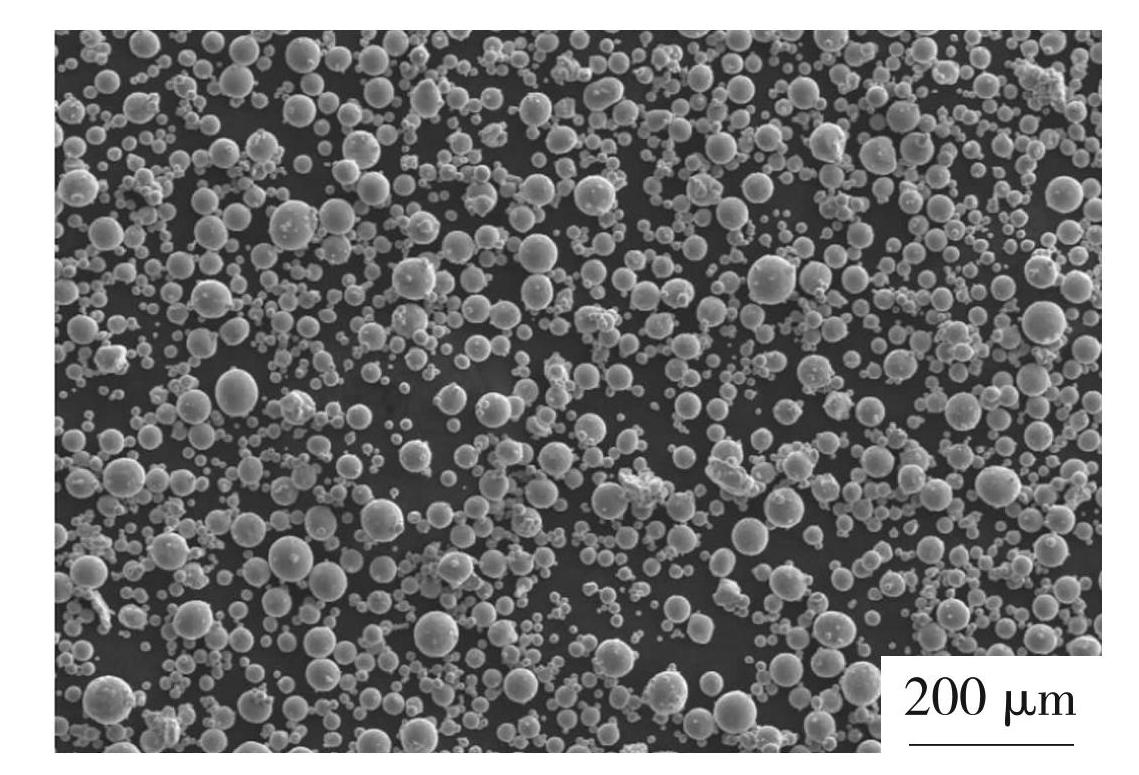
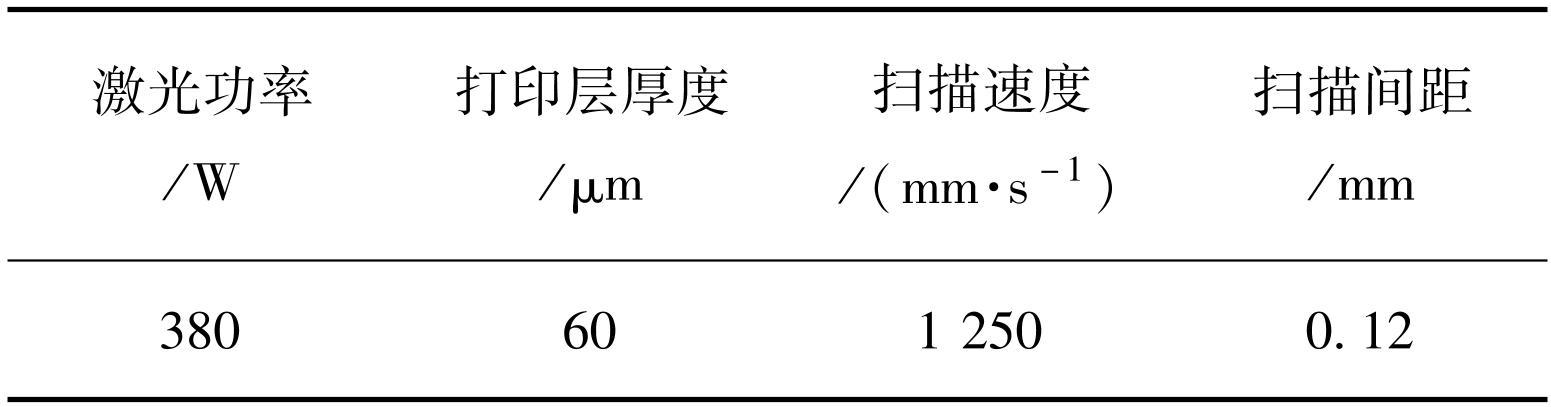
采用粒径为20~60 μm的球形TC4合金粉末(图1)作为原材料,其化学成分(质量分数/%)为6.29Al,3.99V,0.2Fe,0.12O,0.009C,0.02N,0.002H,<0.005Y,0.031Si,余Ti。利用铂力特BLT-S300激光选区熔化(SLM)设备进行合金试棒(Ф7 mm×63 mm)打印,成形工艺参数见表1
1TC4合金粉末
Fig.1TC4 alloy powder
1试棒成型工艺参数
Table1Sample forming process parameters
打印过程采用双向扫描策略,扫描平面为XY平面,相邻两打印层之间扫描方向夹角为90°,打印方向平行于Z轴。为研究不同取样方向对合金力学性能的影响,本文采用两种取向(垂直、水平)进行试棒打印,如图2所示。整体增材制造过程在氩气保护下完成,舱室温度为35℃。试棒打印完成后进行热等静压,其参数为:920℃,保温3 h,压力150 MPa,氩气环境冷却。
采用电火花切割技术从试棒上切取金相试样,打磨光滑后进行抛光,采用1 mL HF+2 mL HNO3+25 mL H2O腐蚀溶液浸蚀15 s,利用光学显微镜(Optical Microscope,OM)分别观察合金垂直平面(XZYZ)与水平平面(XY)的显微组织形貌。将剩余试棒加工成形状如图3所示的拉伸试样。在INSTRON 电子万能材料试验机上对合金进行室温拉伸测试,实验标准按照HB5143—1996《金属室温拉伸试验方法》进行,应变速率为2.5×10⁻⁴ s-1。实验结束后,采用扫描电子显微镜(SEM)对合金样品拉伸断口形貌进行观察。
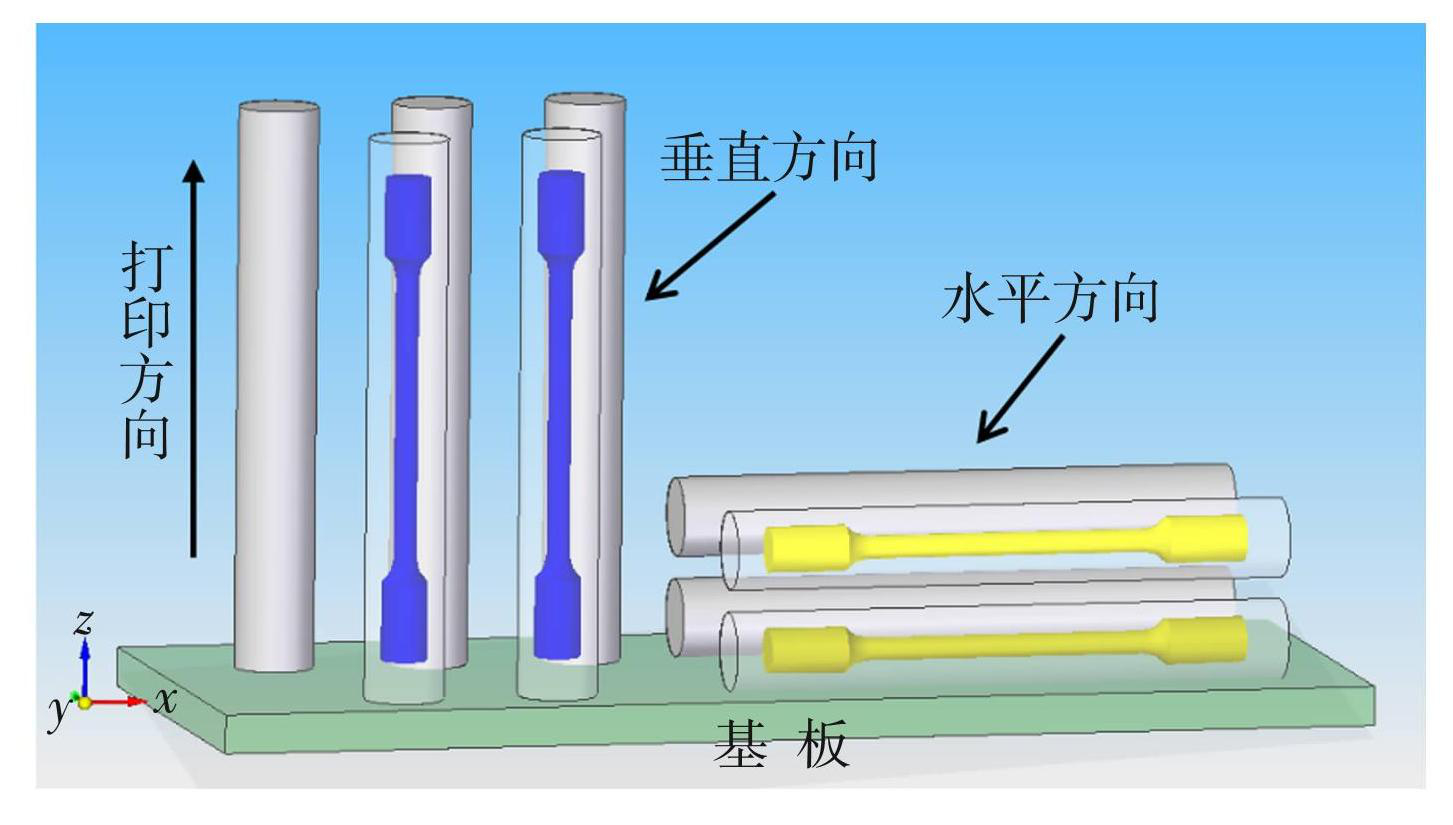
2试棒取向示意图
Fig.2Schematic diagram of sample orientation
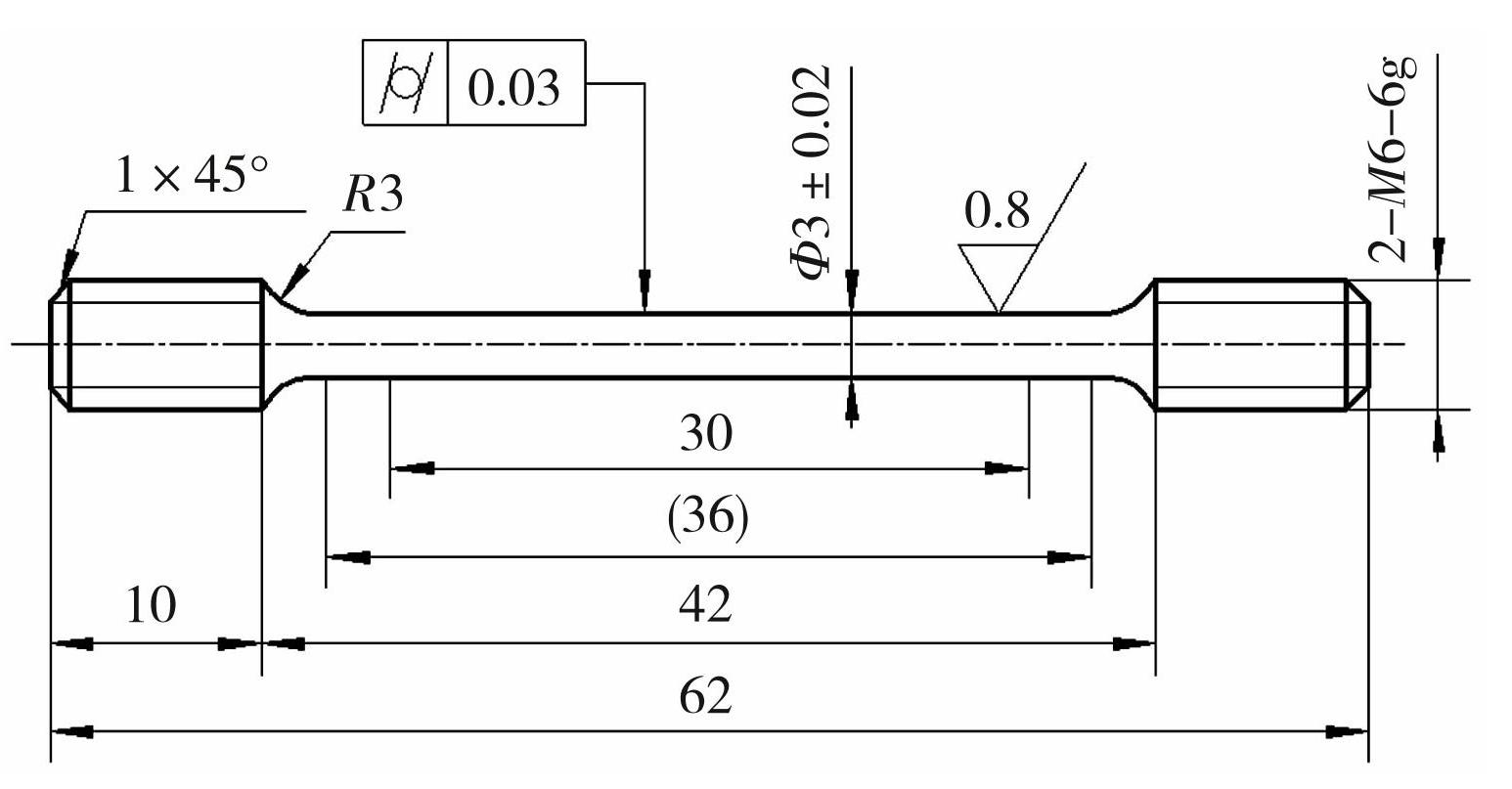
3拉伸试样尺寸(单位:mm)
Fig.3Tensile specimen size
2 结果与讨论
2.1 微观结构
对于SLM TC4合金的微观形貌,诸多文献已经对其进行了相关的报道。在增材制造过程中,由于其逐层打印的特征方式,使得合金在成形过程中不断的出现层间重熔,形成了合金特有的沿打印方向外延生长的β柱状晶结构[18-20]。而由于制造过程中高的能量密度和短的交互作用时间,产生了过高的熔池温度与较快的冷却速率[21],在柱状晶内形成了增材制造TC4合金特有的细针状α′马氏体微观组织结构[922-23]。通过热处理可以调整合金微观组织,将亚稳态的α′马氏体向α+β转变,使合金组织更加均匀、稳定[2224]图4所示为退火(800℃真空保温2 h,氩气环境冷却)与热等静压后SLM TC4合金垂直平面(XZ)与水平平面(XY)的宏观形貌,可知,退火热处理后(图4(a)图4(b)),合金垂直平面为沿打印方向伸长的β柱状晶结构,柱状晶高度横跨多层打印层,水平平面为等轴形貌。经过热等静压后,从图4(c)图4(d)中可以分辨出合金宏观的柱状晶和等轴形貌,但相对合金退火态而言,其宏观特征形貌不明显。Jin等[25]的研究结果表明在750℃退火时,SLM TC4合金中发生由α′向α相的转化,但是转变还不完全,使得合金柱状晶形貌显著,而随着退火温度的增加,水平和垂直方向微观结构的差异逐渐降低。本文中由于热等静压温度高于退火温度,因此相对于退火状态,热等静压后合金中马氏体α′相转化更多,使得其宏观柱状晶和等轴形貌特征减弱。
对两种热处理后合金微观组织进一步观察,如图5所示。退火态合金β柱状晶和等轴形貌为由α晶界(αGB)包围的α集束与α+β网篮组织组成(图5(a)图5(b)),其中衬度较低的为α相,衬度较高的为β相,α集束沿晶界生长,由相互平行的α板条组成,取向一致。与α集束相邻的为α+β网篮组织,组织中的α板条没有明显的方向性,取向随机[26]。热等静压后合金的柱状晶与等轴形貌同样包含有α集束与α+β网篮组织(图5(c)图5(d)),这与退火态组成相似,值得注意的是,在热等静压后合金在水平和垂直平面还出现部分等轴形态的α组织,这与退火热处理有明显区别,表明在热等静压压力作用下,合金的部分α相发生形变。Leuders等[22]研究结果显示随着热处理温度的增加,SLM TC4合金中α板条会发生粗化,Chen等[24]的实验结果也显示出同样的结论。本文中热等静压后合金的α板条宽度相对于退火态增加,长径比降低,主要原因在于,在更高的温度下进行加热时,钛合金原子扩散速率加快,扩散更加充分,在冷却过程中发生相变,形成更加粗大的α板条。
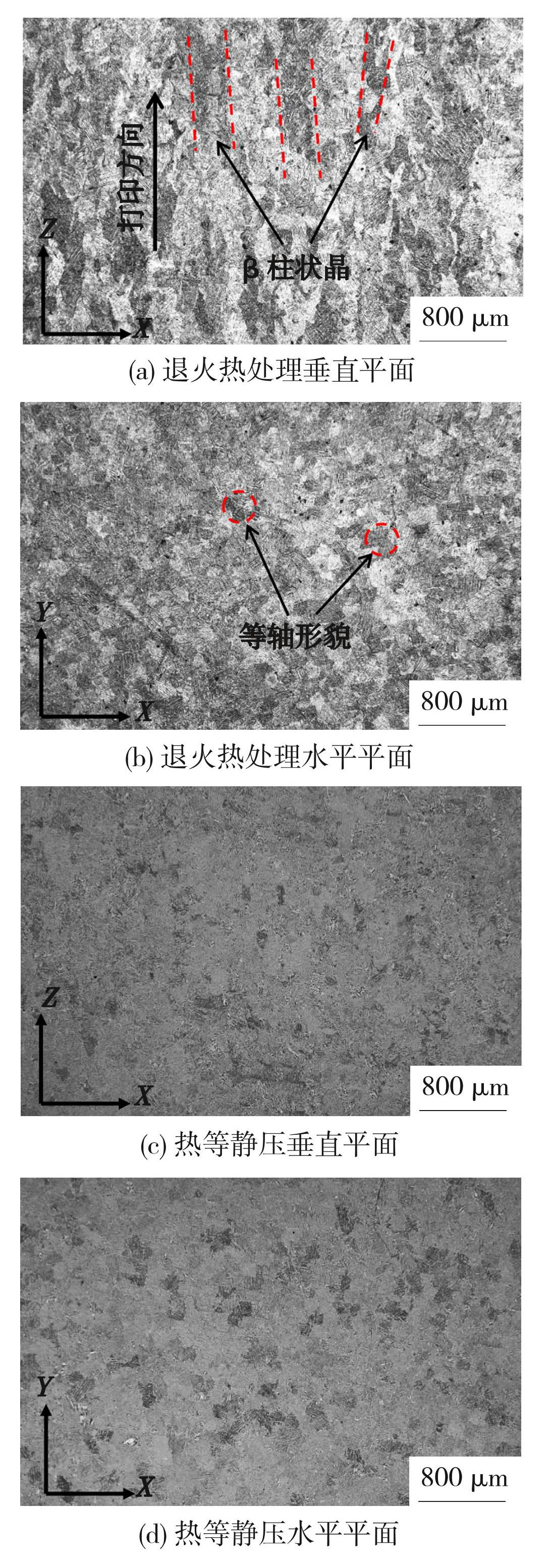
4不同热处理后SLM TC4合金宏观形貌
Fig.4Macroscopic morphology of SLM TC4 alloy after different heat treatments: (a) vertical plane after annealing; (b) horizontal plane after annealing; (c) vertical plane after HIP; and (d) horizontal plane after HIP
2.2 拉伸实验结果
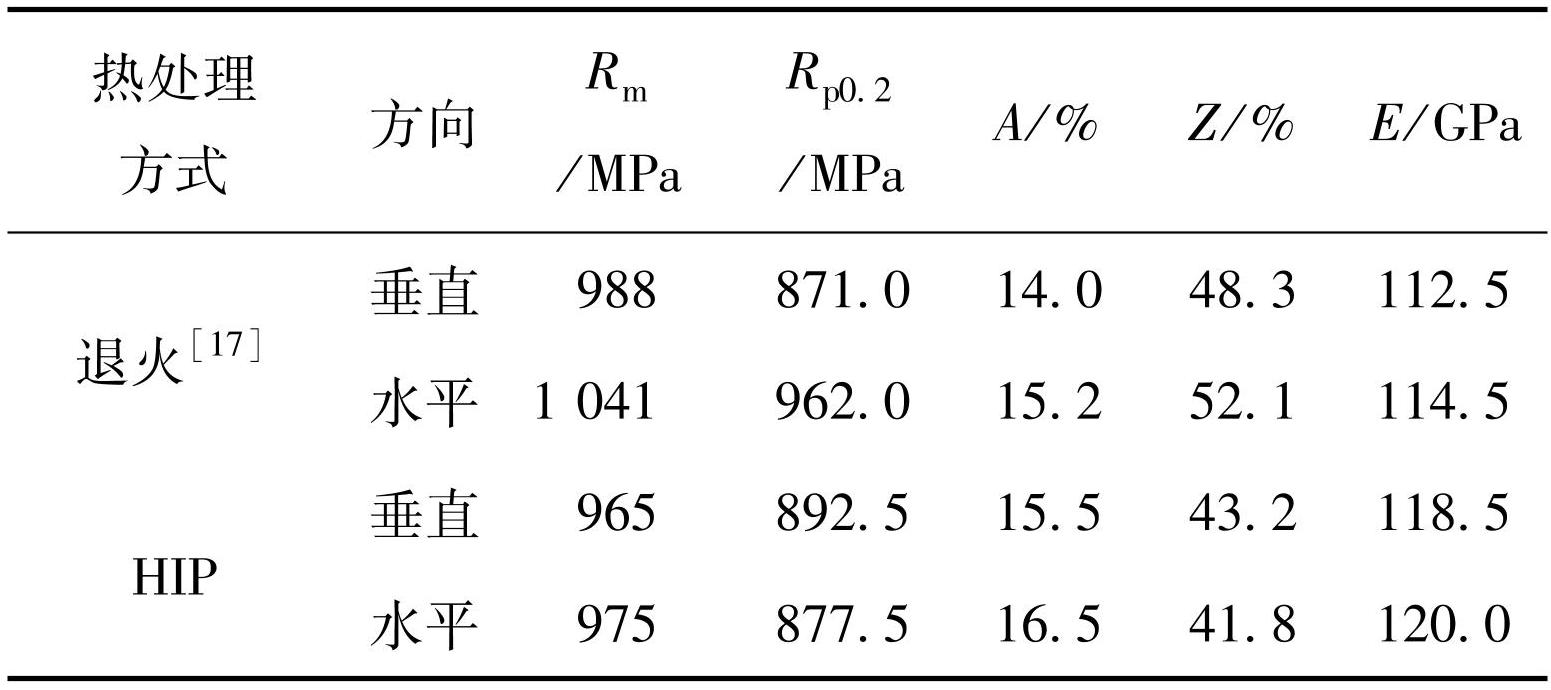
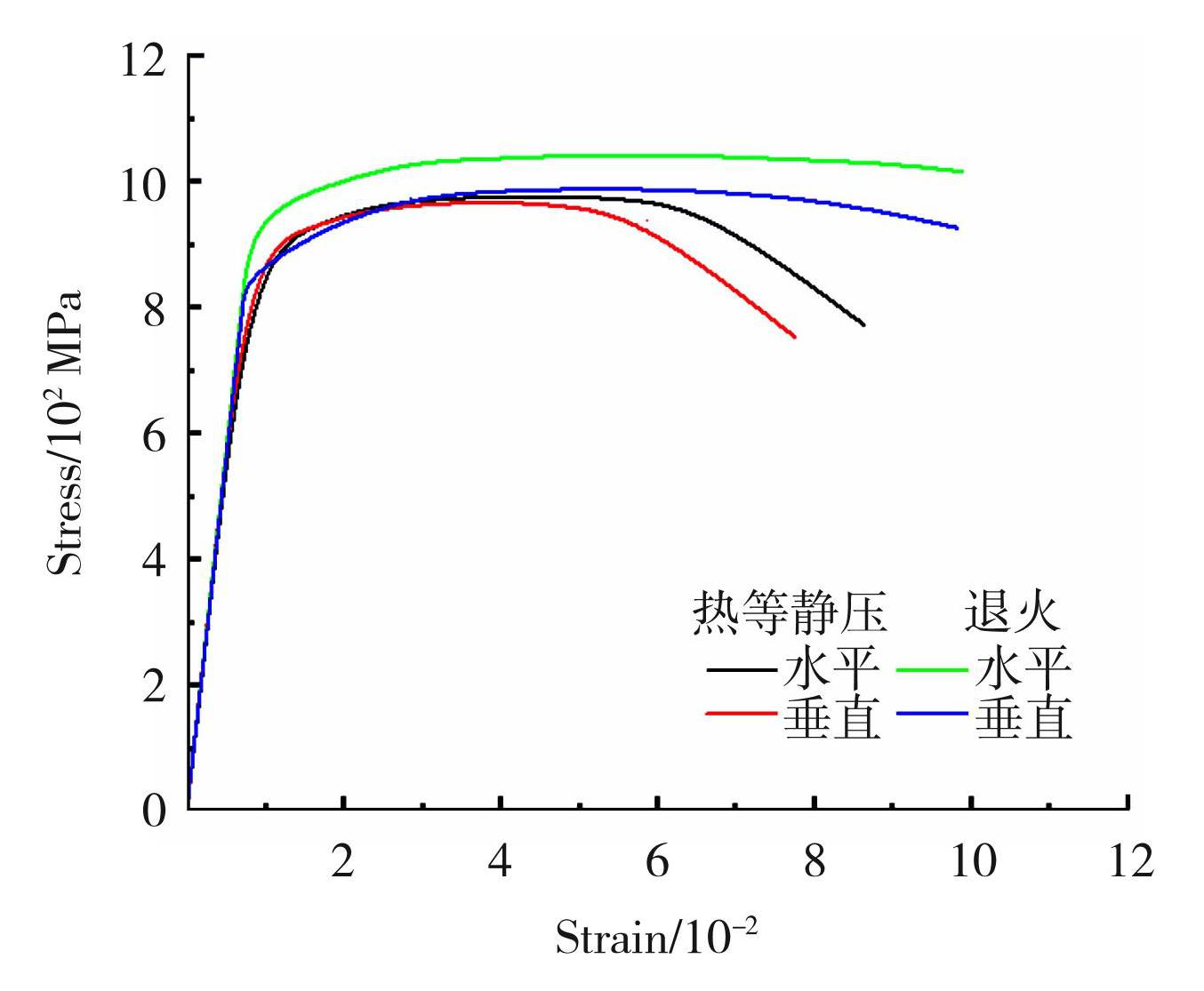
SLM TC4合金退火[17]与热等静压后拉伸性能实验结果见表2,室温拉伸平均全应力-应变曲线如图6所示。从图6中可以看出,热等静压后合金的水平和垂直方向曲线未有明显差异。热等静压后,垂直方向试样抗拉强度为965 MPa,屈服强度为892.5 MPa,断后伸长率为15.5%,断面收缩率为43.2%;水平方向试样抗拉强度为975 MPa,屈服强度为877.5 MPa,断后伸长率为16.5%,断面收缩率为41.8%。
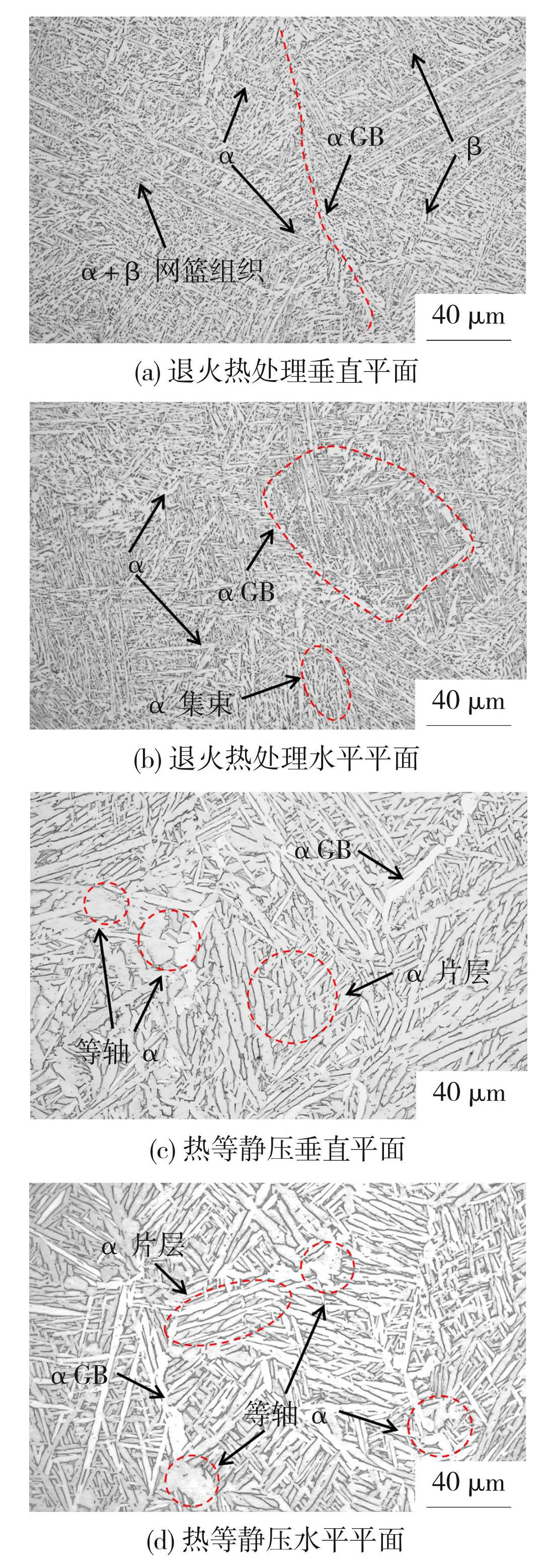
5不同热处理后SLM TC4合金微观组织形貌
Fig.5Microstructure and morphology of SLM TC4 alloy after different heat treatments: (a) vertical plane after annealing; (b) horizontal plane after annealing; (c) vertical plane after HIP; (d) horizontal plane after HIP
2激光选区熔化TC4合金拉伸性能
Table2The tensile properties of SLM TC4 alloy
6SLM TC4合金室温拉伸平均全应力-应变曲线
Fig.6Mean total tensile stress-strain curve of SLM TC4 alloy at RT
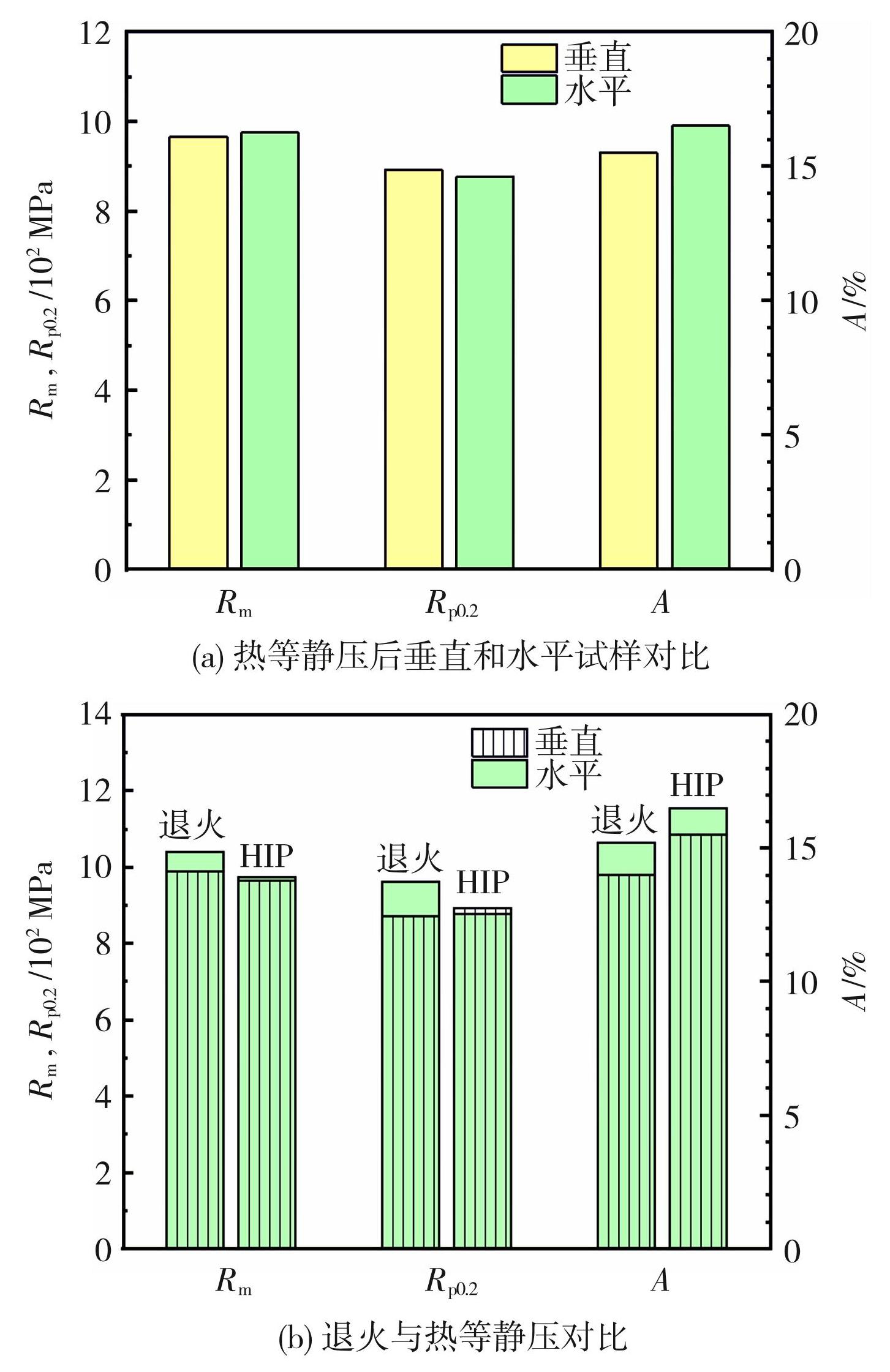
对比合金垂直和水平方向的强度和塑性(图7(a))发现,抗拉强度垂直试样比水平试样低10 MPa(1.0%),屈服强度垂直试样比水平试样高15 MPa(1.7%),断后伸长率垂直试样比水平试样低1%。相对于退火热处理后合金抗拉强度(垂直988 MPa,水平1041 MPa)与屈服强度(垂直871 MPa,水平962 MPa)明显的各向异性(表2)而言,在热等静压后SLM TC4合金垂直和水平方向强度和塑性指标相近,无明显各向异性。图7(b)所示为退火热处理和热等静压后不同取样方向的拉伸强度和塑性值比较。整体而言,热等静压后合金的强度降低,塑性增加。相较于退火热处理,热等静压水平方向试样抗拉强度降低66 MPa,屈服强度降低84.5 MPa;垂直方向试样抗拉强度降低23 MPa,屈服强度增加21.5 MPa,此处屈服强度并未随抗拉强度的降低而降低,其原因可能是合金受到形变强化;断后伸长率轻微增加,水平方向提高1.3%,垂直方向提高1.5%。对比两种不同热处理工艺,热等静压后水平方向试样抗拉强度的降低幅度要高于垂直试样,可见热等静压对合金强度的调节主要体现在水平方向,对垂直方向试样强度的调节程度相对较低。
热等静压后合金水平和垂直方向各向异性弱化主要是受到微观组织结构的影响。前期退火态合金拉伸实验结果显示,水平方向试样拉伸强度要高于垂直方向,主要是受到β晶界数量的影响,水平截面尺寸较小的等轴形貌能够有效提高 β晶界数量,致使位错滑移受到的阻碍较大,故强度较高[17]。在本文中,一方面,热等静压后合金垂直和水平平面的宏观柱状晶和等轴形貌并不明显,使得合金本身宏观形貌各向异性弱化。另一方面,合金微观结构中粗化α板条已经与β晶界处α板条宽度相当,二者对于在拉伸过程中抵抗位错滑移的能力无明显差异,从而使得β晶界在变形过程中的作用减弱,降低了水平和垂直试样由于β晶界数量不同而造成的各向异性影响,从而弱化了合金拉伸性能的各向异性。除上述两项影响因素外,合金在热等静压作用下水平和垂直平面均出现部分α相的等轴化,表明合金不同方向的微观结构均在向等轴组织转变,上述转变同样降低了合金拉伸性能的各向异性。
7SLM TC4合金拉伸性能
Fig.7Tensile properties of SLM TC4 alloy: (a) comparison of vertical and horizontal samples after HIP; (b) comparison of annealing and HIP
相对于退火热处理,合金热等静压后的强度降低与塑性增加同样与其微观组织的变化紧密相关。一方面,α板条结构的粗化使得合金强度降低,由Hall-Petch关系可知,细化的晶粒能够使得晶界界面增强,从而有效地阻碍位错运动,使得合金强度增加,因此晶粒尺寸越小,合金的强度越高。热等静压后合金α板条变宽,晶粒尺寸增加,晶界减少,抵抗位错变形的能力减弱,从而合金强度降低。另一方面是受到β相的影响,根据Chen等[24-25]研究结果显示,随着热处理温度的升高,会使得成形态SLM TC4合金中更多的针状亚稳态α′马氏体相转化为α+β,温度越高,分解转变越彻底,使得微观结构中β相体积分数增加,导致合金变形抗力下降。本文中热等静压的热处理温度要高于退火温度,因此热等静压转变的β相更多,从而使得合金的塑性增加。
2.3 断口分析
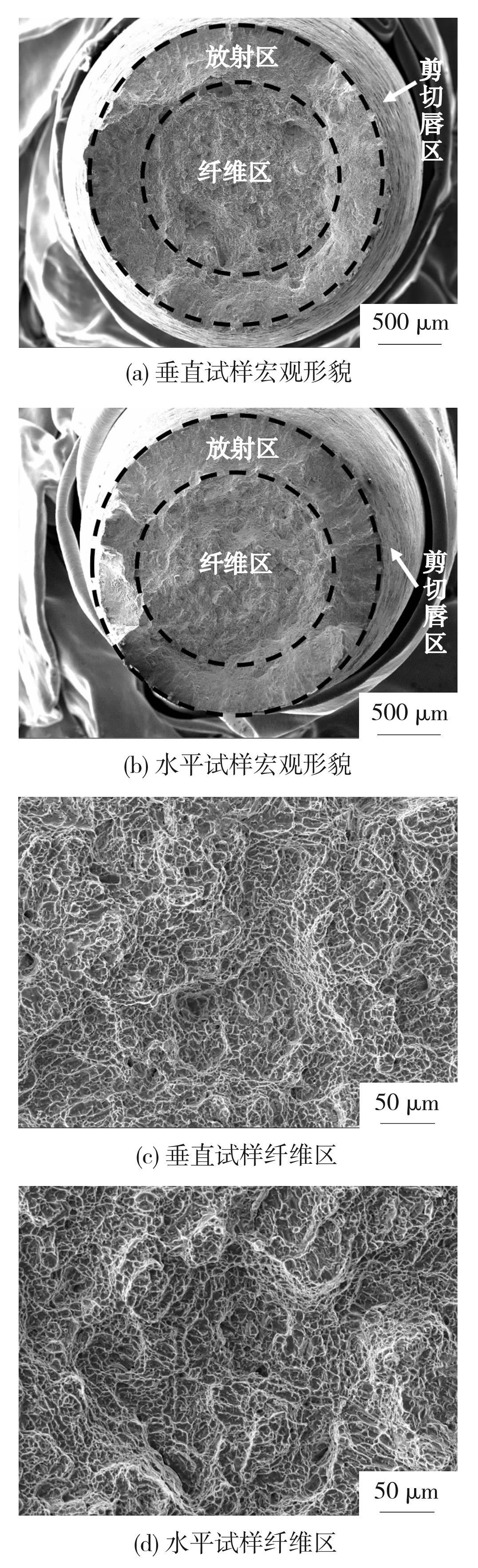
图8所示为热等静压后合金垂直和水平方向试样的拉伸断口。
8SLM TC4合金热等静压试样拉伸断口
Fig.8Fracture surface morphologies of tensile samples of SLM TC4 alloy after HIP: (a) macroscopic morphologies of vertical direction; (b) macroscopic morphologies of horizontal direction; (c) fiber region of vertical direction; (d) fiber region of horizontal direction
图8(a)和8(b)所示为断口宏观形貌,可分为3个区域:纤维区、放射区和剪切唇区。相对于放射区,纤维区形貌更加粗糙,将纤维区放大观测,如图8(c)和8(d)所示。水平和垂直方向形貌类似,表现为大小、深浅不一的韧窝形貌,为微孔聚集型断裂。此处形貌形成是由于中心部位约束度较大,处于平面应变和3向应力状态下,此时微孔发展相对剧烈,不同的微孔相互贯通,形成微裂纹,此时裂纹扩展相对缓慢。放射区形貌相对平坦,此时裂纹扩展到临界尺寸,失稳并快速向前撕裂,形成放射状扩展条纹。最后当裂纹扩展至表面时,试样失稳断裂,形成剪切唇。
与退火热处理断口[17]不同的是,热等静压后垂直和水平方向拉伸断口纤维区形貌相似,均接近于圆形,并未出现退火热处理垂直试样断口纤维区为圆形、而水平试样断口为椭圆形的情况。退火态断口差异的原因主要是由于柱状晶结构的影响导致。水平试样受拉时,裂纹在其横截面的垂直方向沿柱状晶长轴扩展,水平方向沿柱状晶短轴扩展,垂直方向的裂纹具有更快的扩展速率,故在宏观形貌上表现为椭圆形纤维区。热等静压后垂直和水平方向断口形貌均近似于圆形,说明热等静压后柱状晶结构对合金拉伸时裂纹扩展的抗力弱化,不同方向的裂纹扩展抗力相当,从而使得不同方向合金断口形貌相似,进一步证明热等静压后合金拉伸性能无明显各向异性。
3 结论
1)热等静压后,SLM TC4合金宏观形貌垂直面显示为柱状晶结构,水平面显示为等轴形貌,晶内由α集束与α+β网篮组织组成,相对于合金退火态,柱状晶形貌不明显,晶内α板条尺寸增加,长径比减小。
2)热等静压后,SLM TC4垂直和水平方向试样抗拉强度分别为965和975 MPa,断后伸长率分别为15.5%和16.5%。相对于退火热处理,热等静压后合金的抗拉强度降低,塑性增加。
3)相较于退火热处理,热等静压能够有效降低SLM TC4合金拉伸性能的各向异性,拉伸断口呈韧窝特征,断裂机制为韧性断裂。
1TC4合金粉末
Fig.1TC4 alloy powder
2试棒取向示意图
Fig.2Schematic diagram of sample orientation
3拉伸试样尺寸(单位:mm)
Fig.3Tensile specimen size
4不同热处理后SLM TC4合金宏观形貌
Fig.4Macroscopic morphology of SLM TC4 alloy after different heat treatments: (a) vertical plane after annealing; (b) horizontal plane after annealing; (c) vertical plane after HIP; and (d) horizontal plane after HIP
5不同热处理后SLM TC4合金微观组织形貌
Fig.5Microstructure and morphology of SLM TC4 alloy after different heat treatments: (a) vertical plane after annealing; (b) horizontal plane after annealing; (c) vertical plane after HIP; (d) horizontal plane after HIP
6SLM TC4合金室温拉伸平均全应力-应变曲线
Fig.6Mean total tensile stress-strain curve of SLM TC4 alloy at RT
7SLM TC4合金拉伸性能
Fig.7Tensile properties of SLM TC4 alloy: (a) comparison of vertical and horizontal samples after HIP; (b) comparison of annealing and HIP
8SLM TC4合金热等静压试样拉伸断口
Fig.8Fracture surface morphologies of tensile samples of SLM TC4 alloy after HIP: (a) macroscopic morphologies of vertical direction; (b) macroscopic morphologies of horizontal direction; (c) fiber region of vertical direction; (d) fiber region of horizontal direction
1试棒成型工艺参数
Table1Sample forming process parameters
2激光选区熔化TC4合金拉伸性能
Table2The tensile properties of SLM TC4 alloy
张学军, 唐思熠, 肇恒跃, 等.3D打印技术研究现状和关键技术[J]. 材料工程,2016,44(2):122-128.ZHANG Xuejun, TANG Siyi, ZHAO Hengyue,et al. Research status and key technologies of 3D printing[J]. Journal of Materials Engineering,2016,44(2):122-128. DOI:10.11868/j.issn.1001-4381.2016.02.019
顾冬冬, 张红梅, 陈洪宇, 等. 航空航天高性能金属材料构件激光增材制造[J]. 中国激光,2020,47(5):32-55.GU Dongdong, ZHANG Hongmei, CHEN Hongyu,et al. Laser additive manufacturing of high-performance metallic aerospace components[J]. Chinese Journal of Lasers,2020,47(5):32-55. DOI:10.3788/CJL202047.0500002
祝国梁, 罗桦, 贺戬, 等. 镍基高温合金增材制造研究进展[J]. 材料工程,2024,52(2):1-15.ZHU Guoliang, LUO Hua, HE Jian,et al. Advances in additive manufacturing of nickel-based high-temperature alloys[J]. Journal of Materials Engineering,2024,52(2):1-15. DOI:10.11868/j.issn.1001-4381.2023.000676
蔡建明, 弭光宝, 高帆, 等. 航空发动机用先进高温钛合金材料技术研究与发展[J]. 材料工程,2016,44(8):1-10.CAI Jianming, MI Guangbao, GAO Fan,et al. Research and development of some advanced high temperature titanium alloys for aero-engine[J]. Journal of Materials Engineering,2016,44(8):1-10. DOI:10.11868/j.issn.1001-4381.2016.08.001
李俊峰, 魏正英, 卢秉恒. 钛及钛合金激光选区熔化技术的研究进展[J]. 激光与光电子学进展,2018,55(1):29-46.LI Junfeng, WEI Zhengying, LU Bingheng. Research progress on technology of selective laser melting of titanium and titanium alloys[J]. Laser & Optoelectronics Progress,2018,55(1):29-46. DOI:10.3788/LOP55.011403
李萌蘖, 李闯, 李绍宏. TC4合金增材制造的研究现状[J]. 昆明理工大学学报(自然科学版),2018,43(6):20-27.LI Mengnie, LI Chuang, LI Shaohong. Current status of TC4 alloy additive manufacturing[J]. Journal of Kunming University of Science and Technology(Natural Science),2018,43(6):20-27. DOI:10.16112/j.cnki.53-1223/n.2018.06.003
VRANCKEN B, THIJS L, KRUTH J P,et al. Heat treatment of Ti6Al4V produced by selective laser melting: Microstructure and mechanical properties[J]. Journal of Alloys and Compounds,2012,541:177-185. DOI:10.1016/j.jallcom.2012.07.022
KASPEROVICH G, HAUSMANN J. Improvement of fatigue resistance and ductility of TiAl6V4 processed by selective laser melting[J]. Journal of Materials Processing Technology,2015,220:202-214. DOI:10.1016/j.jmatprotec.2015.01.025
CAIN V, THIJS L, VAN HUMBEECK J,et al. Crack propagation and fracture toughness of Ti6Al4V alloy produced by selective laser melting[J]. Additive Manufacturing,2015,5:68-76. DOI:10.1016/j.addma.2014.12.006
STERLING A J, TORRIES B, SHAMSAEI N,et al. Fatigue behavior and failure mechanisms of direct laser deposited Ti-6Al-4V[J]. Materials Science and Engineering: A,2016,655:100-112. DOI:10.1016/j.msea.2015.12.026
HRABE N, GNÄUPEL-HEROLD T, QUINN T. Fatigue properties of a titanium alloy(Ti-6Al-4V)fabricated via electron beam melting(EBM): Effects of internal defects and residual stress[J]. International Journal of Fatigue,2017,94:202-210. DOI:10.1016/j.ijfatigue.2016.04.022
YU Hanchen, LI Fangzhi, WANG Zemin,et al. Fatigue performances of selective laser melted Ti-6Al-4V alloy: Influence of surface finishing,hot isostatic pressing and heat treatments[J]. International Journal of Fatigue,2019,120:175-183. DOI:10.1016/j.ijfatigue.2018.11.019
SIMONELLI M, TSE Y Y, TUCK C. Effect of the build orientation on the mechanical properties and fracture modes of SLM Ti-6Al-4V[J]. Materials Science and Engineering: A,2014,616:1-11. DOI:10.1016/j.msea.2014.07.086
CARROLL B E, PALMER T A, BEESE A M. Anisotropic tensile behavior of Ti-6Al-4V components fabricated with directed energy deposition additive manufacturing[J]. Acta Materialia,2015,87:309-320. DOI:10.1016/j.actamat.2014.12.054
SUN Wenbo, MA Yu’e, HUANG Wei,et al. Effects of build direction on tensile and fatigue performance of selective laser melting Ti6Al4V titanium alloy[J]. International Journal of Fatigue,2020,130:105260. DOI:10.1016/j.ijfatigue.2019.105260
CHANG Kun, LIANG Enquan, HUANG Wenjing,et al. Microstructural feature and mechanical property in different building directions of additive manufactured Ti6Al4V alloy[J]. Materials Letters,2020,267:127516. DOI:10.1016/j.matlet.2020.127516
焦泽辉, 于慧臣, 吴学仁, 等. 激光选区熔化TC4钛合金的室温及高温拉伸各向异性与断裂机制研究[J]. 材料导报,2023,37(S2):439-444.JIAO Zehui, YU Huichen, WU Xueren,et al. Study on tensile anisotropy and fracture mechanism an room and elevated temperature of the selective laser melted TC4 titanium alloy[J]. Materials Reports,2023,37(S2):439-444.
LIU Shunyu, SHIN Y C. Additive manufacturing of Ti6Al4V alloy: A review[J]. Materials and Design,2019,164:107552. DOI:10.1016/j.matdes.2018.107552
XU Z W, LIU A, WANG X S. The influence of building direction on the fatigue crack propagation behavior of Ti6Al4V alloy produced by selective laser melting[J]. Materials Science and Engineering: A,2019,767:138409. DOI:10.1016/j.msea.2019.138409
WANG Xinyan, ZHAO Yang, WANG Luobin,et al. In-situ SEM investigation and modeling of small crack growth behavior of additively manufactured titanium alloy[J]. International Journal of Fatigue,2021,149:106303. DOI:10.1016/j.ijfatigue.2021.106303
YADROITSEV I, KRAKHMALEV P, YADROITSAVA I. Selective laser melting of Ti6Al4V alloy for biomedical applications: Temperature monitoring and microstructural evolution[J]. Journal of Alloys and Compounds,2014,583:404-409. DOI:10.1016/j.jallcom.2013.08.183
LEUDERS S, THÖNE M, RIEMER A,et al. On the mechanical behaviour of titanium alloy TiAl6V4 manufactured by selective laser melting: Fatigue resistance and crack growth performance[J]. International Journal of Fatigue,2013,48:300-307. DOI:10.1016/j.ijfatigue.2012.11.011
VAN H B, MOENS D, BOONEN R,et al. Analysis of fracture toughness and crack propagation of Ti6Al4V produced by selective laser melting[J]. Advanced Engineering Materials,2012,14(1-2):92-97. DOI:10.1002/adem.201100233
CHEN Bingqing, WU Zhengkai, YAN Taiqi,et al. Experimental study on mechanical properties of laser powder bed fused Ti-6Al-4V alloy under post-heat treatment[J]. Engineering Fracture Mechanics,2022,261:108264. DOI:10.1016/j.engfracmech.2022.108264
JIN Nan, YAN Zhenyu, WANG Yangwei,et al. Effects of heat treatment on microstructure and mechanical properties of selective laser melted Ti-6Al-4V lattice materials[J]. International Journal of Mechanical Sciences,2021,190:106042. DOI:10.1016/j.ijmecsci.2020.106042
WU Liangliang, JIAO Zehui, YU Huichen. Study on fatigue crack growth behavior of selective laser-melted Ti6Al4V under different build directions,stress ratios,and temperatures[J]. Fatigue and Fracture of Engineering Materials and Structures,2022,45(5):1421-1434. DOI:10.1111/ffe.13670

友情链接LINKS