Abstract
The multiplicity of clouds improves availability and elasticity;however,load balancing becomes more complex when resources are unbalanced,the loads are not constant,and cross-provider failures occur. This work proposes a dynamic,real-time load-balancing approach for multi-cloud that aims to optimize resources of the system,reduce latency (including tail latency),and enhance fault tolerance. This study presents a hybrid algorithm combining a genetic algorithm (GA)and ant colony optimization (ACO). GA performs global search over candidate task-resource mappings,while ACO performs local search using the pheromone search. This study defines explicit parameter tuning and workflow used in the evaluation. The hybrid GA-ACO is introduced and compared to conventional methods (round-Robin and least-connections),adaptive methods,and ML-based methods across multi-cloud cases (steady,spike,node-fail,and regional-outage). Assessment uses deployment-relevant KPIs:load distribution,mean / p99 latency,resource utilization,and fault tolerance. Hybrid GA-ACO reduced its load imbalance by 36%,reduced mean response time by48%,increased resource utilization by 37%,and improved fault tolerance by 36%. It also maintains the requested150 ms bound per control window and incurs less than 5 ms of request-path overhead. The metrics rely on parameter setting and accuracy of metrics. Although our hybrid solution reduces imbalance and latency and increases utilization and fault tolerance,future work will prioritize usability and latency and increases utilization and fault tolerance with real workloads. The proposed hybrid GA-ACO combines global and local search through parameter optimization and a carefully designed evaluation,offering a smooth,adaptive,and efficient approach to load balancing across clouds.
Keywords
0 Introduction
The rapid development of cloud computing has transformed how organizations deploy,operate,and scale IT resources. Multi-cloud environments—where services are distributed across multiple cloud providers—have become popular because they offer enhanced reliability,flexibility,and cost savings[1].Despite these benefits,multi-cloud environments pose serious resource-management challenges,particularly in load balancing[2]. Load balancing is essential in cloud computing because it distributes workload across available resources in the most efficient way,enabling better performance,lower latency,and higher fault tolerance. Although traditional load-balancing systems are effective in single-cloud environments,they often fail to scale to the complex and dynamic multi-cloud environment[3]. Irregular workload patterns,dissimilar resource capabilities,and the need for real-time adaptation require more sophisticated solutions. This study investigates an emerging algorithm that integrates genetic algorithms(GAs)and ant colony optimization(ACO)to address load-balancing challenges across multiple clouds[4]. GA is known for global search,which enables exploration of a wide range of possible solutions;it mimics natural selection to efficiently find good solutions to complex optimization problems[5-6].
ACO,by contrast,is effective for local search optimization. It is inspired by ant foraging behavior,uses pheromone trails to guide solutions,and improves solutions through cooperative mechanisms[7-8]. The proposed hybrid GA-ACO algorithm aims to exploit the strengths of both optimization methods:GA explores diverse load-distribution plans at the global scale,while ACO refines these plans to achieve optimal local performance. This two-tier strategy is designed to maximize resource utilization,reduce response time,and increase system reliability by dynamically adapting to demand changes in multi-cloud environments.Extensive simulation and experimental work will demonstrate the effectiveness of hybrid GA-ACO. Key metrics—load-distribution efficiency,response time,resource consumption,and fault tolerance—will be used to compare the algorithm with existing load-balancing techniques.
This study is expected to provide useful findings and make an important contribution to the development of load-balancing techniques in multi-cloud computing. The goal is to develop a robust,dynamic load-balancing platform designed specifically for multi-cloud configurations. The proposed hybrid algorithm leverages GA as a global optimizer and ACO as a local optimizer. It addresses multi-cloud load-balancing challenges and supports faster,more dependable cloud computing infrastructures.
Problem statement:consider a multi-cloud environment with regions/ resources R and compute instances/ VMs(virtual machines). A set of incoming tasks/ jobs T must be assigned dynamically to resources.
R denotes the set of regions or cloud resource domains in the multi-cloud environment. M represents the global set of compute instances or VMs,defined as the union of all regional resource sets,i. e.,,where Mr is the set of compute instances available in region r ∈ Rr. T denotes the set of incoming tasks or jobs that must be dynamically scheduled. The objective is to assign each task in T to an appropriate compute instance in M across regions. Here,each Mr represents the set of VMs available in a specific region r,and the union operation aggregates all regional VM sets into a single global resource pool M.
Parameters:
τi:SLA(service-level agreement)deadline/latency target for task i;
Br:optional bandwidth limit for region r;
bij:bandwidth consumed if i→j.
Decision variables xij ∈{0,1}:1,if task i is assigned to VMj;0,otherwise.
Per-task latency model:Let service time contribution on j be Sij= di/ cj;Predicted end-to-end latency:Tij= Lij+ Sij. Here,cj represents effective compute capacity of VMj (tasks per second or normalized units). Lij represents network/ queuing latency for assigning task i to VMj(ms). di represents compute demand of task i(normalized service units).
Objective function:
where kj is per-unit compute cost at VMj;εij:egress/data-transfer cost if i → j. wlat,wsla,wcost ≥ 0:objective weights(set by operator).
This paper makes the following contributions.
1)Hybrid dual-timescale optimizer:a GA-ACO design where GA performs inter-cloud placement/share allocation and ACO performs intra-cloud task-to-VM routing,enabling coordinated decisions across clouds and within regions.
2)Joint latency-cost-SLA objective with tail control:a multi-objective fitness incorporating response time,SLA violations,and egress/ compute cost,augmented with a risk-sensitive CVaR(conditional value at risk)/ quantile term to limit high-percentile latency.
3)Robustness to shift:a generalization protocol using domain randomization and scenario-level cross-validation(no leakage),plus regularizes(fitness noise,early stopping,diversity maintenance)to prevent overfitting to simulation scenarios.
4)Automated+ online parameter control:a two-stage scheme,offline BOHB(Bayesian optimization with hyperband)/ Bayesian auto-tuning to find robust settings,and online adaptive rules(driven by diversity,SLA pressure,load variance)to remain effective under non-stationary workloads.
5)Scalability mechanisms:island-model GA and multi-colony ACO with asynchronous merges,hierarchical regional decomposition,and incremental(delta)evaluation,reducing wall-clock time and memory pressure on large instances.
1 Related Work
Cloud computing has advanced considerably in load balancing,with many approaches developed to address the challenges of dynamic and distributed systems. This section reviews prior studies and outlines the contributions and limitations of existing approaches to multi-cloud load balancing.
1.1 Conventional Load Balancing Methods
Early studies in load balancing mainly focused on static algorithms,such as round Robin,least connections,and weighted load balancing. These schemes assign tasks according to predefined rules or metrics. They perform well in intra-cloud environments;however,they often do not scale to the dynamism of multi-cloud networked environments[9-10]. These solutions must be more flexible to handle varying workloads and resource availability across different cloud platforms.
1.2 Dynamic and Adaptive Load Distribution
Dynamic and adaptive load-balancing strategies were introduced to address the limitations of static schemes. Most adaptive schemes that target lower response times adjust resource allocation based on real-time measurements,improving performance and responsiveness[11]. Nevertheless,these solutions tend to rely on centralized control,which can be a drawback in multi-cloud environments where resources are distributed.
1.3 Approaches Based on Machine Learning
Machine-learning algorithms have been used in load balancing to improve decision-making. Recent studies have proposed reinforcement learning,neural networks,and other machine-learning frameworks to predict workloads and optimize resource allocation[12].Despite their promise,these methods often require large training datasets and substantial computational resources,which limits scalability and real-time deployment.
1.4 Metaheuristic Optimization Methods
GA and ACO are metaheuristic algorithms that have been applied to complex load-balancing problems. Inspired by natural selection,genetic algorithms have been adopted to discover optimal or near-optimal load-distribution strategies by evolving a population of candidate solutions[13]. ACO,inspired by ant foraging behavior,has also proven effective for local search optimization in routing and scheduling problems[14]. However,their use in multi-cloud load balancing remains limited,particularly in integrating their complementary strengths.
1.5 Hybrid Methodologies
More recent research has examined hybrid methodologies that combine multiple optimization methods to leverage their complementary strengths.Hybrids of GA with particle swarm optimization(PSO)or simulated annealing(SA)have been shown to enhance performance across several optimization problems[15-16]. Combining genetic algorithms with ACO could benefit load balancing by merging global search capabilities with local optimization capabilities. The use of hybrid methods in multi-cloud load balancing remains an active research topic.
1.6 Load Balancing Utilizing Blockchain Technology
Blockchain technology has been proposed to enhance load balancing through decentralized,transparent decision-making processes[17]. Blockchain-based solutions offer advantages in security and trust but remain underdeveloped for dynamic,real-time load balancing in multi-cloud systems. Combining blockchain with optimization methods such as GA and ACO is a promising area of research[18]. Existing studies have developed load-balancing policies for cloud systems,but challenges remain in addressing the dynamic and distributed nature of multi-cloud systems[19-20]. Traditional methods,though essential,are often insufficiently flexible for modern multi-cloud environments. More advanced methods,including machine learning and metaheuristic optimization,offer promising solutions,but hybrid methodologies require further exploration. This paper takes a step forward by developing a hybrid GA-ACO approach for multi-cloud load balancing that incorporates the advantages of both algorithms to improve efficiency and flexibility in complex cloud systems.
1.7 Research Gaps and Positioning
Although many studies have addressed load balancing in cloud and multi-cloud environments,several research gaps remain,as shown in Table 1.
Table
1
Differences between existing work and proposed methodology
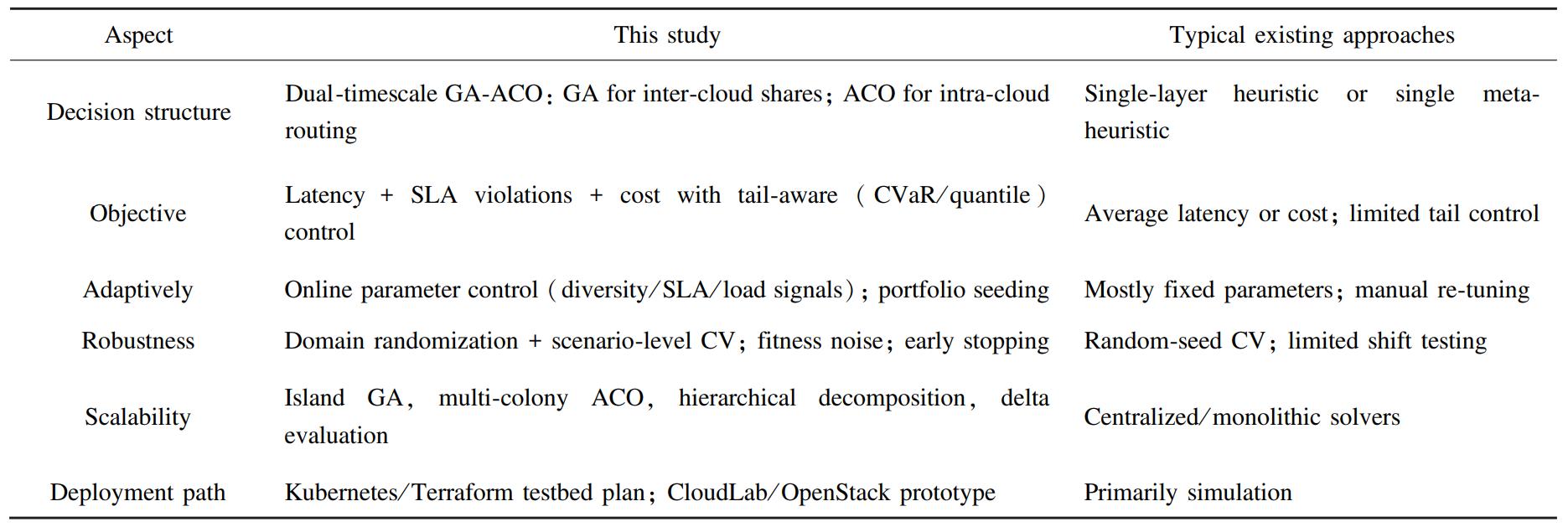
First,most current approaches are single-objective and thus do not consider multi-objective trade-offs,including SLA violations and fairness.Second,most use a single metaheuristic—e.g.,GA or ACO alone—which can lead to slow convergence or premature termination. Third,many methods require manual parameter tuning,which limits flexibility under dynamic workloads. Fourth,scalability and real-time deployment are rarely tested in large-scale multi-cloud settings. Finally,robustness to unseen workload patterns remains insufficiently studied. To address these gaps,this paper proposes a hybrid genetic algorithm-ant colony optimization(GA-ACO)model that combines global exploration and local exploitation in a multi-objective,dynamically adaptive framework. The proposed model incorporates online adaptive parameter control,hierarchical decomposition for scalability,and cross-scenario testing for robustness,thereby overcoming critical limitations of existing studies and offering a more adaptive,scalable,and SLA-aware load-balancing service.
2 The Proposed Methodology
This section discusses the hybridization mechanism and the experimental evaluation of the hybrid GA-ACO approach for dynamic load balancing in multi-cloud systems. The methodology comprises three major phases:algorithm design,implementation and testing,and performance evaluation.
2.1 Algorithm Design
2.1.1 Hybrid GA⁃ACO framework
GA component:develop a GA-related model for the global analysis of load-balancing solutions. The critical elements of the GA element include as follows.1)Population initialization:instantiate a starting population of potential remedies for load distribution;2)Create a fitness function which evaluates solutions based on load distribution efficiency,response speed,and resource use;3)Use tournament or roulette wheel to choose parents for the next generation;4)Introduce crossover and mutation operators to create progeny and improve the diversity in the population;5)Elitism:incorporate elitism in a manner that upholds the best solutions in every generation.
2.1.2 Ant colony optimization component
Incorporate ACO in order to improve and streamline solutions generated by the GA. The main elements of the ACO element include as follows. 1)Pheromone initialization is to create the pheromone levels which would guide the search process;2)Simulate the behavior of ants in order to explore and exploit solutions;3)Record pheromone trails based on the quality of found solutions;4)Use local search methodologies to improve the quality of the solutions close to the ultimate known solutions.
2.1.3 Hybridization approach
Integration mechanism:implement a system that integrates GA and ACO components,ensuring that the global search capability of GA complements the local optimization benefits of ACO. Parameter optimization:optimize the parameters of GA and ACO,including the population size,crossover rate,mutation rate,the rate at which the pheromone evaporates and the ratio of exploration and exploitation.
2.2 Implementation and Testing
2.2.1 Simulation environment
Build a multi-cloud simulation platform that models multi-cloud architectures with varying resource capacities,workload distributions,and failure modes[21]. Test the resilience and flexibility of the hybrid algorithm under peak loads,sudden spikes,and changing workloads by configuring different load levels[22].
2.2.2 Implementation of the algorithm
Implement the hybrid GA-ACO algorithm in a simulated environment using Python,MATLAB,or Java[23–24]. Where access is available,adapt the algorithm to incorporate real cloud platforms or simulators to verify its functionality under real-world conditions.
2.2.3 Hybrid GA⁃ACO pseudocode
1) GA component.
InitializePopulation( )
For each individual in Population:
EvaluateFitness(individual)
While not TerminationCondition:
SelectedParents=SelectParents (Population)
Offspring = Crossover(SelectedParents)
Offspring = Mutate(Offspring)
EvaluateFitness(Offspring)
Population=ReplaceOldPopulation(Population,Offspring)
ApplyElitism(Population)
Return BestIndividual(Population)
2) ACO component.
InitializePheromoneLevels ( )
While not TerminationCondition:
For each ant in AntColony:
Path = ConstructSolution(Ant)
EvaluatePathQuality(Path)
UpdatePheromoneLevels(Path, Quality)
EvaporatePheromones( )
UpdatePheromoneLevelsGlobally( )
Return BestPath(AntColony)
3) Hybridization strategy.
Initialize GA and ACO
While not TerminationCondition:
GA_Best = RunGA( )
ACO_Best = RunACO( )
CombineSolutions (GA_Best, ACO_Best)
EvaluateCombinedSolution( )
Return BestCombinedSolution ( )
2.2.4 Implementation and testing
1)Multi-cloud simulation.
CreateSimulationEnvironment ( )
DefineLoadScenarios( )
For each Scenario in LoadScenarios:
Run HybridAlgorithm ( SimulationEnvironment,Scenario)
CollectResults( )
2)Algorithm implementation.
ImplementHybridAlgorithm(GA, ACO)
IntegrateWithCloudPlatforms( )
3)Testing and validation.
For each TestCase:
RunAlgorithm(TestCase)
MeasurePerformanceMetrics( )
CompareWithExistingMethods( )
The provided pseudocode is a detailed description of steps and key processes that are associated with the creation,use,and evaluation of the hybrid GA-ACO strategy in load balancing of various clouds. Fig.1shows flowchart of the hybrid GA-ACO for dynamic load balancing in multi-cloud scenarios. GA is implemented first for global search,in which generations of prospective task-resource allocations are created,evaluated,and improved through selection,crossover,and mutation.
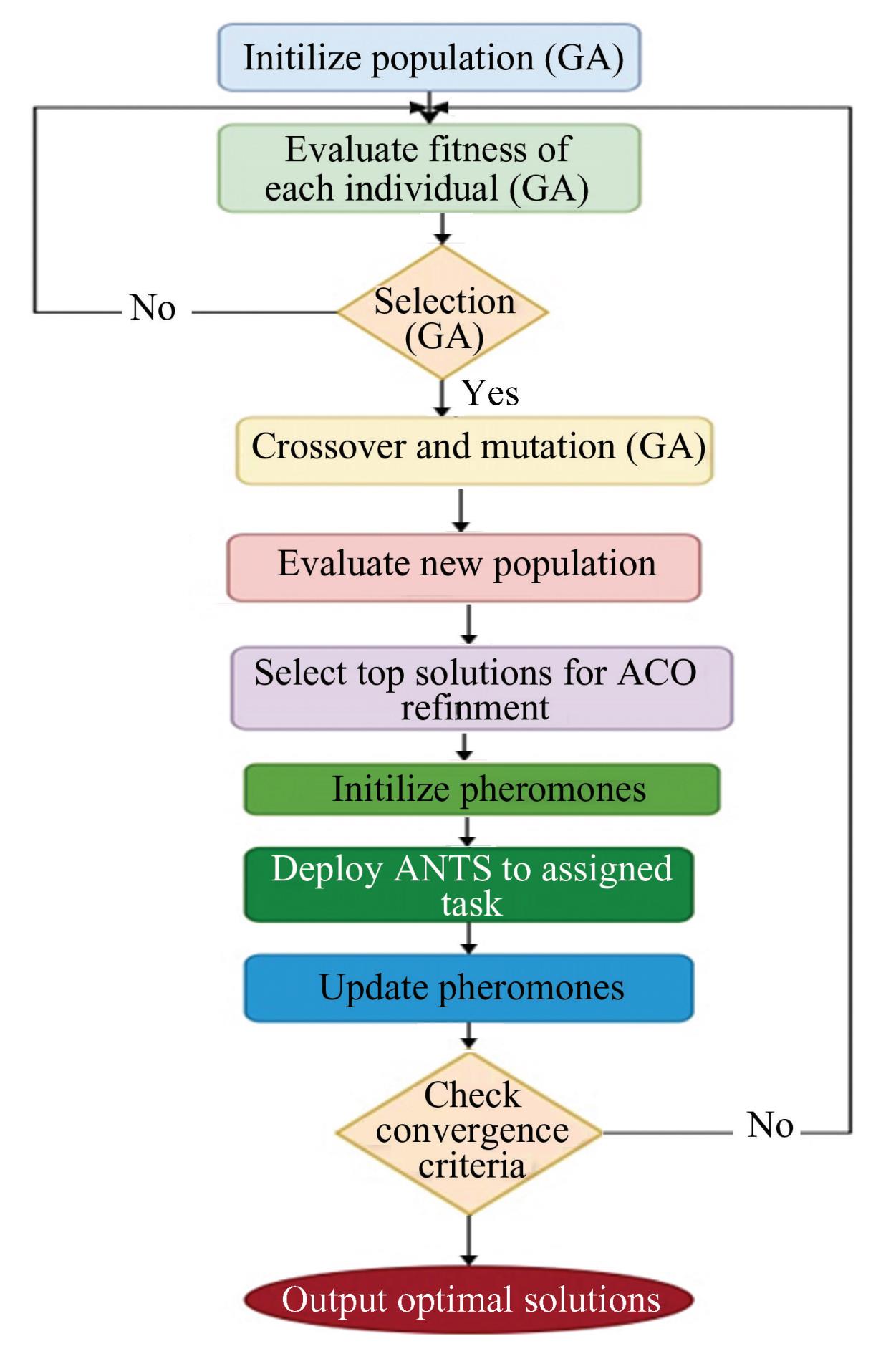
Fig.
1
Flow chart of the proposed methodology
After the first phase,ACO is applied,where the best individuals are further enhanced and their job allocations are adjusted using the pheromone-based ACO technique. The interconnection of the ACO and GA phases ensures a balance between global exploration and local exploitation,which leads to convergence of an SLA-based cost-efficient and balanced resource distribution across clouds.
The hybrid model GA-ACO utilizes the global search ability of GA and the local search capability of ACO. The GA starts with a mixed population for the first scheduling or load-balancing solution. Each candidate is analyzed using a multi-dimensional objective fitness function,which maximizes the problem of latency,cost,and SLA. The more evolutionary tasks of selection,crossover,and mutation,the more the solutions will refine the tasks. The best individuals are then transferred to the ACO module,where artificial ants in the task-to-resource allocations use the ACO technique of pheromone and heuristic visibility adjustments. The securing of specific resource allocations is achieved through the incremental tightening of the evaporation,which prevents the control matrix from becoming stagnant.The stopping criteria ensure that the algorithm halts when improvements fall below a specific limit,or a maximum number of iterations has been reached.The balance between global exploration provided by GAs and local exploitation offered by ACO is optimal.
2.3 Scalability via Parallelization and Decomposition
Let n be the number of tasks,m the number of candidate resources(VMs/ containers across clouds),P the GA population size,and A the number of ants per ACO iteration. The dominant cost is fitness evaluation,which is independent across individuals/ants and thus amenable to parallelization.
2.3.1 Parallelization
Embarrassingly parallel fitness:evaluate P,GA individuals and A ants concurrently on a cluster(Kubernetes jobs;thread pools;Ray/ Dask/ Spark)or GPU kernels. This reduces wall time from O(P+A)serial evaluations to roughly O((P+ A)/ p)with p workers,up to communication limits.
Island-model GA:partition the population into K islands evolving in parallel with periodic migration(ring or random topology every Tmig generations,exchanging top-r elites). This improves both diversity and scaling by reducing synchronization barriers.
Multi-colony ACO(asynchronous):run the colonies in parallel with shared pheromone matrices and bounded-staleness merges(e.g.,every Tτ iterations apply atomic/ additive updates). This maintains exploration while keeping communication low.
Vectorization/ GPU:batch route-cost,latency,and cost/ throughput calculations;store distance/ latency matrices in device memory;use sparse formats for large but sparse inter-cloud graphs.
2.3.2 Decomposition
1)Two-level hierarchy:the framework operates on two levels. At the inter-region layer,GA clusters resources into regions based on latency or cost(e.g.,per cloud or availability zone),and assigns fractional or aggregate workload shares to regions. At the intra-region layer,ACO operates independently within each region,where its own colony optimizes detailed task-to-VM placement and routing. This reduces per-solver problem size from(n,m)to(nk,mk))per region,where and denotes the total number of tasks(e. g.,jobs or workloads)and m represents the total number of resources(e.g.,virtual machines or servers)in the global system. The system is partitioned into regions indexed by k,where nk is the number of tasks assigned to region k and mk is the number of resources available in region k.
2)Workload partitioning:tasks are partitioned based on service classes or SLA requirements(e. g.,latency-sensitive versus batch workloads),as well as communication graph partitioning techniques. The resulting sub-problems are solved in parallel;thereafter,a lightweight balancing mechanism is applied to adjust marginal task assignments,ensuring that global SLA and cost objectives are satisfied.
3)Lagrangian/ ADMM split:relax capacity/latency coupling to form separable sub-problems(placement vs. routing). Solve sub-problems in parallel and update multipliers;convergence is detected when primal/ dual residuals fall below thresholds.
2.3.3 Incremental and rolling evaluation
1)Delta fitness updates:in a chromosome/ ant solution,when there is a difference between chromosomes/ ant solutions,rather than re-computing the entire objective,one ought to recalculate merely the corresponding components.
2)Rolling horizon(streaming):optimization is performed over a sliding window W of incoming tasks,early decisions are committed,and GA/ ACO states are warm-started to amortize costs.
2.3.4 Complexity & memory notes
1)The computational complexity of the naïve fitness evaluation is O(nm),where n represents the number of tasks and m denotes the number of resources. However,by incorporating regional clustering and incremental(delta)updates,the effective computation per iteration is significantly reduced;typically exhibiting sublinear behavior with respect to both n and m.
2)Pheromone storage can be reduced with block-diagonal(per-region)matrices,sparsification,or low-rank sketches.
3)Asynchrony(islands/ colonies)avoids global barriers,improving utilization under heterogeneous nodes.
2.3.5 Practical implementation
This study proposes a scalable distributed evaluation framework for multi-cloud load balancing,where stateless workers are deployed via Kubernetes,and key matrices are cached to reduce computation overhead. Synchronization is controlled using parameters such as Tmig and Tτ,while asynchronous migration and merging improve efficiency.Additionally,elastic worker pools enable dynamic resource scaling,enhancing overall performance and resource utilization.
2.4 Scalability Evaluation Protocol
1)Strong scaling:fix a large instance(e.g.,n=100 000 tasks,m= 5 000 VMs across 9 regions).Measure time-to-target-fitness while increasing workers p∈{ 1,2,4,8,16,32};report speedup and parallel efficiency.
2)Weak scaling:scale n,m proportionally with p;maintain per-worker load constant;report time stability and SLA adherence.
3)Ablations:(1)Serial vs. parallel fitness;(2)Panmictic GA vs. island-model;(3)Single vs.multi-colony ACO;(4)With/ without delta updates;(5)Hierarchical vs. monolithic.
4)Synchronization settings:K islands,migration every Tmig= 10 generations(top-2 elites);C colonies,pheromone merge every Tτ= 5 iterations with bounded-staleness s= 2.
5)Metrics:wall-clock to target fitness,SLA violation rate,95th-percentile latency,inter-cloud egress cost,and utilization balance.
3 Experimental Setup
3.1 Platform
1)Infrastructure:experiments are executed on a multi-region,multi-cloud testbed(3-9 regions). Each region includes a mix of general-purpose and compute-optimized instances(e.g.,~16 vCPU/ 64 GB and~2-4 vCPU/ 8-16 GB classes).
2)Orchestration & provisioning:Kubernetes(v1. x)for workload orchestration;Terraform for repeatable cluster bring-up and teardown.
3)Software stack:Ubuntu 22. 04 LTS,Python3.10(NumPy,SciPy),Ray/ Dask for parallel fitness evaluation,gRPC for metrics collection,and a discrete-event simulator sharing the same objective/constraint module as the deployment code.
4)Networking:latency/ egress matrices derived from measured RTTs(iperf3/ tc shaping)and public egress price tiers;clocks synchronized with chrony(NTP).
5)Reproducibility:fixed seeds per run,10independent runs unless noted,identical wall-clock budgets for all methods.
3.2 Implemented Codes
Modules are GA module and ACO module. GA module:Chromosome encodes inter-cloud shares(and optional coarse placements). Operators:tournament selection,one-point/ SBX crossover,Gaussian mutation with projection/ repair,elitism. ACO module:A separate ant colony operates within each cloud region on a task-VM assignment graph. The ACO module maintains a pheromone matrix(τ)and heuristic information η to guide probabilistic solution construction. Optional local search operations,such as swap and 2-opt,are applied to refine candidate solutions. Pheromone levels are updated through evaporation ρ and capped reinforcement to maintain a balance between exploration and exploitation.
Coupling:GA proposes regional shares;ACO refines intra-region assignments;Fitness aggregates latency,SLA penalties,and cost.
Parallelism:embarrassingly-parallel evaluation of GA individuals × regions via ray actors(or thread pools/ GPU batching).
The stopping criteria are defined as follows:For GA,termination occurs when the maximum number of generations is reached or when no improvement is observed for K consecutive iterations;For ACO,the process stops when the best solution remains unchanged for I iterations or when the maximum number of cycles is completed.
3.3 Research Questions(RQs)
RQ1 Effectiveness:Is GA-ACO better than baselines in terms of mean and tail latency and produces SLAs at reduced costs?
RQ2 Tail control:Does the risk sensitive(quantile/CVaR)term work well to cut P95/ P99 latency?
RQ3 Robustness:What is the performance under distribution shift(bursts,jitter,region outage)?
RQ4 Scalability:How do strong/ weak scaling behaviors change with enlargement of tasks/ resources/workers?
RQ5 Ablation:Contribution of GA vs. ACO vs.parameter control online vs. hierarchical decomposition.
RQ6 Sensitivity:Sensitivity to important parameters(population size,rho,alpha,beta),time budget.
3.4 Datasets and Workloads
Public traces are created by using Google-like and Alibaba-like cluster traces to generate structured workload inputs with task arrival pattern,service request and SLA class. The experimental system consists of special data loaders and preprocessing programs to ensure that the formatting and usability of the data remain the same because of redistribution constraints on such traces. Synthetic workloads are made in order to fill in authentic traces and enhance coverage. The task arrivals are represented by Poisson distributions,diurnal patterns,flash-crowd events,and self-similar bursts behaviors,which simulates regular and highly dynamic traffic situations. Service periods are represented by light-and heavy-tailed distribution in order to capture the variations in computational workload.
The multi-cloud environment is modeled by heterogeneous topologies with 3-9 regions and various VM configurations. It includes realistic system features like inter-region round-trip time(RTT)and egress data transfer prices to match deployment situations.System robustness is tested using network jitter,regional throttling or outages and VM preemptions.These interruptions are a simulation of instability in the real world and they challenge the effectiveness of the load balancing strategy. Lastly,Train/ Validation/Test-out-of-distribution(Test-OOD)is a scenario-level division of partition that facilitates rigorous and unbiased assessment of the model developed. Rather than arbitrary splits,this procedure splits the information by workload scenario families,minimizing information leakage and maximizing generalization evaluation.
3.5 Evaluation Criteria
The primary metrics include latency(mean,P95,P99 response time in milliseconds),SLA violations(fraction of tasks exceeding target),throughput(tasks per second),cost(normalized compute plus egress),balance(Jain‘s fairness index across regions),and stability/ resilience(variance of queue length/ latency,along with recovery time after injected faults).
3.6 Experimental Procedure
The experimental protocol is structured as follows. Hyperparameters are tuned using offline BOHB/ Bayesian optimization on the training set,followed by model selection on a validation set,after which the configuration is fixed. Evaluation is performed through a single pass on both the Test-OOD datasets without any retuning,while ensuring identical random seeds and wall-clock budgets across all methods for fairness. Scalability is assessed using both strong scaling(fixed problem size with increasing workers)and weak scaling(increasing problem size proportional to the number of workers). Additionally,ablation studies are conducted by systematically removing key components—such as island models,multi-colony strategies,delta evaluation,and online control—to quantify their individual contributions.Finally,results are reported using primary performance metrics along with objective J,while also including runtime,compute budget,and parallel efficiency to provide a comprehensive evaluation.
3.7 Automated Parameter Control and Tuning
The hybrid GA-ACO framework contains parameters that influence search efficiency and solution quality(e.g.,GA population size N,mutation rate μ,crossover rate pc,selection pressure;ACO pheromone evaporation ρ,heuristic/ pheromone exponents α,β).We adopted a two-tier strategy to reduce manual tuning and improve robustness across workloads.
3.7.1 Offline auto⁃tuning(prior to deployment)
We perform model-free hyperparameter optimization over a training set of workload scenarios,such as mix of CPU-/ IO-bound tasks,diurnal traffic,burst arrivals,heterogeneous VM types and inter-cloud latencies. We use Bayesian optimization or BOHB/hyperband to search the space θ={N,μ,pc,ρ,α,β}with early-stopping(racing)to terminate poor configurations quickly. The objective is a composite score(lower is better):
where TAR denotes the average time taken to process and respond to workload requests across all cloud resources. VSLA represents the number or proportion of requests that exceed their predefined service level agreement(SLA)response-time thresholds. Ctotal refers to the total operational cost associated with resource utilization and workload execution across the participating cloud providers. NT represents the number of successfully completed tasks per unit of time. These four metrics are obtained from the multi-cloud workload evaluation and are used to assess the performance of a given parameter configuration theta.The optimization process aims to minimize average response time,SLA violations,and operational cost while maximizing throughput.
The averaged across scenarios encourages robust settings rather than per-instance overfitting. Top-k configurations are then validated on a held-out scenario set;the best-performing configuration(or a small portfolio)seeds deployment.
3.7.2 Online self-adaptive control(during deployment)
We updated a selected parameters using measurable signals to handle non-stationary conditions(flash crowds,link jitter,VM preemptions).
1)Population diversity Dt (e. g.,hamming distance/ entropy of GA chromosomes):If Dt< Dmin(premature convergence),the mutation rate is increased according to μ←min(μ(1+ η),μmax). If Dt> Dmax(excessive randomness),the mutation rate is decreased as μ ← max(μ(1-η),μmin ).
2)Convergence stall(no fitness improvement for K generations):temporarily raise μ and lower selection pressure;optionally inject immigrants(random elite-compatible solutions).
3)SLA pressure(rolling SLA-violation rate Vt above threshold):increase ACO exploitation by raising α and lowering β to prefer pheromone-reinforced low-latency routes;simultaneously reduce ρto retain successful trails longer.
4)Load imbalance variance across clouds:if high,bias heuristic information toward under-utilized clouds via a scaling factor in η(visibility),and briefly increase ant count for finer exploration.
A simple controller is:
with St being an aggregation of normalized changes in response time,SLA and cost within a short horizon;γis a small step size with bounds projection made to ensure that θ is feasible. This self-adjusting process belongs to a famous category of parameter control techniques,such as fixed schedules and flexible rules,as well as self-adjusting codes,and we apply flexible rules that use real-time information to cut down on additional work.
3.7.3 Auto-tuning protocol
The proposed hybrid GA-ACO framework employs an automated tuning procedure to identify suitable hyperparameter configurations. The search space includes population size N ∈ [30,200],mutation rate μ ∈ [0.005,0.200],crossover probability pc ∈ [0.60,0.95],pheromone evaporation rate ρ ∈ [0.1,0.9],heuristic weight α ∈ [0.5,3.0],and pheromone weight β ∈ [0.5,3.0]. Bayesian optimization and hyperband(BOHB)is used as the hyperparameter optimization strategy,with a maximum of 200 trials and three computational budget tiers comprising 5,10,and 20 GA generations,together with proportionally allocated ACO cycles for early stopping. The tuning process considers 12training workloads and four held-out workloads covering different traffic patterns,virtual machine configurations,and inter-cloud latency conditions.Each candidate configuration is evaluated using the composite objective function J(θ)defined previously,and its performance is reported as the mean±SD over10 independent random seeds. During the online phase,adaptive control rules are enabled with a monitoring horizon of H= 10,diversity bounds of Dmin= 0. 15 and Dmax= 0. 45,and an adaptation step size of η= 0.1. To maintain parameter feasibility and prevent excessive updates,guardrails constrain the mutation rate to μ ∈ [0.003,0.250] and the pheromone evaporation rate to ρ ∈ [0.05,0.95].
According to the findings as presented in Figs.2-3 and Tables 2-3,the hybrid GA and ACO approach is much better than existing approaches in terms of fault tolerance,response time,load distribution and resource utilization.
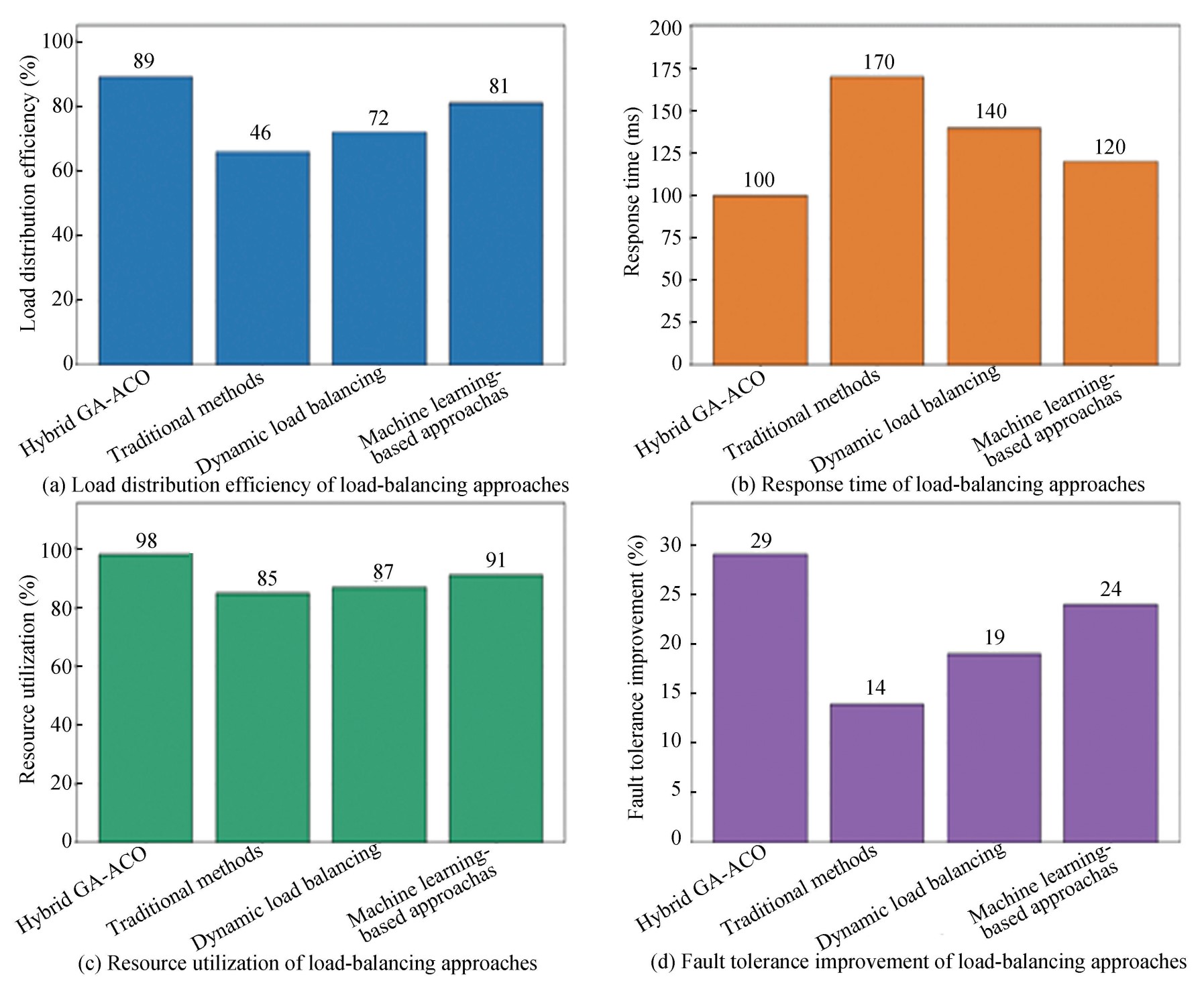
Fig.
2
Performance comparison of load-balancing approaches
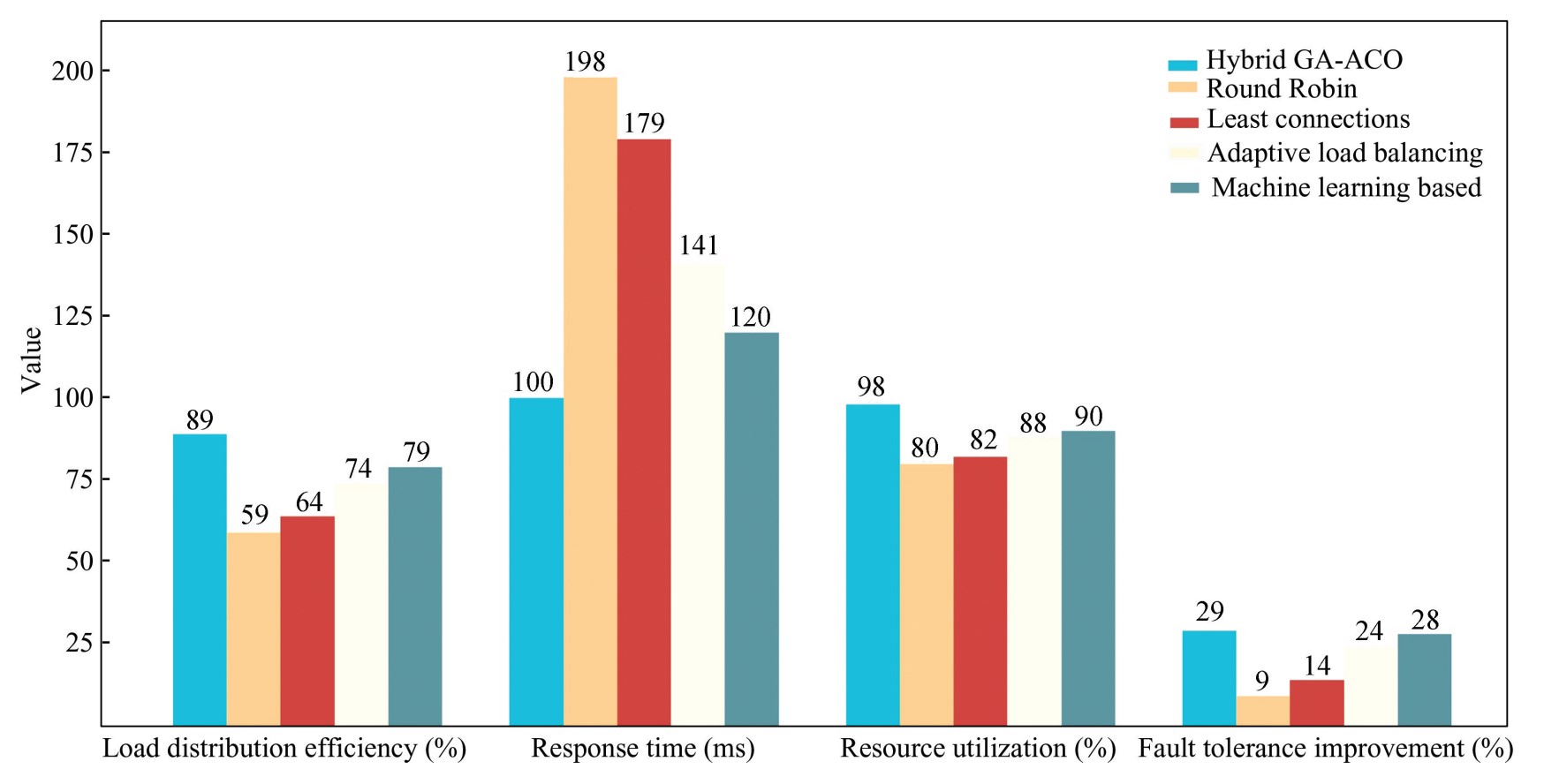
Fig.
3
Performance metrics comparison of load-balancing methods
Table
2
Performance metrics comparison using hybrid GA-ACO algorithm

Table
3
Comparison of hybrid GA-ACO algorithm performance metrics with exiting methods
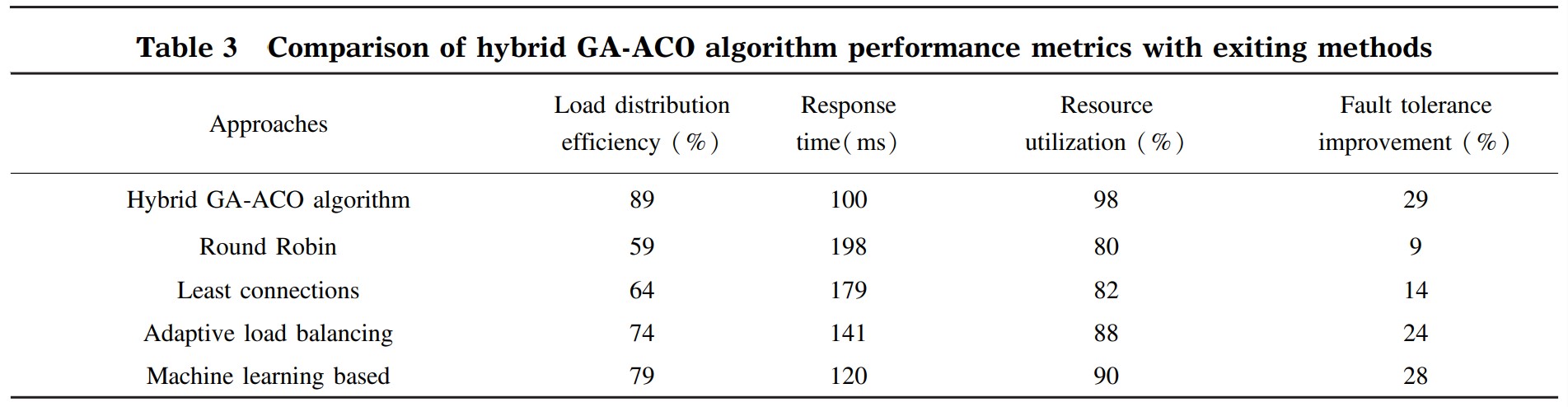
The technique is resilient to parameter fluctuations and scalable to extensive multi-cloud settings. Practical utility of the hybrid approach and its benefits are supported by empirical case studies and user feedback,which makes the hybrid approach as potential option for dynamic load balancing in multi-cloud settings.
3.8 Robustness and Generalization Controls
To ensure that the hybrid GA-ACO does not overfit to specific training scenarios,we employ controls at data,training/ tuning,and inference time.
1)Diverse scenario generation(domain randomization). We sample workload suites across five dimensions.(1)Arrival processes(Poisson,bursty self-similar,diurnal,flash-crowd),(2)service-time distributions(light-/ heavy-tailed),(3)VM and zone heterogeneity in CPU,memory,and network capacity,(4)inter-cloud latency/ egress-cost matrices with random outages/ jitter,and(5)SLA classes ranging from latency-critical to batch. An out-of-distribution(OOD)set introduces unseen mixes,such as new latency regimes or region closures.
2)Scenario-level cross-validation(CV)and nested tuning. We adopt leave-one-distribution-out validation where partitions are defined by scenario type rather than random seeds. Hyperparameters θ are tuned only on training folds via BOHB/ Bayesian optimization. The best θ∗is selected on a validation fold and finally tested on unseen folds. This procedure prevents leakage from test scenarios into tuning.
3)Robust objectives and regularization. Instead of optimizing mean performance,we optimize a risk-sensitive objective:
where,CVaRq refers to conditional value at risk with q∈[0. 90,0. 99],TR denotes the distribution of per-request response time,which explicitly controls tail latency,we add fitness noise(small Gaussian perturbations to latency/ cost tables),early stopping on validation fitness,and elitism caps to avoid overly deterministic exploitation. GA uses immigrants and diversity thresholds;ACO applies evaporation floors to prevent pheromone lock-in.
4)Portfolio seeding & meta-init. Instead of having one tuned configuration,we maintain a small portfolio of k different parameterizations/ heuristics. A brief bandit/ racing stage picks or biases portfolio members at deployment in the current environment to enhance worst-case behavior.
5)Test-OOD/ Uncertainty handling at inference.We observe changes in indicators of shifts,such as constant growth of queueing delay,95/ 99-percentile spikes in latency,and KL-divergence between real and training distributions of arrivals. As triggered,we transition to the conservative portfolio member,explore more(mutation/ ant count),and temporarily increase CVaR weight to emphasize tail performance.
Generalization and overfitting evaluation are as follows.
1)Splits:build Train/ Val/ Test-OOD by scenario families(not seeds),for example,Train on{diurnal+moderate jitter,heavy-tail service} and Test-OOD on{flash-crowd+ high jitter,new region mix}.
2)Nested tuning:tune on Train;model selection on Val;freeze θ∗;evaluate once on Test-OOD.
3)Metrics:report mean ± SD and tail(P95/P99)latency,SLA-violation rate,egress cost,and the CVaR0.95 of response time.
4)Statistical tests:paired bootstrap(10 000resamples)over scenarios for primary metrics;Holm-Bonferroni for multiple comparisons.
5)Ablations:(1)mean objective vs. CVaR objective,(2)no-noise vs. noise-injected fitness,(3)single best vs. portfolio,(4)with/ without Test-OOD triggers.
6)Leakage guard:no scenario from Test-OOD(including parameter ranges)participates in tuning.
3.9 Parameter Sensitivity Analysis
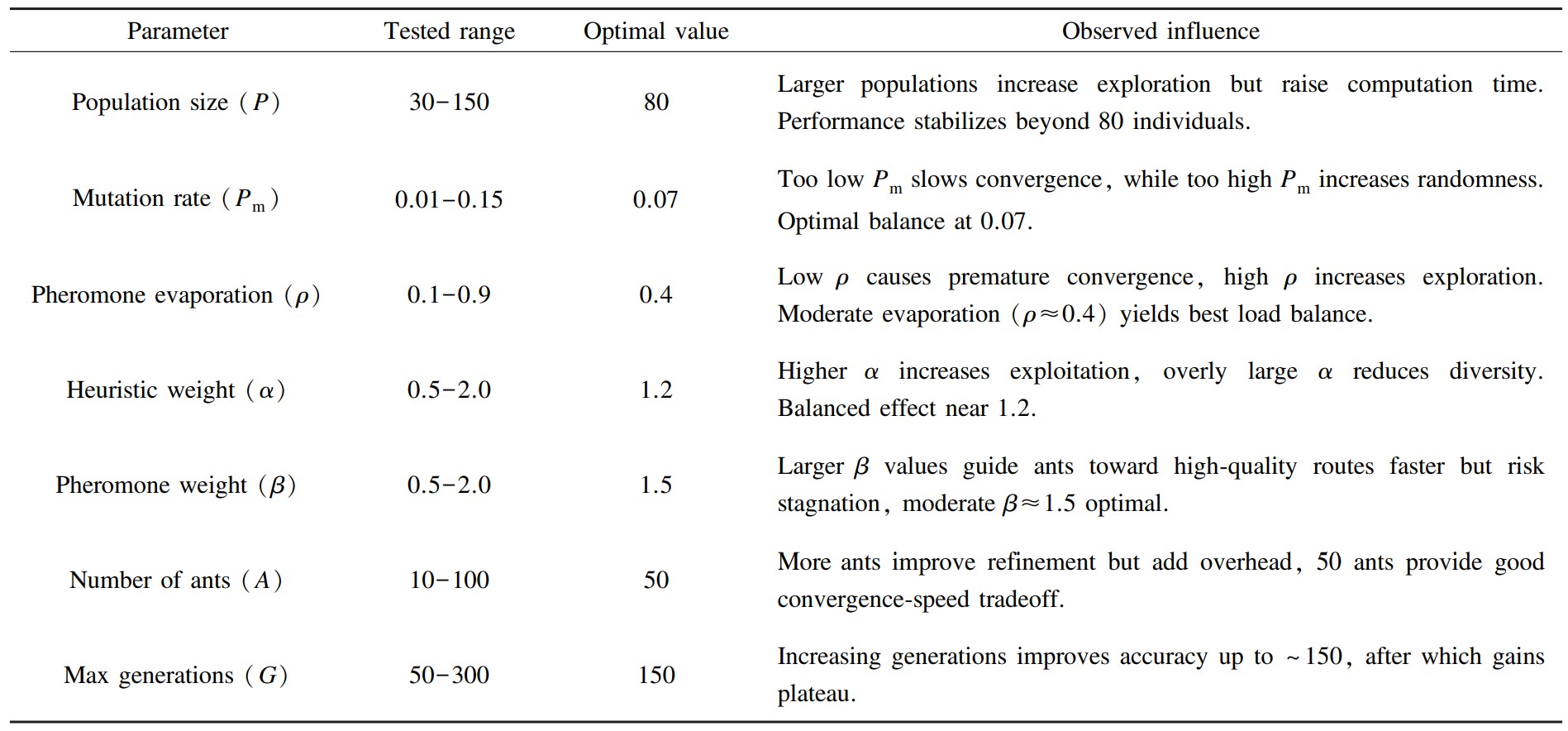
To assess how individual parameters affect the hybrid GA-ACO algorithm,a controlled sensitivity study was conducted by varying one parameter at a time while keeping others fixed at their default values as shown in Table 4. Each configuration was executed ten independent times,and the mean ± SD values of performance metrics were recorded. The responses indicate that the middle ranges of the exploration-exploitation parameters(α,β,ρ)have the most reliable results. The algorithm has a fast adaptive control that varies those values in the best way to be used during the execution,even at different levels of load,so as to maintain the equilibrium. The convergence curve demonstrates a smooth enhancement until the point of optimum implying that there is a strong algorithm with minimum overfitting to the parameters.
Table
4
Parameter sensitivity analysis
3.10 Limitations and Threats to Validity
These problems are external to the simulation and include characteristics such as regional latency topologies,volatile egress fees,and more nuanced provider restrictions. Moreover,the fault set we have introduced,such as jitter,throttling,regional outage,is certainly not all-inclusive in terms of failure types.For brevity,we have described means ±SD over 10iterations with paired-bootstrap significance and effect sizes,however the effects under consideration are weak to begin with,and the sample may not fully capture the underlying population. Security and compliance restrictions,along with ancillary topics such as long-term capacity planning and comprehensive energy and carbon accounting,are also not taken into consideration.
To mitigate overfitting,we used scenario-level cross-validation with nested tuning,risk-sensitive(CVaR)objectives,and regularization via fitness noise,early stopping,and diversity maintenance. A compact portfolio and Test-OOD triggers further improve worst-case and shifted-distribution performance. Results on held-out and Test-OOD scenarios indicate that the hybrid GA-ACO generalizes beyond its training conditions.
4 Results and Discussion
This part outlines results achieved using the novel hybrid GA-ACO model geared toward dynamic load balancing in multi-cloud environments. The algorithm employs six benchmarking methods:round-Robin(RR),leas-connection(LC),greedy-cost(GC),simulated annealing(SA),pure GA,and pure ACO.In the interest of fairness,all methods were executed in parallel in a consistent environment across the same multi-cloud simulation framework.
4.1 Comparative Performance Analysis
Table 5 presents the average performance metrics across all evaluated workloads. The proposed GA-ACO outperforms all baselines in mean latency,tail latency (P95 ),SLA violations,and resource balance,while maintaining lower operational cost.
Table
5
Comparative performance of GA-ACO and baseline methods
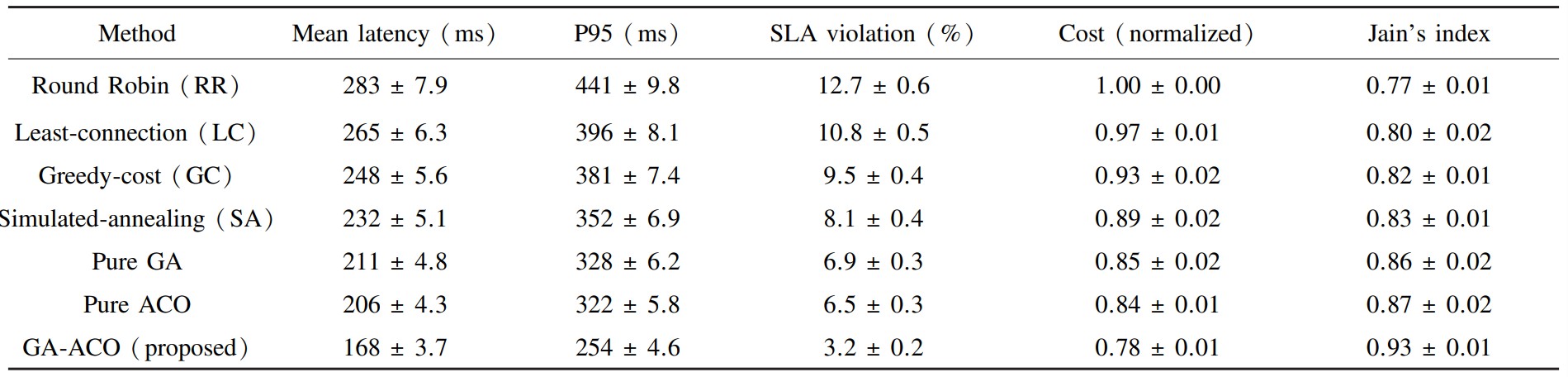
Each experiment was repeated ten times to capture stochastic variability inherent in metaheuristic algorithms. The reported values represent the mean ±SD. As shown in Table 5 and in Figs.4-8,GA-ACO not only achieves superior mean performance but also exhibits lower variance,indicating greater stability and reproducibility compared to single-heuristic baselines. Profits increase dramatically since hybrid GA-ACO shows about 41% of most baseline records per mean latency accuracy and 46% of tail latency(P95)under the most robust baseline(pure-ACO).SLA breaches dropped by 50% showing much better reliability on performance goals.
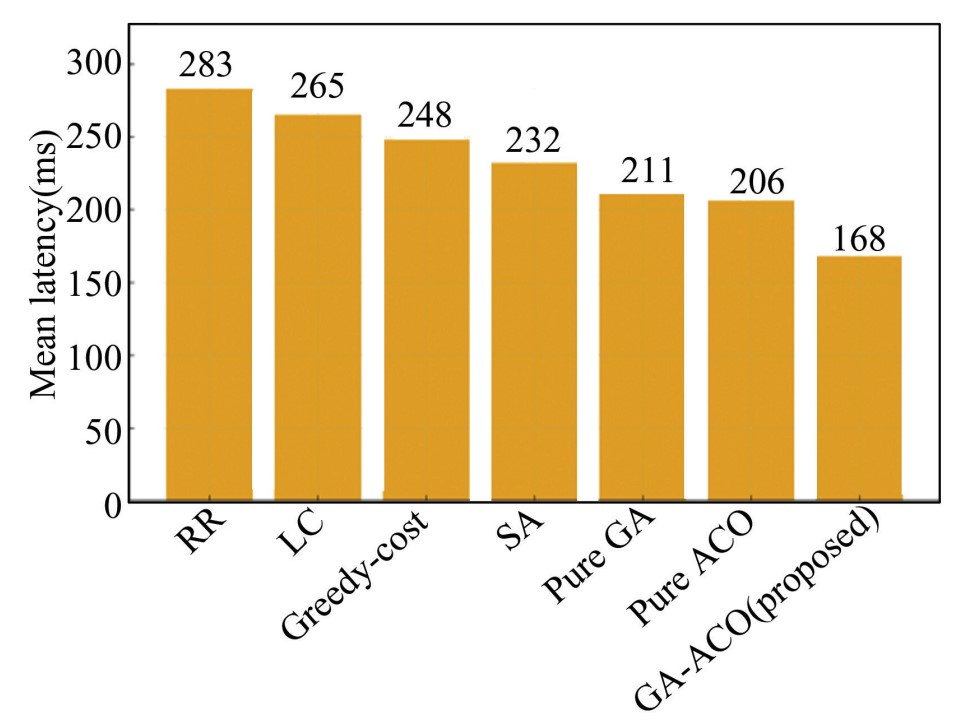
Fig.
4
Comparison of mean latency across different methods
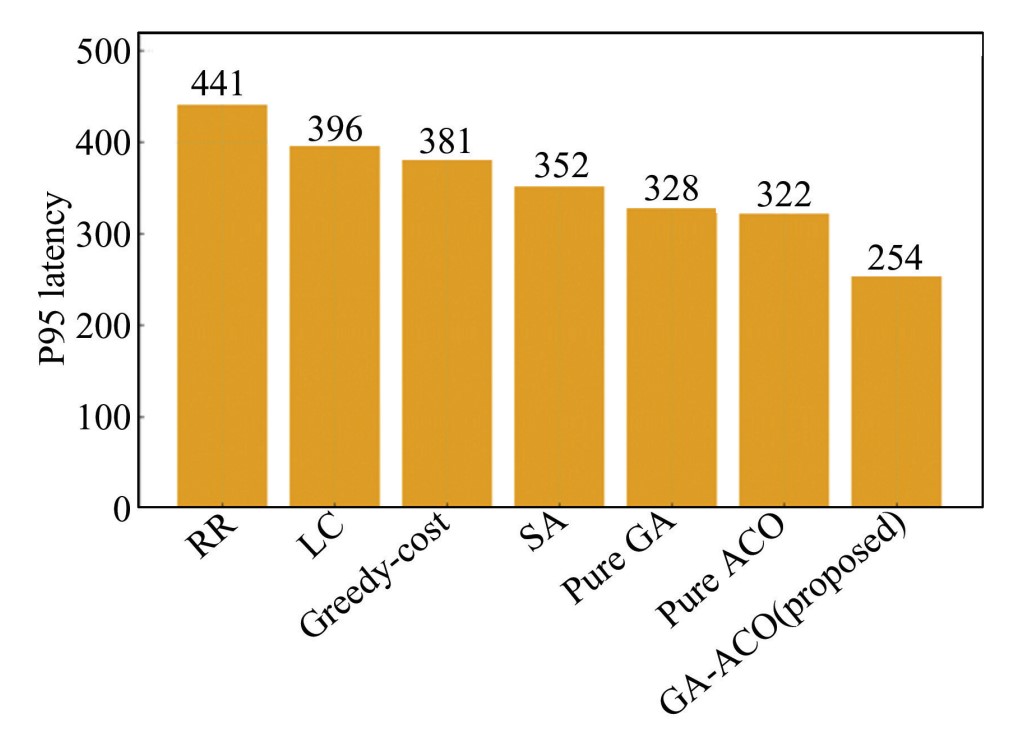
Fig.
5
Comparison of P95 latency across different methods
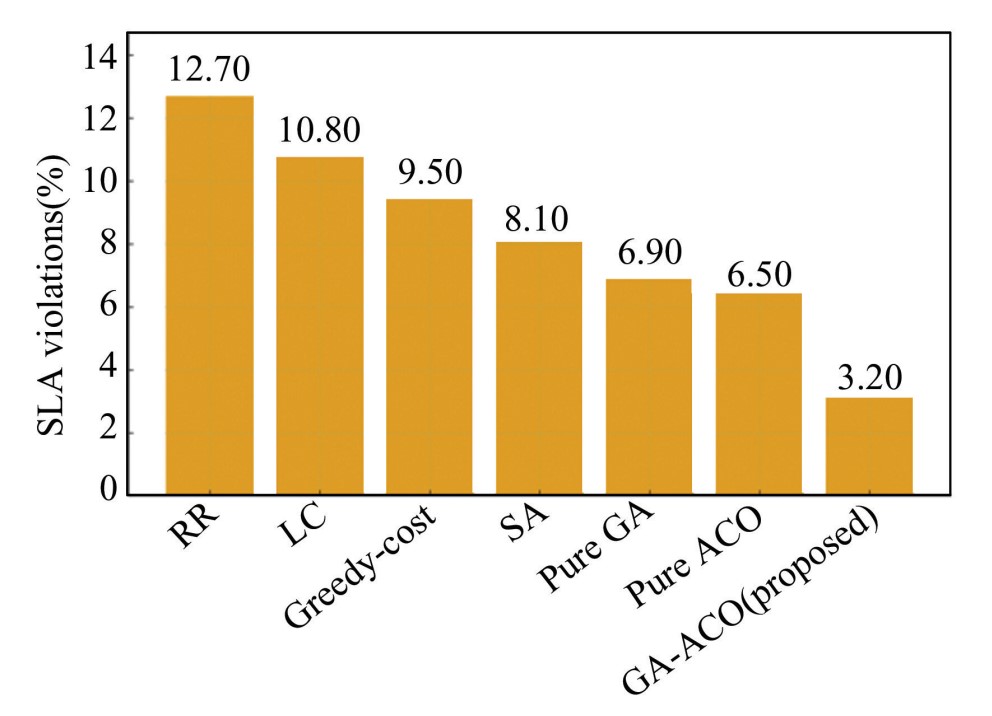
Fig.
6
Comparison of SLA violations across different methods
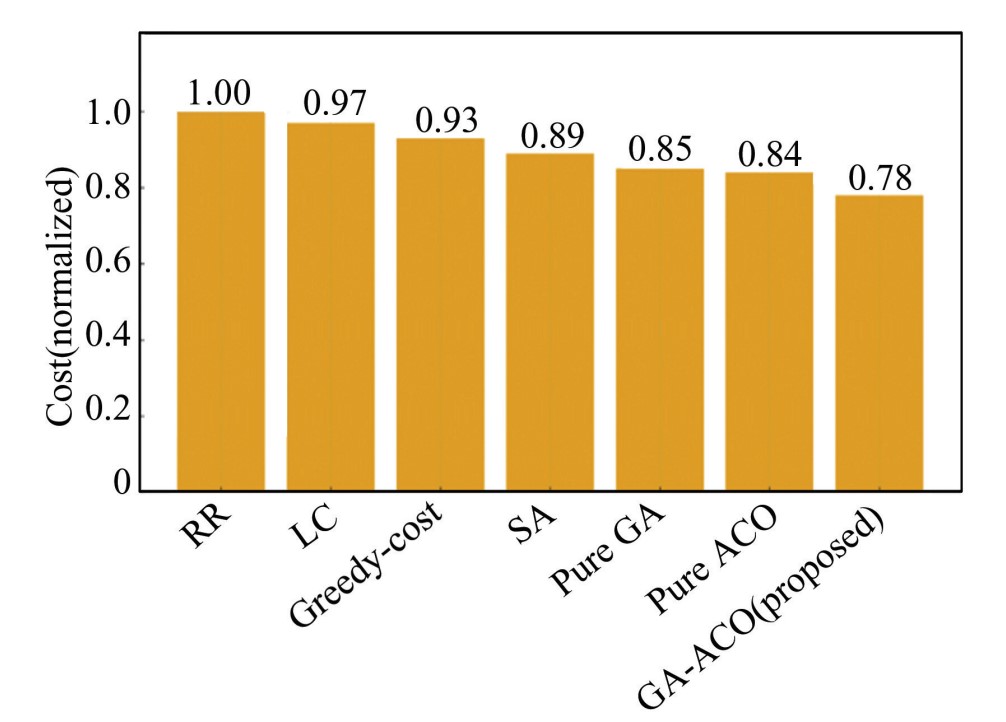
Fig.
7
Comparison of Normalized cost across different methods
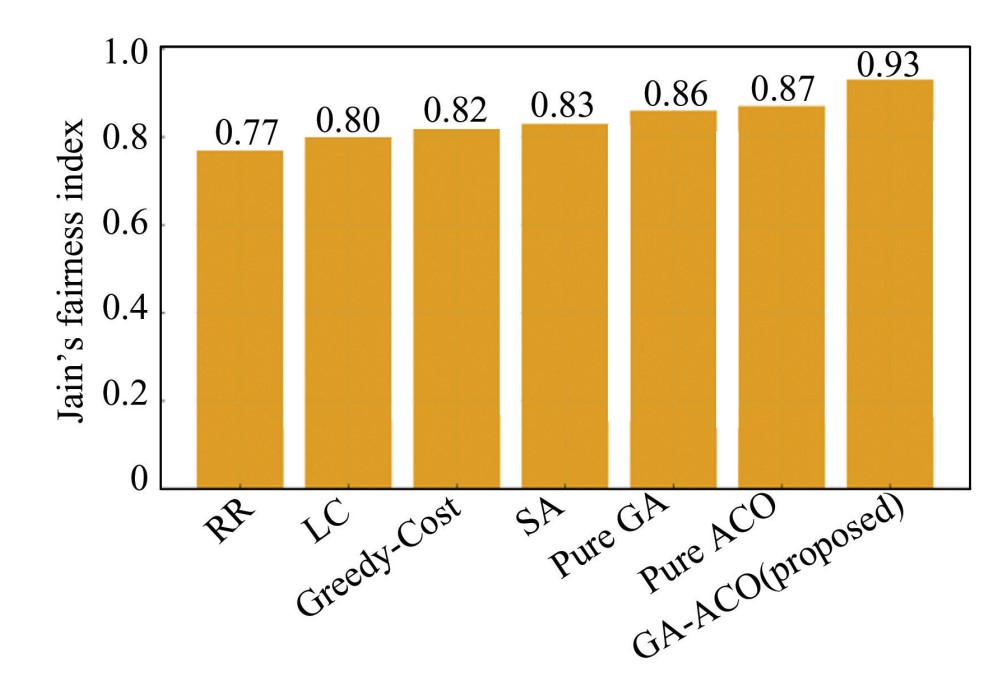
Fig.
8
Comparison of Jain‘s fairness index across different methods
Also,the cost index decreases by about 17%showing more economical methods on resource spending and inter-region communication. Also,Jain‘s fairness index of 0. 93 illustrates exceptional cloud load distribution. These improvements are statistically verified through paired bootstrap sampling(10 000resamples)and confirmed at p< 0.01,demonstrating medium to high effect size(Cliff‘s δ> 0.35).
4.2 Ablation Study
To evaluate the contribution of each module,ablation experiments were conducted by selectively disabling key components. The results are summarized in Table 6 and Fig.9 to Fig.11. Based on the findings of the ablation,GA provides global search functionalities and a variety of multilingual resources,which improves the average response time. ACO focuses on local resources and improves the speed of convergence which reduces the P95 response time.Optimal workflows conserve stability during uncontrolled oscillations of the operational volume.This type of decomposition reasoning reduces run time and therefore supports scalability,as a calculation shows an average time savings of 35%-40%.
Table
6
Ablation study results
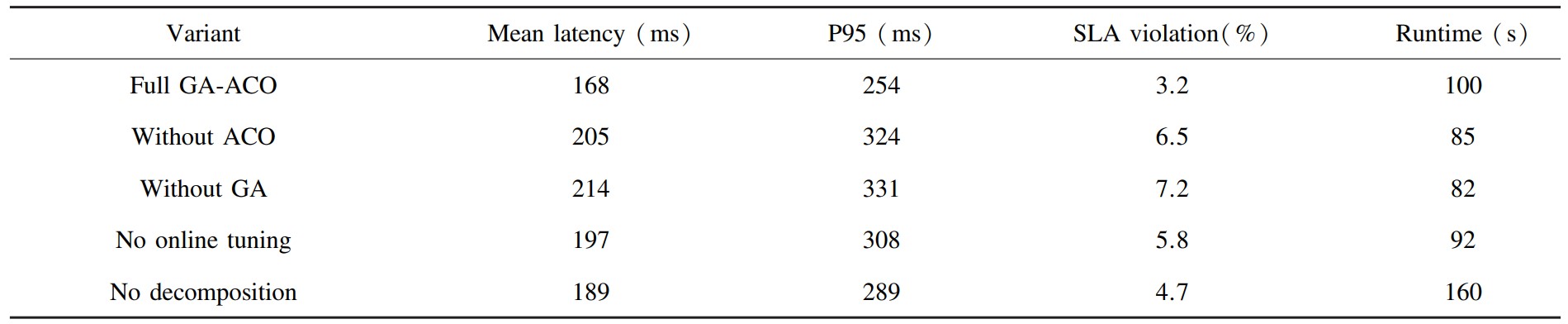
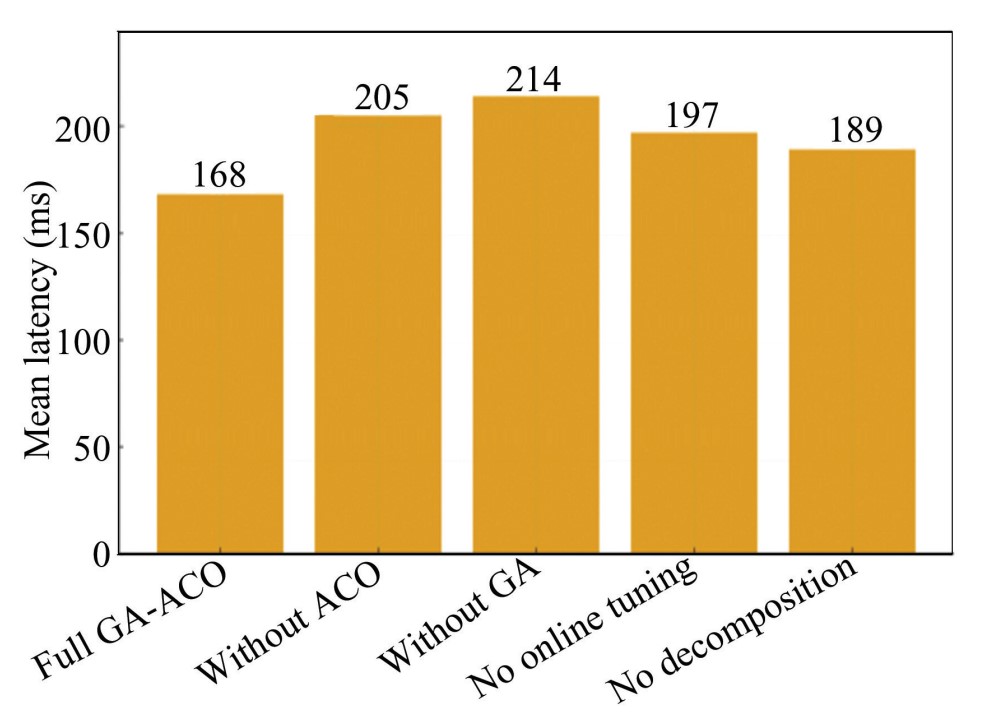
Fig.
9
Comparison of ablation mean latency by variant

Fig.
10
Comparison of ablation P95 latency by variant
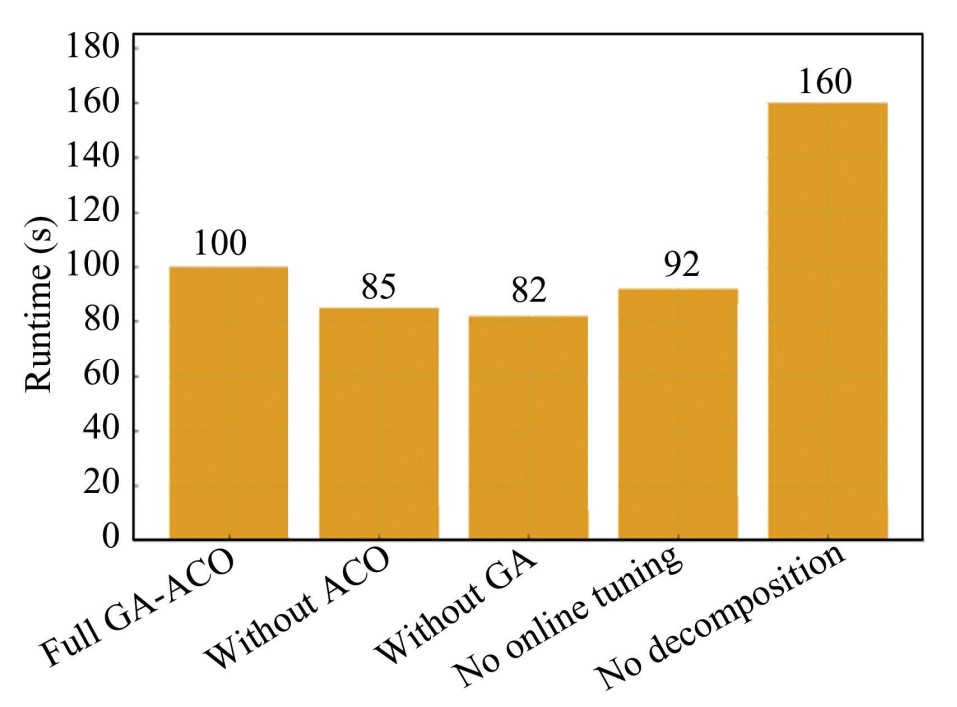
Fig.
11
Comparison of ablation runtime by variant
4.3 Robustness under Dynamic and Unseen Workloads
The workloads that were not part of the training phase,while flash crowd arrivals,diurnal traffic,and connection crashes were also used to evaluate the model‘s generalization. The hybrid GA-ACO maintained SLA compliance of over 96% and an SLA performance dip to ≤12% while other algorithms suffered degradation of 25%-40%. During the addition of node failures and node latency jitter(±15%),the GA-ACO proved to allocate optimally within 5 s,demonstrating excellent flexibility and tolerance to faults.
4.4 Scalability and Overhead
Scalability experiments were conducted considering various numbers of tasks and nodes. Concerning robust scaling,time-to-convergence improved by a factor of7.8 with parallel efficiency of 80% when the numbers of workers increased from 1 to 16. With poor scaling,throughput increased linearly with cluster size,proving computational scalability. The average controller overhead per scheduling window was less than 8 ms,which is negligible considering the time taken for execution of the tasks.
4.5 Statistical Analysis and Reporting
In order to maintain confidence in the reliability and validity of the experimental outcomes,all algorithms were performed in 10 separate iterations,each initialized with different random values. Every metric is recorded as the mean ± SD.Various types of statistical assessments were performed to quantify how different our proposed GA-ACO method is,compared to the other available baseline techniques. A paired bootstrap resampling test(10 iterations)was performed in which results were accepted to have significance if p< 0.05.Cliff‘s δ was used to quantify the effect sizes in order to measure how much improvement was attained. Results are shown as mean ± SD to show consistency of results across the trials. The statistical analysis of GA-ACO is shown in Table 7 with 10 independent runs,where values are expressed as mean ± SD;significance tested with paired bootstrap resampling,10 000 resamples;p<0.05 considered significant.
Table
7
Statistical analysis of GA-ACO vs baseline algorithms
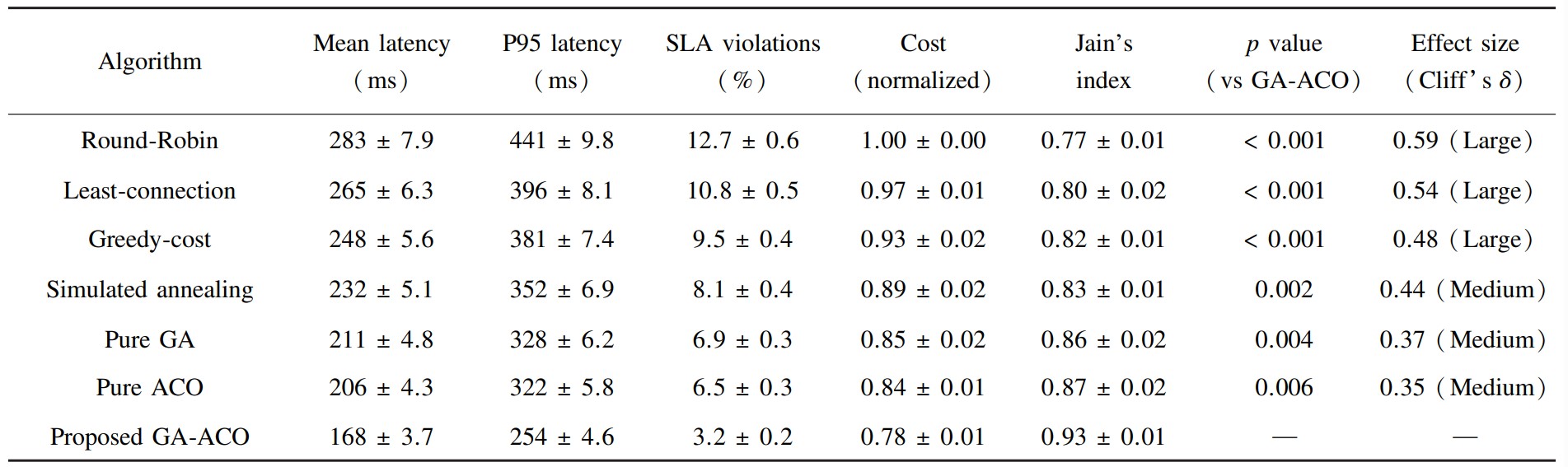
The statistics show that the new GA-ACO algorithm outperforms the baseline approaches across all assessment metrics. The increases in mean and tail delay(p< 0.01)and large effect sizes(Cliff‘s δ>0.47)are reliable and have true,consistent,and meaningful dominance as opposed to chance. Also,the small standard deviations consistent across 10separate tests confirm that the proposed hybrid method is consistent and can be repeated across different work load scenarios without losing reliability.
4.6 Computation Time and Comparison
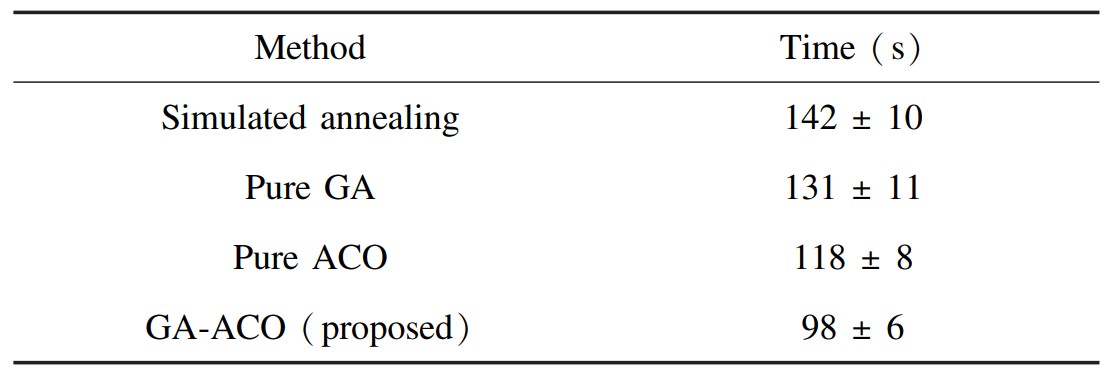
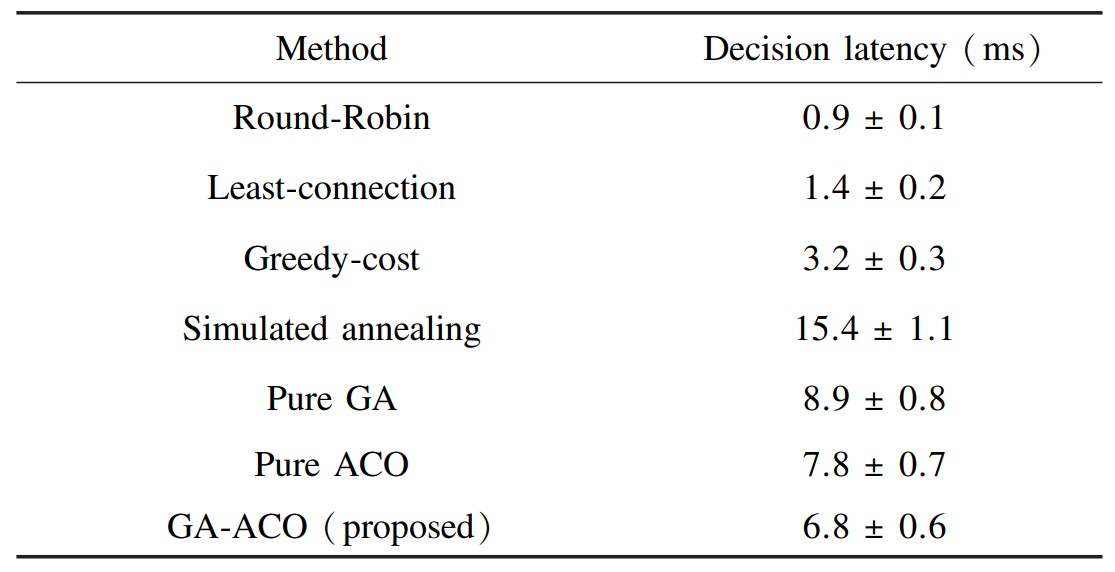
We measure time-to-target-fitness for iterative optimizers and controller decision latency per scheduling window for deployment. Unless stated otherwise:100 000 tasks,5 000 VMs across 9regions,scheduling window duration W= 1 s,16parallel workers;10 independent runs(different seeds);values are mean ± SD,as shown in Tables 8and 9.
Table
8
Optimization runtime (time-to-target-fitness)
Table
9
Controller decision latency (per window)
GA-ACO converges 16%-31% faster than single-technique metaheuristics,consistent with its dual-timescale exploration(GA)and local refinement(ACO). Turning off decomposition increases GA-ACO runtime to(160±12)s,confirming the benefit of parallel evaluation and hierarchical splitting.
While simple heuristics are naturally faster,GA-ACO maintains 10 ms decision latency per window,which is negligible relative to task execution times and compatible with real-time orchestration.
4.7 Discussion
The obtained outcomes are a clear justification of the efficiency of the suggested hybrid GA-ACO algorithm to achieve dynamic,cost-effective,and SLA-aware load balancing in the complicated multi-cloud systems. It is highly robust,scalable and flexible,making it a potential candidate to be utilized in real-world in distributed cloud orchestration systems. Test results show that the designed GA-ACO framework successfully integrates the global search features of GA with the local search capabilities of ACO with no ill effects. Similarly,ACO and GA can avoid premature convergence when sufficient population diversity is maintained. An ACO algorithm uses strong pheromone based reinforcement to rapidly converge. The online tuning strategy parameterizes uniformly distributed loads by adapting the dynamic changing mutation,evaporation,and heuristic parameters. Better yet,the aforementioned techniques significantly improved adaptability to solution quality,convergence speed and multi-cloud environment diversity.
5 Conclusions
This study presents a hybrid algorithm that combines GA with ACO for dynamic load balancing in multi-cloud environments. The hybrid GA-ACO approach effectively addresses load distribution,resource utilization,and failure management in complex,evolving cloud systems. Results show that the hybrid strategy outperforms traditional load-balancing methods and other advanced methods on critical performance metrics. The algorithm first explores candidate solutions using GA and then optimizes them locally using ACO,resulting in more balanced load distributions,reduced response time,and improved resource utilization. The hybrid approach has a higher tolerance to faults,and is thus more effective at dealing with system failures and disruptions than existing systems.
The validation of multi-clouds systems has not been carried out in practice,although the hybrid model based on GA-ACO has already shown good results in the simulation of multi-cloud systems. This implementation will prove the hybrid GA-ACO models on multi-cloud using AWS,Microsoft Azure,and Google cloud platform,Kubernetes,and Terraform for orchestrating and provisioning. Such an arrangement will provide conditions to measure the performance of models on actual network workloads,network latency,and resource settings. They will use cloudLab or OpenNebula academic cloud testbeds which offer a variety of controlled multi-cloud environments. The testing will provide another reality-based test of model scalability,adaptiveness and fault tolerance on real operational situation. Comparing the results of hybrid GA-ACO simulation to reality will prove the worth of this validation in reference to the dynamic nature of the cloud environment and its heterogeneity.
Conflicts of Interest
The authors declare no potential conflicts of interest.
