Abstract
Early and precise identification of wheat leaf diseases is crucial for sustainable crop management and yield improvement. In this study,we propose a novel hybrid framework that combines deep feature extraction (using ResNet50and VGG16)with ANOVA-driven feature selection and whale optimization algorithm (WOA)for hyperparameter tuning of support vector machine (SVM)classifiers. The dataset consists of 40 285 wheat leaf images across eight classes(seven disease types and healthy leaves),including augmented samples to address class imbalance. The analysis of variance (ANOVA)method significantly reduced dimensionality by selecting the top 500 most relevant features,while the WOA fine-tuned the SVM to enhance classification performance. The proposed model achieved an impressive accuracy of 98.1%,along with a precision of 97.9%,a recall of 98.0%,and an F1-score of 98.0% on the independent test set. A comparative analysis shows that our method outperforms several state-of-the-art (SOTA)models,including standard CNN and ensemble approaches. This study demonstrates that combining statistical feature selection and bio-inspired optimization with deep learning can substantially advance automated wheat leaf disease detection,offering promising applications for precision agriculture.
0 Introduction
Wheat(Triticum aestivum L.)represents one of the most extensively grown cereal crops worldwide and functions as the primary food source for over a third of people on the planet. The production of wheat faces serious risks from multiple foliar diseases,including leaf rust,yellow rust,powdery mildew,and septoria tritici blotch,which lead to significant yield losses unless they are detected and managed promptly[1-2]. Timely control measures and food security depend on the early and accurate detection of these diseases.
Manual inspection by experts remains the foundation of traditional disease diagnosis methods,resulting in time-consuming operations and human error-prone processes[3]. The evolution of machine learning(ML)alongside deep learning(DL)technologies has created new possibilities for automatic plant disease identification through leaf symptom image analysis[4-5]. Computational models enable these methods to detect intricate patterns in leaf images,enabling accurate disease classification across different environmental conditions.
Although there has been significant progress in wheat disease detection using deep learning and machine learning,current models still face challenges such as high computational complexity due to large feature spaces,insufficient generalization in field conditions,and limited optimization of classifier parameters. Many existing methods fail to effectively combine statistical feature selection with advanced optimization techniques,resulting in suboptimal accuracy and an increased risk of overfitting. To address these limitations,this study proposes a hybrid framework that integrates deep feature extraction,analysis of variance(ANOVA)-based feature selection for dimensionality reduction,and whale optimization algorithm(WOA)for precise hyperparameter tuning. This approach aims to enhance classification performance,improve model robustness,and achieve superior accuracy in real-world wheat leaf disease identification.
Latest research demonstrates that convolutional neural networks(CNNs),combined with transfer learning and hybrid models,achieve classification accuracies above 95%[6-7]. The combination of deep learning with methods such as feature selection and data augmentation,together with edge computing,has greatly improved system robustness and scalability[8-9]. The purpose of this research is to investigate the latest advancements in wheat leaf disease identification and classification while examining current methodologies,data sets,and tools,and suggesting possible enhancements for real-world agricultural applications. This study makes several major contributions,including the following elements:
· The study introduces an innovative hybrid framework that combines deep feature extraction capabilities of ResNet50 and VGG16 with SVM classification methods. The traditional machine learning classification strength is combined with deep learning's advanced feature representation through this hybrid method.
·The model's discriminative ability increases when ANOVA selects the top 500 most significant features from the deep feature space. This step achieves better classification accuracy and decreases computational complexity.
·The WOA enhances support vector machine(SVM)hyperparameter tuning,which increases model accuracy from 93.7% to 98.1%,thereby validating the use of nature-inspired optimization methods in agricultural diagnostics.
·The research employs advanced data augmentation methods to adress class imbalance and enhance training data diversity,resulting in improved generalization performance across multiple disease conditions and environments.
The performance of the newly developed system in accurately classifying seven wheat leaf diseases and healthy leaves demonstrates its suitability for precision agriculture and automated disease detection applications. The opening section establishes the basic context for wheat leaf disease detection and classification while demonstrating its importance for maintaining crop health and optimizing agricultural yields. Section 1 presents a thorough examination of existing research while identifying current techniques and their constraints,and explaining why the proposed method is necessary. Section 2 outlines the proposed methodology by explaining data collection processes,preprocessing steps,feature extraction methods employed,and model architecture. Section 3 evaluates the model's performance by assessing its ability to distinguish between healthy wheat leaves and various leaf diseases. The study concludes in Section 4,which summarizes the main findings and suggests future research directions.
1 Literature Review
The occurrence of wheat leaf diseases poses a significant threat to global food security,leading to reduced crop yields and quality. Effectively managing diseases requires early and precise identification of diseases. Technological advancements in machine learning(ML),deep learning(DL),and computer vision have transformed how researchers identify plant diseases. Although prior studies have explored various combinations of deep learning,machine learning,and data augmentation techniques for wheat disease detection,a significant gap remains in designing a fully integrated hybrid pipeline that systematically addresses both feature dimensionality and classifier optimization. Existing methods typically rely on either raw deep features or manually selected features without applying statistical methods like ANOVA to ensure that only the most discriminative features are retained. Moreover,while some works optimize classifiers using conventional grid search or random search,the potential of metaheuristic algorithms such as the WOA for precise hyperparameter tuning remains largely unexplored in this context. This study bridges these gaps by proposing a novel pipeline that uniquely combines deep feature extraction from ResNet50 and VGG16,ANOVA-based feature selection,and WOA-driven SVM optimization—resulting in improved accuracy,reduced computational complexity,and enhanced robustness for practical wheat leaf disease classification.
Kaur and Oberoi[10]established an automated detection system for wheat diseases through image processing techniques that used K-means clustering for segmentation along with SVM for classification of rust,powdery mildew,and leaf blotch diseases in RGB images,and achieved 80. 02% accuracy with1200 field images,demonstrating its utility in early disease detection. Singh and Misra[11]used texture and color features to identify wheat diseases by extracting GLCM texture features and color histograms prior to classification using SVM with an RBF kernel,achieving an 86.7% accuracy rate in distinguishing healthy leaves from two disease types and the highest accuracy of 88.3% for detecting rust. Barbedo[12]performed an extensive analysis of how image quality affects disease detection through different segmentation methods on 5 000 plant images,concluding that controlled lighting enhanced accuracy by 12%-15%,with optimized thresholding producing the top results at 91.3%. Picon et al.[13]developed a deployable wheat disease diagnostic system based on random forest and hyperspectral imaging(400-1 000 nm)with 20 vegetation indices,which reached92.4% classification accuracy across five diseases and provided exceptional early rust detection at 94. 1%accuracy. Kaur et al.[14]demonstrated that combining SVM and KNN with Gabor filter feature extraction yielded hybrid machine learning models that achieved90.5% accuracy and outperformed individual models by 4%-6% using a dataset of 3 500 images. Zhang et al.[15]developed an ensemble of random forest and XGBoost enhanced with data augmentation techniques,achieving 93. 8% accuracy and 8% better consistency across various growth stages compared to single models. Mohanty et al.[16]tested deep learning models,such as AlexNet and GoogleNet,using the PlantVillage dataset and found that GoogleNet achieved 95.3% accuracy across 14 different crop diseases,including wheat,and demonstrated 96. 1%specificity for wheat rust detection. Ferentinos[17]compared CNN architectures for disease diagnosis using VGG16,ResNet50,and InceptionV3 on a dataset of 58 000 plant images and discovered that ResNet50 achieved the highest laboratory performance at 99.53%,while its field performance reduced to87.2% because of environmental factors. Singh et al.[18]demonstrated strong clinical relevance by optimizing CNN architecture for wheat rust detection through modifications to VGG16 with extra convolutional layers,achieving 86.53% accuracy on field images and 97.8% recall in severe infection cases. Agarwal et al.[19]demonstrated how EfficientNet-B4 fine-tuning with transfer learning methods produced a wheat disease classification model that achieved 97.8% accuracy,while reducing parameter count by 40% compared to ResNet50,and showed substantial efficiency enhancements. Usman et al.[20] marked the first application of vision transformers in agriculture,utilizing ViT-B/ 16 on wheat disease datasets,which achieved 98.00%accuracy and outperformed conventional CNNs by2.1% during comprehensive cross-dataset validation studies. Wang et al.[21]demonstrated that Swin transformer(Swin-T)architectures surpassed ViT models in disease recognition through Swin-T model training on multi-spectral wheat images to achieve98.1% accuracy and 30% faster inference speeds,thus showing computational and accuracy benefits. Sethy et al.[22]developed a MobileNetV2-based lightweight CNN solution for disease detection,utilizing pruning techniques.Their application reached 94.2% accuracy with 200 ms inference times on regular smartphones to enable field use. Jiang and Tong[23]optimized MobileNetV3 for real-time field deployment through depth-wise separable convolutions,achieving 98.31%accuracy with 2.3 million parameters,thus making it ideal for resource-limited edge devices. Thomas et al.[24]significantly improved disease detection by applying hyperspectral imaging through 3D-CNN architectures to analyze 25 spectral bands(450-950 nm),enabling detection of diseases 5-7 days before visual symptoms with 96.5% accuracy. Zhao et al.[25]demonstrated that large-scale agricultural disease monitoring systems based on UAV-mounted multi-spectral cameras with 5 bands and YOLOv5 detection algorithms reached a mean average precision of94.10% across 0.5 km²/ h,demonstrating outstanding scalability for commercial farming applications. Xu et al.[26]examined dataset requirements for deep learning models by training CNNs with different dataset sizes and determined that at least 1 500 images per class were essential to attain over 90% accuracy in agricultural applications. Arrieta et al.[27]enhanced model transparency for agricultural AI systems by fusing Grad-CAM methods with EfficientNet models to achieve a 37% rise in farmers' trust and sustain96.2% classification accuracy,thus linking technical effectiveness with practical implementation. Gulzar et al.[28]conducted a comprehensive comparative analysis of multiple transfer learning models(including popular CNN architectures)to identify the most effective approach for sunflower leaf disease classification. They systematically evaluated and fine-tuned these pre-trained networks on a curated sunflower disease dataset,measuring performance across metrics such as accuracy,precision,and recall.The study highlighted how transfer learning can significantly improve detection accuracy even with limited data and demonstrated which specific architectures are better suited for this task. Seelwal et al.[29]proposed an extensive and structured review of recent deep learning techniques applied to rice disease detection,categorizing approaches based on model architectures,feature extraction strategies,and data augmentation methods. They critically analyzed the strengths and limitations of these methods,identified key challenges such as dataset scarcity,class imbalance,and a lack of explainability,and outlined emerging trends,including the use of lightweight models and edge computing. Gulzar and Unal[30]developed and introduced PlmNet,a specialized deep learning architecture enhanced with transfer learning,to detect bruises in plums at different stages shortly after damage occurs. By designing the model to be sensitive to the progression of bruising over time,they addressed the challenge of early,near-real-time detection,which is crucial for quality control in supply chains. The study demonstrated that PlmNet outperforms standard CNN models in both accuracy and timing,highlighting its potential for deployment in automated sorting systems and reducing post-harvest losses. A summary of recent research on wheat disease detection using image processing and deep learning techniques is illustrated in Table1.
Table
1
Summary of recent research on wheat disease detection using image processing and deep learning techniques
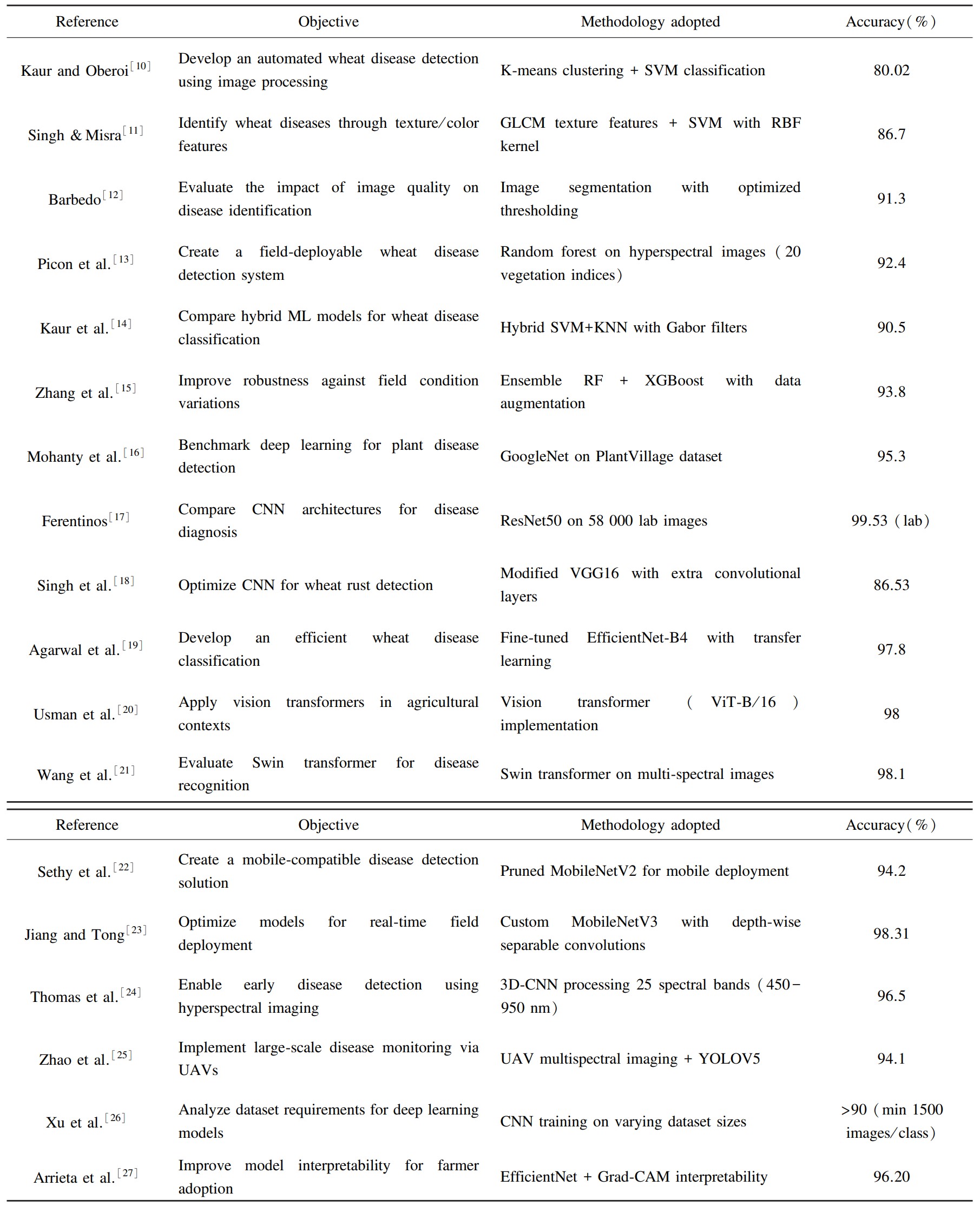
The study represents a breakthrough in wheat disease classification through a unique hybrid framework that combines deep learning with machine learning techniques to overcome existing methodological limitations. The proposed methodology advances over previous research by integrating deep feature extraction through ResNet50 and VGG16 with SVM's optimized classification capabilities.
2 Material and Methodology
2.1 Dataset
A comprehensive image dataset of wheat leaves was compiled,comprising both original and augmented images representing 8 distinct classes:the wheat leaf image dataset consists of 8 different categories,namely black rust,brown rust,leaf blight,mildew,septoria,tan spot,yellow rust,and healthy leaves,as shown in Fig. 1. The original dataset features highquality images of wheat leaves affected by disease,as well as healthy wheat leaf images captured in real field conditions using a smartphone camera with an average resolution of1 024 × 768 pixels,under natural daylight to capture realistic variability.
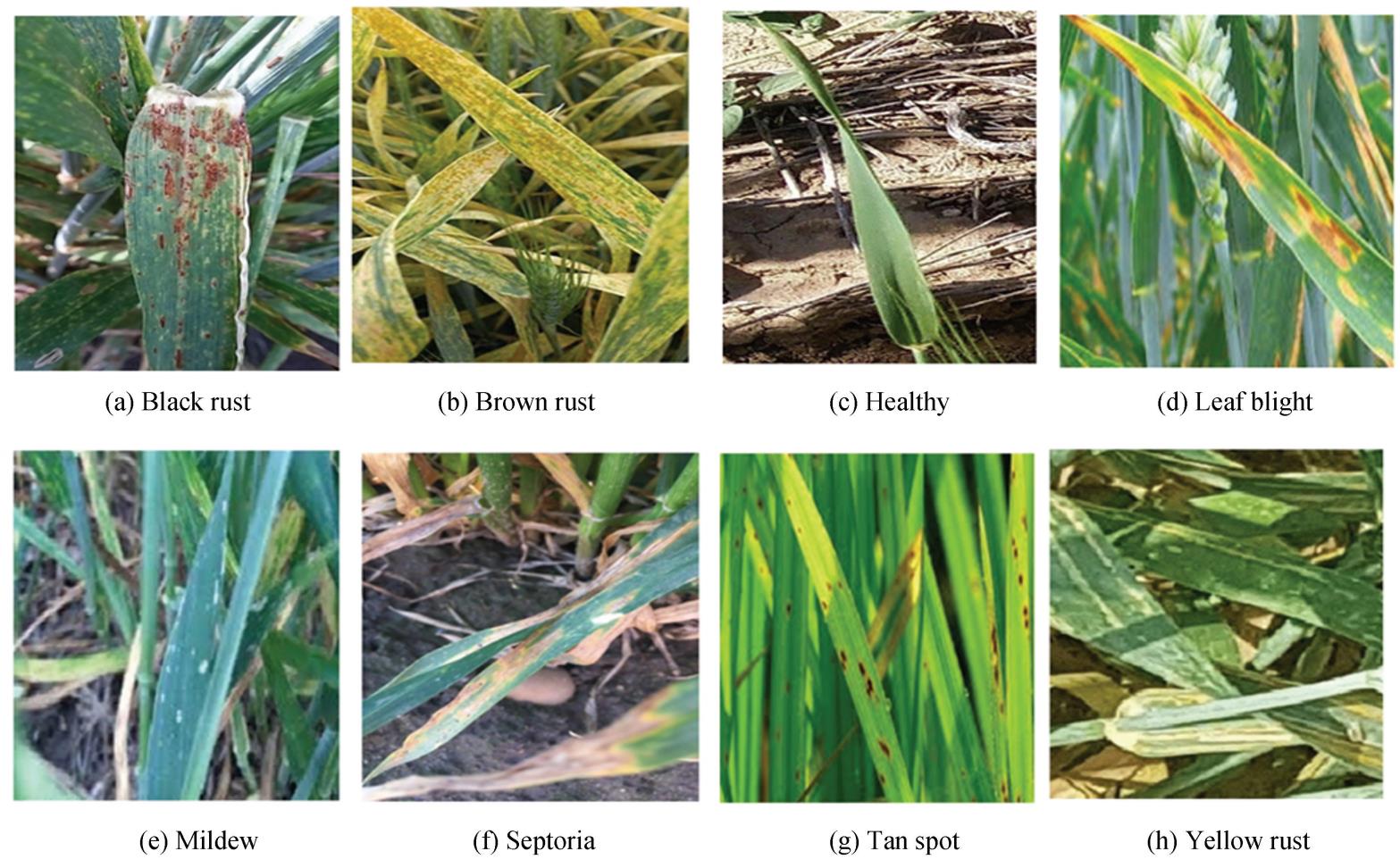
Fig.
1
Sample of wheat leaf images
The approach to balancing classes and diversifying features included comprehensive data augmentation methods,including rotation,flipping,scaling,contrast adjustment,and cropping. The methodology expanded the sample size for each class,resulting in better model generalization during training. The dataset was separated into two components:training/ validation sets and a testing set.The training and validation process utilized 85%–90% of images from each class,while 10%–15% of images were set aside as an independent test set for performance evaluation on unseen data. The dataset consisted of 36 565 images for training and validation purposes,and 3 720 separate images for testing purposes,as shown in Table 2.
This balanced and diverse dataset ensures robust model training,effective disease classification,and high accuracy in real-time applications for precision agriculture.
2.2 Methodology
This research introduces a hybrid framework that combines deep learning and machine learning methods to detect and categorize wheat leaf diseases.Researchers initially gather a dataset of wheat leaf images containing both healthy and diseased leaf specimens. For input data standardization,each image underwent resizing and normalization before being augmented through rotation,flipping,and scaling.The preprocessing procedures expand the dataset's volume and diversity,while also addressing the problem of class imbalance. The processed data is divided into training,validation,and test sets to ensure that the model evaluation remains unbiased and achieves good generalization. Fig. 2 illustrates a schematic block diagram with 3 approaches of classification for wheat disease identification.
Table
2
Detailed distribution of dataset
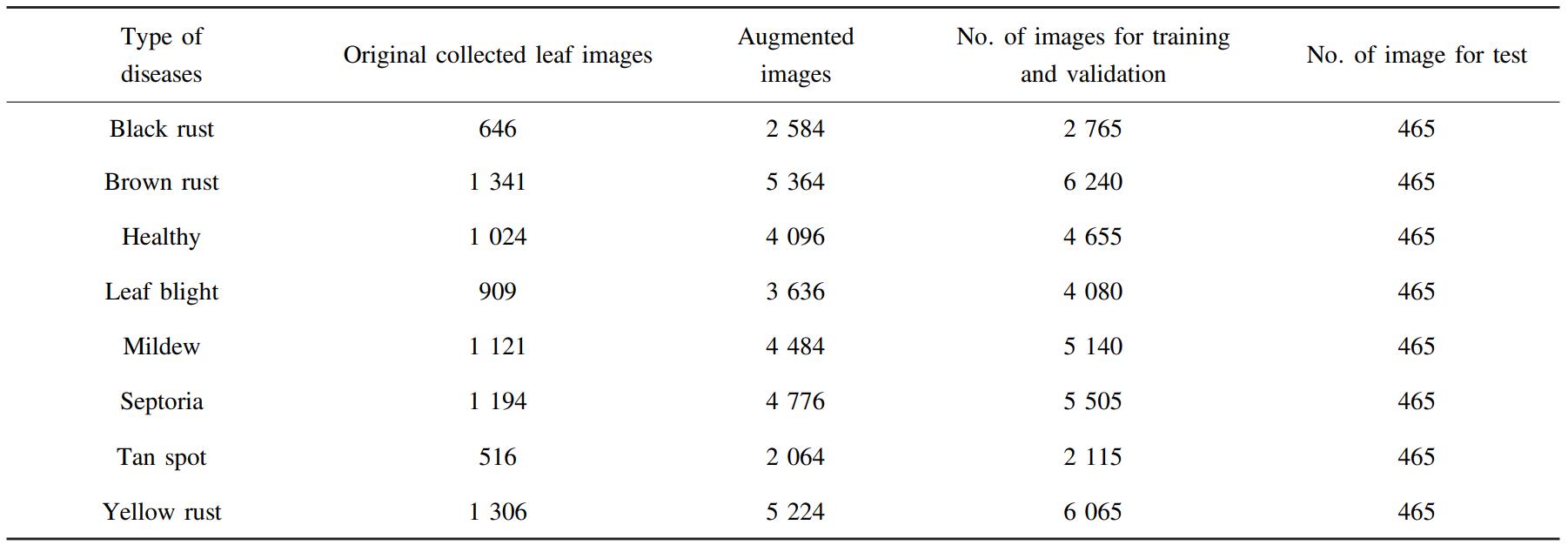
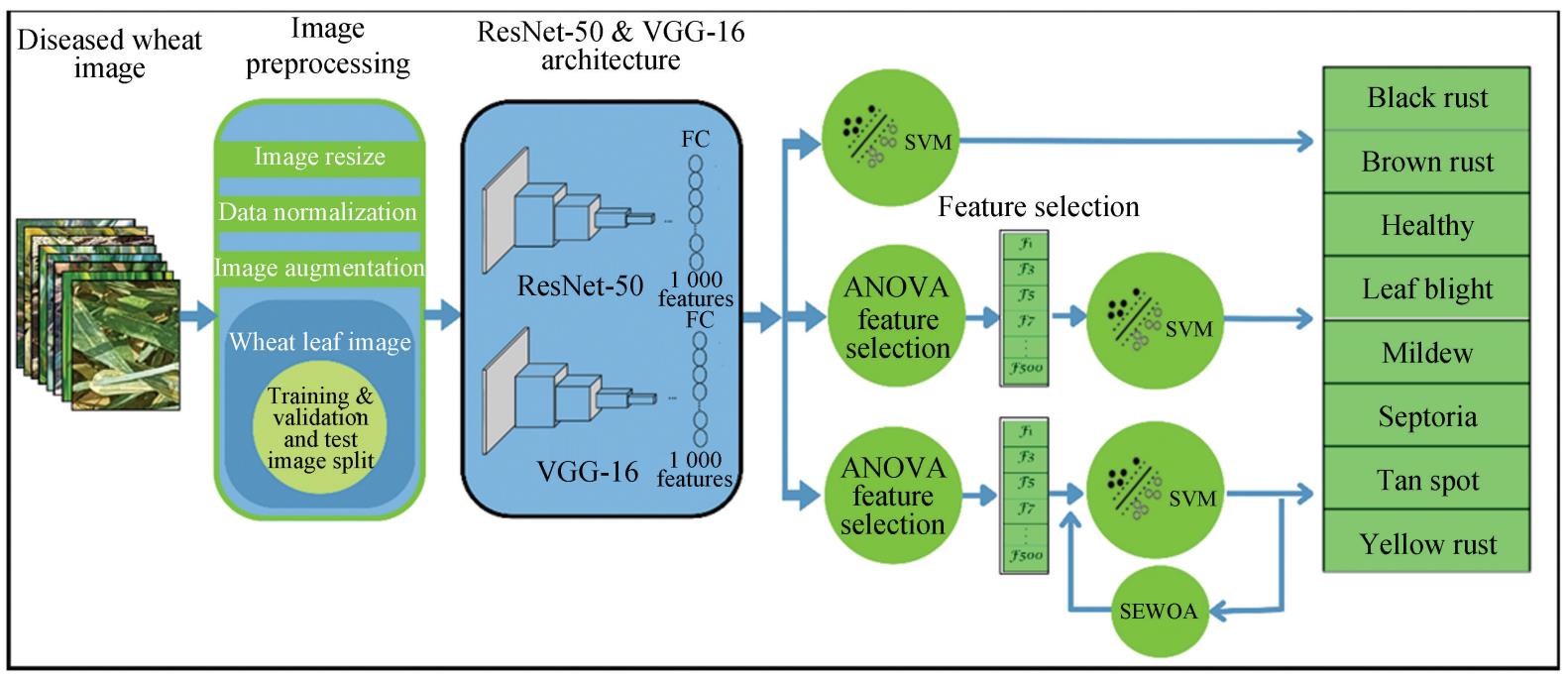
Fig.
2
Schematic block diagram with 3 approaches of classification for wheat disease identification
Two established CNNs,ResNet-50 and VGG-16,perform deep feature extraction after image preprocessing. The feature vectors extracted from ResNet50 and VGG16 are concatenated(fused)into a single combined feature vector before proceeding to the feature selection stage. This fusion was chosen to leverage the complementary strengths of both networks:ResNet50's deeper residual connections and VGG16's simpler,uniform architecture,thereby enriching the representation of leaf disease patterns.The SVM achievs a baseline accuracy of 80. 3% in classifiying the extracted features. ANOVA serves to boost classifier discrimination while minimizing feature space dimensionality. ANOVA determines the statistical importance of features to select the top 500most relevant ones for additional analysis. The choice of selecting the top 500 features using ANOVA was determined empirically through a validation process.We experimented with several feature set sizes(e.g.,300,500,800)and observed that 500 features provided the best trade-off between model accuracy and computational efficiency. Selecting fewer features(e.g.,300)led to a slight drop in accuracy,while including more(e. g.,800)increased computational cost without significant accuracy improvement. The choice was thus based on validation experiments aimed at optimizing both performance and efficiency.
The SVM achieves superior classification performance through fine-tuning with the WOA,which effectively searches for optimal hyperparameters. The optimization process boosts the model's accuracy level up to 98.1%. The final model shows high accuracy in differentiating among 7 wheat leaf diseases,including black rust,brown rust,leaf blight,mildew,septoria,tan spot,yellow rust,and healthy leaves. The combination of deep feature extraction,statistical feature selection,and metaheuristic optimization in this methodological pipeline delivers a highly efficient solution for early disease detection and agricultural precision optimization.
2.2.1 ANOVA feature selection technique
The ANOVA technique serves as a statistical approach to identify important features from the 1 000features of the ResNet-50 and VGG16 CNN models extracted for wheat leaf disease classification. The feature selection process starts by determining the F-statistic for each feature to assess the ratio between between-class variance and within-class variance.𝑆between measures the variation of feature values between healthy leaves and 7 different wheat leaf diseases,while 𝑆within assesses feature value variations within each disease class. The F-statistic for a feature 𝐹(𝑓)is calculated as:
where 𝑘 is the number of classes(4 in this case);𝑁 is the total number of samples; with 𝑛𝑖 being the number of samples in class 𝑖,𝑓 𝑖 is the mean of feature 𝑓 in class 𝑖; where 𝑓 𝑖𝑗 is the value of feature 𝑓 for the 𝑗th sample in class 𝑖.
High F-statistic values indicate that features demonstrate strong discriminative power because they effectively separate the classes. We choose the top 500features based on F-statistic values to reduce the feature space from 1 000 to 500. The model achieves better performance and faster computations through dimensionality reduction that removes both redundant and irrelevant features. ANOVA serves to identify features that improve class separation while minimizing noise and improving model generalization. The model achieves higher accuracy in wheat leaf disease classification by selecting only the most discriminative features,which allows it to focus on key patterns. In agricultural imaging tasks,this method proves highly effective,as selecting features efficiently and accurately is crucial for achieving optimal model performance. ANOVA finds extensive application in feature selection within statistical analysis and machine learning and demonstrates notable improvements in efficiency and accuracy for agricultural tasks such as wheat leaf disease detection and classification.
2.2.2 Spiral enhanced WOA
The spiral enhanced whale optimization algorithm(SEWOA)enhances wheat leaf disease classification accuracy through optimized SVM hyperparameters.SVMs stand out as potent supervised learning models that agricultural image analysis experts frequently use because they efficiently manage high-dimensional data and produce strong decision boundaries. The effectiveness of SVMs depends greatly on the proper choice of important hyperparameters,such as the regularization parameter 𝐶 and the kernel parameter 𝛾.The classification performance decreases when the parameters are tuned incorrectly because they can cause underfitting or overfitting.
SEWOA builds upon the original WOA with a spiral search mechanism that replicates the hunting patterns of humpback whales. The algorithm benefits from enhanced local search performance through its spiral motion,which makes it well-suited for precise hyperparameter optimization tasks. Within this framework,each potential solution in the SEWOA algorithm population consists of two values [𝐶,𝛾],which are assessed by their performance in terms of SVM classification accuracy. The goal is to minimize a fitness function that uses the equation below
or its general version
to balance between accuracy and training time efficiency. The spiral update mechanism in SEWOA is given by the following equation:
where 𝑏 is a constant(e.g.,1)that defines the tightness of the spiral,𝑙 is a random number in [-1,1], is the best solution so far(best [ 𝐶,𝛾 ] found), is the current whale's solution.
The spiral movement helps the algorithm focus its search around optimal solutions more effectively than typical methods,while enabling it to bypass local optima for improved convergence results. SEWOA enables the determination of ideal SVM parameters that result in superior classification results by analyzing image characteristics from diseased wheat leaves. The approach eliminates the need for expensive grid search techniques and prevents the inefficiencies associated with random trial-and-error parameter adjustments.SEWOA helps develop precise disease classification models that are robust and generalizable,while supporting early detection and management of wheat crop disease.
3 Results and Discussions
3.1 Experimental Setup
MATLAB software was used to perform empirical evaluations of the proposed hybrid model on a computer system equipped with a Core i5 processor running at 2.50 GHz and an NVIDIA GTX3050graphics card. The hardware setup,together with16GB of RAM,supplied sufficient computational power to process the classification results for 7 wheat leaf diseases,including black rust,brown rust,leaf blight,mildew,septoria,tan spot,and yellow rust,as well as healthy leaves. The models were trained for50 epochs with a batch size of 32,and the SVM classifier employed an RBF(radial basis function)kernel,which outperformed linear and polynomial kernels in preliminary tests. The complete deep feature extraction and classification pipeline required an average training time of approximately 2.5 h on the experimental setup,equipped with a Core i5 processor and an NVIDIA GTX 3050 GPU. Additionally,the ANOVA feature selection process was relatively quick,taking about 4-5 min,whereas the WOA-based SVM hyperparameter optimization process took around 45-50 min,depending on convergence speed,to achieve the best performance.
3.2 Experimental Results
This research implemented three progressive strategies to improve wheat leaf disease classification accuracy by combining deep features from CNNs and SVMs. The visual evidence for the performance of these approaches is presented through confusion matrices and ROC-AUC curves,which effectively demonstrate the classification capability across 8different classes of wheat leaf conditions. The classification system identifies 8 wheat leaf conditions,including black rust,brown rust,healthy condition,leaf blight disease,mildew infection,septoria presence,tan spot issue,and yellow rust.
We extracted deep features from the ResNet-50and VGG-16 models in our initial approach. The classification process used an SVM to evaluate a combined set of 1 000 features. The generated confusion matrix shows numerous misclassifications among multiple classes. The classification shows significant overlap between black rust and brown rust,while leaf blight and tan spot demonstrate similar confusion with adjacent classes. This method achieved a classification accuracy rate of 80. 3%. The ROC-AUC curves show moderate separability with values ranging from 0.92 and 0. 98. The model exhibits difficulty with specific classes due to high-dimensional,irrelevant,or redundant features,which leads to a wide spread in AUC values and deviations from the top-left corner in the ROC curve,as shown in Fig. 3.
The ANOVA feature selection technique reduced dimensionality from 1 000 features to the top 500relevant features in the second improvement approach.The SVM classifier was trained using these features selected for their high discriminatory power. The confusion matrix after applying ANOVA feature selection demonstrates major enhancements in prediction accuracy through reduced misclassification rates. The classes healthy,septoria,and mildew demonstrate strong diagonal dominance,which shows their high true positive rates. In this particular case,the classification accuracy reached a high level of93.7%. The ROC-AUC plot demonstrates that almost all classes have achieved AUC values above 0. 99while their curves approach the top-left corner,showing substantial reductions in false positive rates alongside greater true positive recognition across classes,as illustrated in Fig. 4.
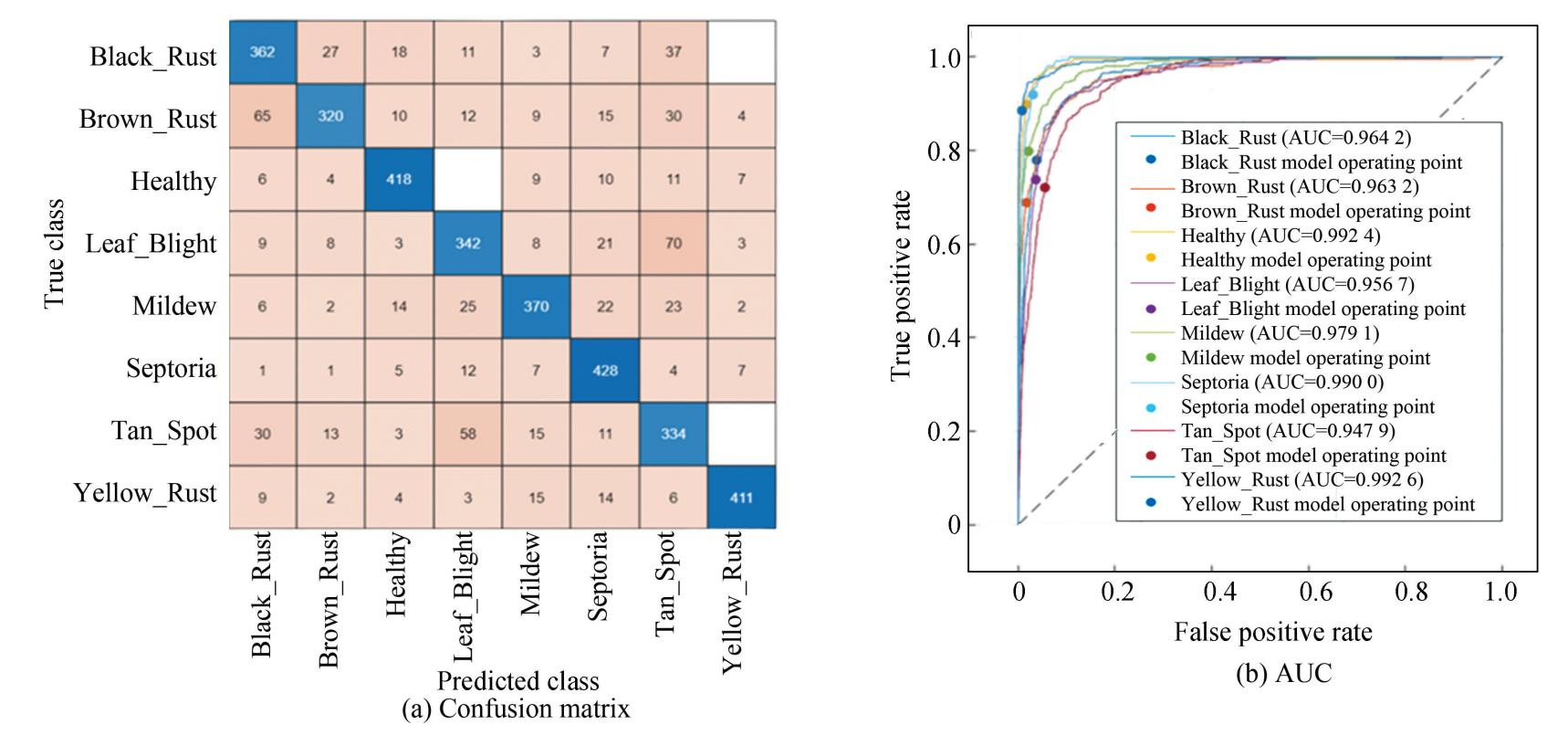
Fig.
3
Performance of first approach with classification accuracy 80.3%
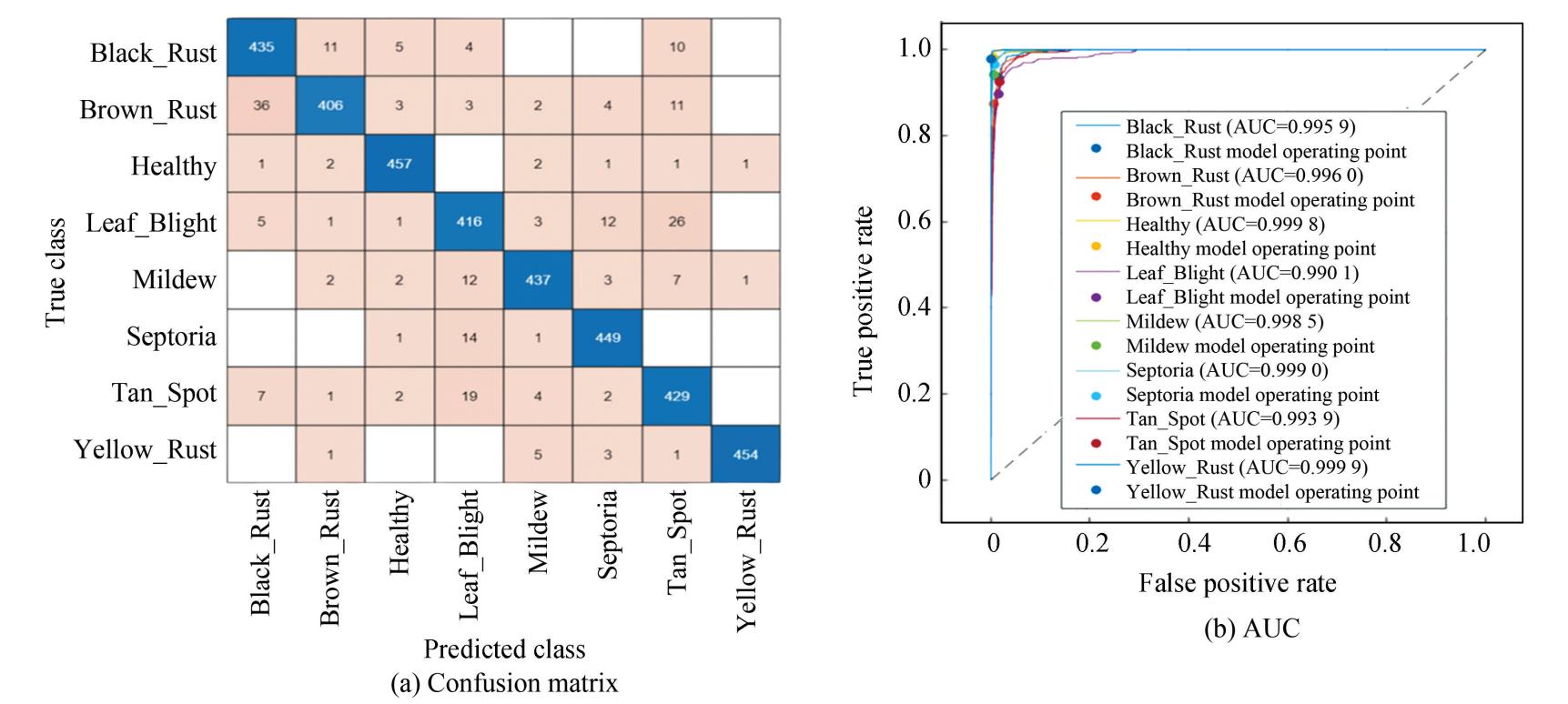
Fig.
4
Performance of second approach with classification accuracy 93.7%
The most effective method for tuning the SVM hyperparameters(𝐶 and 𝛾)is the SEWOA. This bio-inspired metaheuristic algorithm efficiently navigates the hyperparameter space by utilizing spiral-shaped search updates to strike a balance between exploration and exploitation. The confusion matrix for this approach demonstrates near-perfect classification performance,as it shows almost no off-diagonal values,indicating that the true labels closely match the predicted labels. The classes Healthy,Mildew,and Yellow Rust achieve perfect or near-perfect classification with just one or two incorrectly classified instances. The model achieved an outstanding overall accuracy of 98. 1%. The ROC-AUC curves demonstrate superior model performance because their AUC values approach 1. 0 across all classes and display steep vertical ascent towards the top-left. Fig.5 demonstrates that SEWOA-based hyperparameter tuning improves SVM performance by better fitting the feature space,resulting in enhanced decision boundaries for each class and a significant reduction in classification errors.
Fig. 6shows the progressive improvement in classification accuracy from 80. 3%(baseline)to93.7%(with ANOVA)and finally to 98. 1%(with SEWOA). The confusion matrix serves as an essential tool for model evaluation because it presents a detailed class-specific count of correct identifications and all forms of incorrect classifications. The confusion matrix facilitates comprehension of class-level problems,including overlapping features or unclear patterns present in diseased leaf images. The ROC-AUC curves serve as essential metrics for evaluating how well the classifier discriminates between classes at various threshold settings. Higher area under the curve(AUC)values demonstrate stronger class separation capabilities. The combined use of these evaluation tools provides a comprehensive picture of model performance,which directs the refinement process among various methods,as this study suggests.
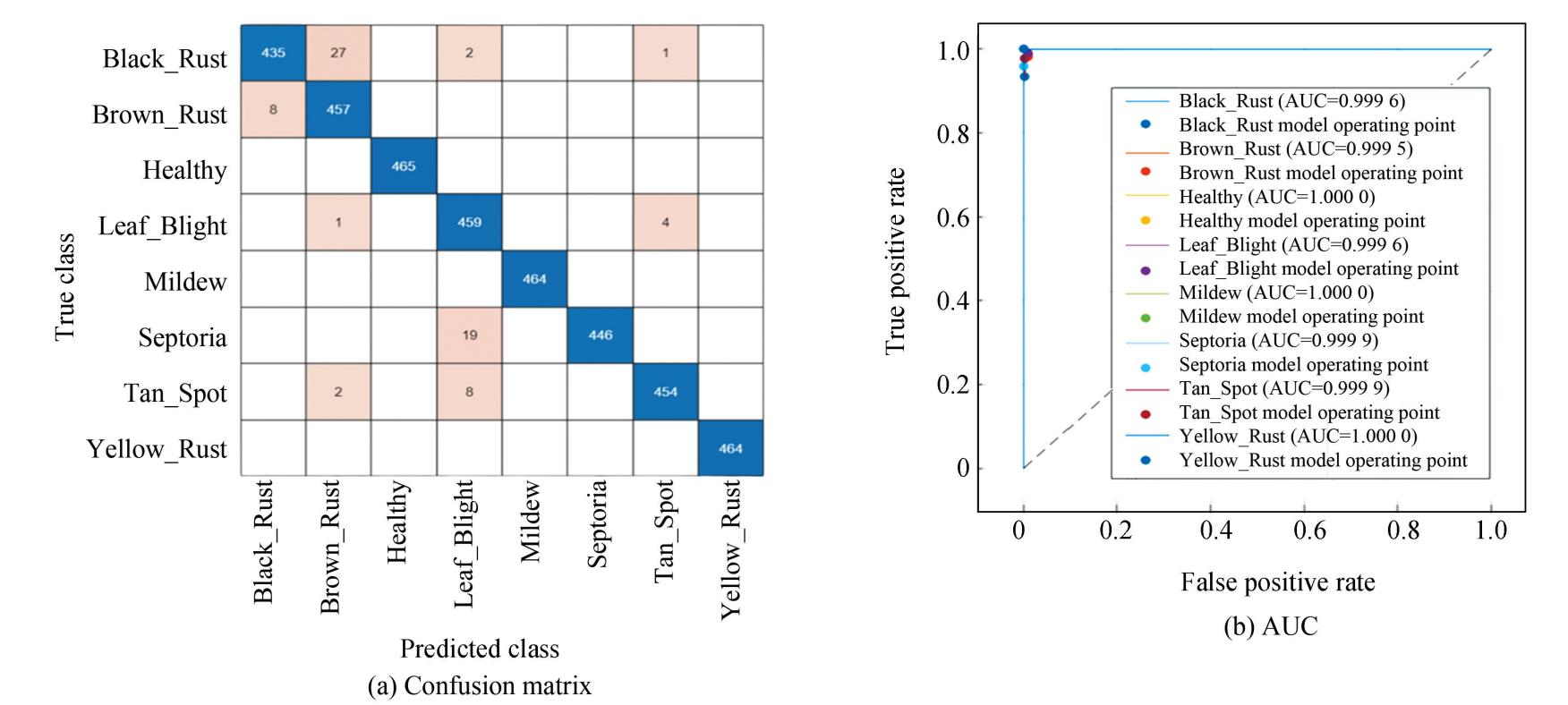
Fig.
5
Performance of third approach with classification accuracy 98.1%
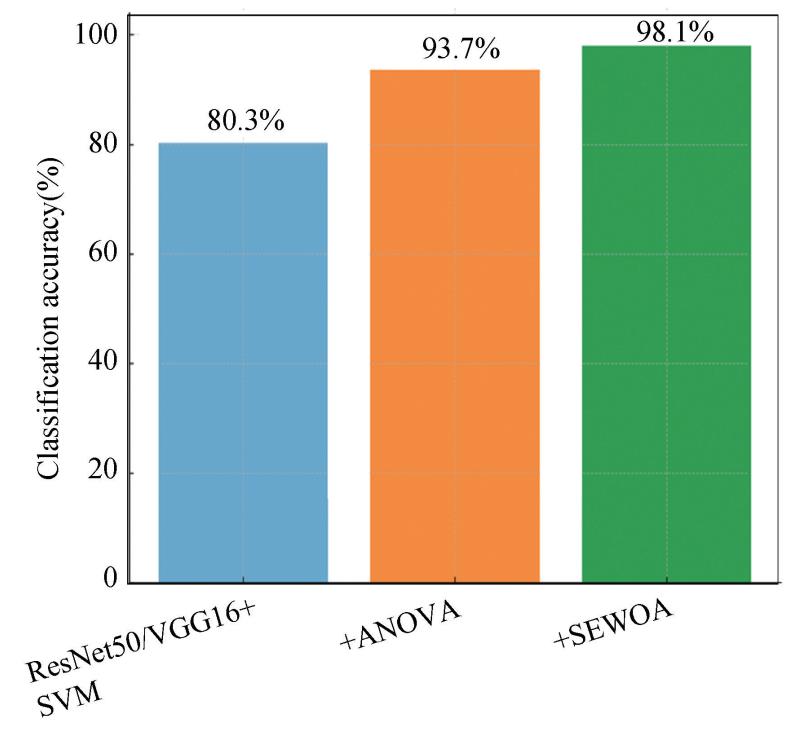
Fig.
6
Accuracy comparison across three proposed approaches
4 Conclusions and Future Scope
The new hybrid deep learning and machine learning system effectively classified 7 wheat leaf diseases along with healthy leaves.
The model demonstrated a substantial performance boost—from an initial accuracy of 80.3%to 93. 7%,and ultimately to 98. 1%—achieved through feature extraction using ResNet50 and VGG16,combined with SVM,and successive refinements via ANOVA for feature selection and WOA for hyperparameter tuning. Data augmentation improved model generalization capabilities by mitigating class imbalance and broadening feature diversity. The model demonstrated reliability and robustness in identifying visually similar disease patterns,as evidenced by experimental results validated through confusion matrices and ROC-AUC analysis. Our scalable solution achieves precise early disease detection,which enables better crop management decisions and advances sustainable farming practices.
While the results are promising,many areas still need investigation. The model's performance and robustness are evaluated specifically on wheat leaf diseases,and its generalization to other crops or entirely unseen disease types remains a challenge that requires further validation with diverse datasets. The approach still relies on some degree of handcrafted preprocessing and data augmentation,which may introduce bias or limit automation in fully end-to-end workflows. Further research should investigate the real-time implementation of the proposed framework through mobile or edge devices,providing farmers with immediate assistance during field operations. The addition of images from diverse geographic areas and various environmental conditions to the dataset will enhance the model's robustness and adaptability. The classification process benefits from multi-spectral or hyperspectral imaging integration because it captures physiological details beyond the visible light spectrum.Further performance improvements could be achieved by testing ensemble modeling techniques and advanced optimization methods,including quantum-inspired algorithms and swarm intelligence hybrids.
Ethical Statement
The authors affirm that the research presented in this manuscript was conducted in adherence to ethical principles and guidelines. The study does not involve any human participants,animal subjects,or personally identifiable information,ensuring that no ethical approvals were required.
Conflict of Interest
The authors declare no potential conflict of interest.
Data Availability
Data will be made available on request.
