Abstract
In this study, a new extragradient algorithm is proposed, which combines an inexact projection operator with relative error to solve quasimonotone variational inequality problems in infinite-dimensional Hilbert space. The algorithm integrates a feasible inexact projection operator into the classical extragradient framework, and theoretical analysis shows that the method has weak convergence under the assumption that the operator is Lipschitz continuous. In addition, the strong convergence of the iterative sequence is guaranteed when the operator exhibits strong pseudomonotonicity. The effectiveness and practical performance of the algorithm are demonstrated through numerical experiments on typical problem instances. The proposed approach contributes to the advancement of variational inequality theory by extending the applicability of extragradient methods to broader classes of operators. It also provides a scalable and efficient solution paradigm for large-scale optimization problems involving quasimonotone structures.
0 Introduction
The variational inequality problem is formulated as follows: In the context of a real Hilbert space 𝐻, given a nonempty subset that is closed and convex, consider a mapping 𝐹∶𝐻→𝐻, we seek an element 𝑥∈𝐶 such that
(1)
We abbreviate this problem as VIP[1]. The set of all solutions to problem(1) is denoted by 𝑆, and is assumed to be nonempty. The set 𝑆D, which consists of all feasible solutions, is defined by the subsequent mathematical problem,
(2)
Obviously, the set 𝑆D is both closed and convex, and , For this study, we assume that it is also nonempty. Given the continuity of the operator F and the convexity of 𝐶, if 𝐹 also satisfies the condition of being pseudomonotone, then the solution sets 𝑆 and 𝑆D coincide, as demonstrated in Lemma 2.1 from Ref.[2]. But the conclusion fails to remain true when the operator is quasimonotone and exhibits continuity.
To address variational inequality problems, a range of projection-based methods has been introduced and rigorously examined in previous studies [3-12]. We operate in the context of a real Hilbert space 𝐻, and there exists a constraint set 𝐶 that satisfies three fundamental properties: it is not empty, closed and convex. The mapping that identifies the unique point in 𝐶 closest to a given vector 𝑥∈𝐻 is formally defined as the projection operator 𝑃𝐶. It is defined by the following procedure:
(3)
Problem(1) may also be interpreted through a fixed-point perspective, namely, its resolution corresponds to locating a point of the type: find 𝑥*∈𝐶 such that 𝑥*=𝑃𝐶(𝑥*-𝜆𝐹(𝑥*)), for any 𝜆>0.
By applying the previously introduced formula, we are able to derive the following iterative scheme, commonly referred to as the projected gradient method. Addressing variational inequality problems often leads researchers to the projected gradient method(PGM), which typically stands out due to its simplicity and widespread adoption[13], as detailed below:
Assuming that 𝐹 satisfies strong monotonicity with modulus 𝜂 together with 𝐿-Lipschitz continuity, then taking any positive scalar step 𝜆 ensures that the iterates generated by the scheme approach exhibit strong convergence properties, ultimately arriving at the sole solution to the given variational inequality. These strict conditions greatly limit the scope of application of this method in practical problems. If 𝐹 only holds monotonicity and Lipschitz continuity, the PGM is not ensured to converge, as noted in Ref.[14]. Korpelevich and Antipin[15-16] proposed an algorithm to tackle VIP in finite-dimensional space, the scheme known as extragradient method(EGM) can be reformulated as follows:
It relies on an operator F that exhibits monotonicity together with 𝐿-Lipschitz continuity, and its iterative updates are performed with a positive parameter controlling the step length 𝜆, which is chosen from the interval 0,1/L.
In contexts of variational inequality problems where the map only satisfies quasimonotonicity, the convergence of the interior neighborhood method, as discussed in Refs.[11-12], can be established under alternative conditions, such as the nonemptiness of the set 𝑆D. In the study of Ye and He[3], a novel dual-projection scheme was developed to address variational inequalities with quasimonotone(or potentially non-monotone) operators in finite-dimensional Euclidean spaces with the key precondition that the solution set 𝑆D is nonempty.
Typically, each iteration requires solving two constrained projection subproblems over the feasible domain. This computational burden becomes particularly pronounced when dealing with high-dimensional systems, where the increased number of variables may substantially elevate per-iteration expenses. Therefore, when the method iteratively deviates from the solution of the considered problem, it may not be reasonable to perform an exact projection. In recent decades, researchers[12, 17-23] have successively devised various inexact methods to reduce the computational cost of projection.
Millán et al.[24] introduced a new iterative scheme employing practically feasible inexact projection techniques that incorporates the extragradient method to tackle variational inequalities(1) with pseudomonotone structure in Euclidean space of limited dimensionality, building on more sophisticated projection techniques proposed by many researchers[3-10, 25]. Similar to the structure of traditional extragradient algorithms, this method replaces exact projections with inexact projections by the following procedure:
where the mapping 𝐹 is pseudomonotone, 𝐿-Lipschitz continuous. The step size 𝑟 satisfies and the error tolerance 𝛾𝑛 satisfies The inexact projection is defined as
(4)
Motivated by this line of research, the present study generalizes the extragradient inexact projection method with a tolerable error to address a category of VIPs characterized by quasimonotonicity in Hilbert space. Theoretical analysis demonstrates that, within a Hilbert space of infinite dimension, if the operator exhibits quasimonotone behavior and satisfies the Lipschitz continuity condition, the method achieves weak convergence, aligning with the convergence behavior of existing algorithms[16, 26]. Moreover, assuming that the mapping exhibits 𝛿-strong pseudomonotone behavior within a Hilbert space, the iterative method constructs a series of points whose limit is a solution to the variational inequality, with the convergence being of a strong nature.
The structure of this study is as follows: Section 1 outlines fundamental concepts and assembles the foundational theorems essential to proving the convergence results. Section 2 details an extragradient algorithm based on inexact projection, along with a rigorous proof of its weak and strong convergence under predefined conditions. Section 3 demonstrates the algorithm's practical performance and effectiveness through numerical experiments on typical problem instances. Conclusions are presented in Section 4.
1 Preliminaries
Let H be a real Hilbert space characterized by inner products and norms, indicated as〈·,·〉and ‖·‖, respectively. To simplify notation, the concept of strong convergence is expressed using the symbol →, whereas the presence of weak convergence is reflected through .
Assume we have a subset 𝐶 residing in a real Hilbert space 𝐻. This set 𝐶 is nonempty and exhibits both convexity and the property of being closed. The lemma below highlights some fundamental characteristics of metric projection 𝑃𝐶, frequently utilized in related mathematical analyses.
Lemma 1[27] For all 𝜏,𝑣∈𝐻, and 𝜂∈𝐶, the following statements hold:
(a)
(b) is firmly nonexpansive,i. e., in particular,
(c)𝐴 is δ-strongly pseudomonotone on 𝐻,if there exists 𝛿> 0 such that
(e)𝐴 is quasimonotone on 𝐻,if
(f)𝐴 is 𝐿-Lipschitz continuous on 𝐻,if a constant 𝐿> 0 exists such that the inequality holds.
(g)𝐴 is sequentially weakly continuous,i.e.,if then
Obviously, Nevertheless,the reverse implications are not guaranteed in general.
This subsection revisits the notion of feasible inexact projections over closed convex domains,building upon foundational work documented in Refs.[19-20,24-25,28]. This study incorporates several novel characteristics of feasible inexact projections in Ref. [ 24],which serve as fundamental components for our subsequent analysis. The formal characterization of these approximate projections is presented below.
Definition 1 (Feasible inexact projection[24])Consider a convex subset 𝐶 that is also closed within a Hilbert space 𝐻 and a nonnegative real parameter representing a given error tolerance of projection accuracy. Let denote a 𝛾-feasible inexact projection operator of 𝜉 taken relative to reference point 𝑎 ∈ 𝐶 onto 𝐶,which is characterized by Eq.(4).
Feasible inexact projection is the set-valued mapping. This framework extends conventional projection theory. Below,we analyze key properties of this generalized operator.
Lemma 2[24] Given parameters 𝛾 ≥ 0 be error tolerance,set 𝐶 ⊂ 𝐻,𝜉 ∈ 𝐻,𝑎 ∈ 𝐶 and 𝛾> 0,then
(a)When 𝛾= 0, coincides with the exact projection of 𝜉 onto 𝐶,for all 𝜉 ∈ 𝐻.
(b)The inclusion guarantees
(c)Monotonicity:If 𝑎 ≤ 𝑏 then
(d)An analogous property to the firm non-expansiveness characteristic of the exact projection operator is established for the feasible inexact projection,and its proof is derived by employing a similar line of reasoning as that found in Ref.[24]. If and then
Definition 2 Suppose 𝑆 is a nonempty subset of the Hilbert space 𝐻. 𝐴 sequence is said to be quasi-Fejér convergent to 𝑆,if and only if,for all there exists 𝑡₁ ≥ 0 and a sequence with such that for al l
Lemma 3[29] Consider the sequence{𝜉𝑡} ⊂ 𝐻 and 𝐶 ⊂ 𝐻 be a nonempty set,and assume that the sequence{𝜉𝑡} demonstrates quasi-Fejér convergence towards 𝐶. The following two key outcomes are derived from the analysis:
1)The global behavior of the iterative process,confirming that the sequence{𝜉𝑡} is bounded.
2)The entire sequence converges to ,if a cluster point of{𝜉𝑡} lies in 𝐶.
Lemma 4[24] Let 𝐹 ∶ 𝐻 → 𝐻 be an operator defined over a Hilbert space. Suppose 𝐶⊂𝐻 be a closed,convex set that is not empty. Consider 𝜉₀ ∈ 𝐶,𝛾 ∈ [0,1)and 𝛼> 0. If the points and,then the following estimates hold:
1)
2)
Moreover,if the mapping 𝐹 satisfies Lipschitz continuity on 𝐶 with Lipschitz constant 𝐿> 0,then the bound improves to:
Lemma 5[24] The following characterizations of those points which satisfy the variational inequality problem stipulated by the operator 𝐹 within the confines of the admissible set 𝐶 are interchangeable:
1)The point 𝜉 is contained in,which denotes the collection 𝑆 of all solutions to the associated variational inequality VIP(𝐹,𝐶).
2) for all 𝜆 ≥ 0.
3)There exists such that0,for be a sequence that converges weakly to some element 𝜉,then for any 𝑦 ∈𝐻,with 𝑦 ≠ 𝜉,the minimal asymptotic distances satisfy:
(5)
Lemma 7[30] Consider a sequence{ 𝜙𝑡}comprised of nonnegative real values that fulfill the condition,where,where 𝜙𝑡 and ψt are sequences formed by nonnegative numbers such that{𝜙𝑡} ⊆ [1,+ ∞),{𝜓𝑡} ⊆ [0,+ ∞), Then,we obtain that exists.
2 Convergence Analysis
The current section introduces a new iterative framework designed for solving variational inequality problems(1)with quasimonotonicity assumptions in Hilbert spaces. Distinct from traditional projection-based methods,this scheme integrates feasible approximations of projections,guided by a suitably chosen tolerance condition involving relative error.Instead of requiring exact projections onto an acceptable range at each step,the algorithm permits controlled inaccuracies,improving computational efficiency while maintaining convergence.
We make some assumptions as follows:
(A1)The set 𝑆D is nonempty:𝑆D ≠ Ø.
(A2)The mapping 𝐹 is quasimonotone and 𝐿-Lipschitz continuous.
(A3)The mapping 𝐹 is weakly sequentially lower semicontinuous,that is,whenever and it holds that
(A4)The set 𝐴={𝑧 ∈ 𝐶 ∶ 𝐹(𝑧)= 0} \ 𝑆D is a finite set.
(A5)The step size λ satisfies 0< 𝜆<
(A6)
Building upon the foundational extragradient framework,this study introduces an efficient variant that relaxes the requirement for exact projections. The formal procedural steps of this approach,designated as Algorithm 1,are outlined below:
Algorithm 1
Initialization:Choose parameters and
Step 1:Select the initial point 𝜉₁ ∈ 𝐶,and set iteration counter 𝑡 ∶=1.
Step 2:Determine the error tolerance 𝛾𝑡 satisfying:
(6)
Step 3:Calculate feasible inexact projections onto 𝐶 as follows:
(7a)
(7b)
Stopping rule:If either or ,terminate the algorithm. Otherwise,increment 𝑡 ∶= 𝑡+1 and return to Step 2.
It is worth noting that from inequality(6),we have
(8)
Consider an iterative process where the first iterate 𝜉₁is selected from the set 𝐶 and for every 𝑡 ∈ℕ,and each subsequent point 𝜉𝑡+1is constructed via a valid inexact projection into 𝐶 that remains within the feasible domain. Under these conditions,the entire sequence{ 𝜉𝑡} is confined to 𝐶. Furthermore,given that 𝐶 possesses the topological property of being closed,from the aforementioned properties,we can deduce the following:assuming the sequence{ 𝜉𝑡}possesses cluster points,each of which is inevitably contained within the specified solution set 𝐶,ensuring feasibility throughout.
To lay the groundwork for the primary theorem,we first deduce a key result that is fundamental to its development.
Lemma 8 Let{ 𝜉𝑡} and be the sequence produced through the execution of Algorithm 1. The ensuing results are derived from these sequences:for and
Proof We set we have
Since for we get
According to the definition of ,
So
(9)
Since for we obtain then
Noticing that We have
(10)
Moreover,
(11)
According to the definition of{ 𝜉𝑡} and ,then using Eq.(4),we get
(12)
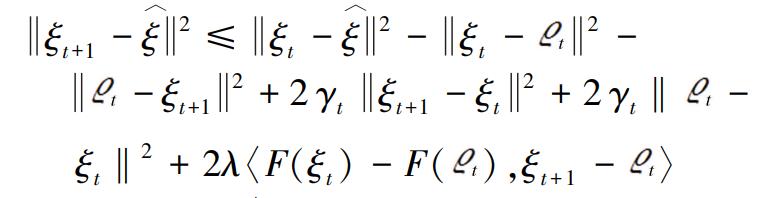
Substituting Eq.(11)and inequality(12)into inequality(10),we have
(13)
In addition, combined with the inequality(13),yields
(14)
From Lemma 4,we can get
(15)
Set
We have
(16)
Then,considering that and assumptions therefore 𝜂1> 0,𝜂2> 0. Thus,it follows from inequality(16)that
According to Definition 2,the inequality stated above indicates that the sequence{ 𝜉𝑡} exhibits quasi-Fejér convergent toward the 𝑆D. Assuming that 𝑆D is nonempty,this conclusion directly follows from term1)of Lemma 3,we imply that{𝜉𝑡} is bounded. Then by Lemma 7,inequality(6)and assumptions+ ∞,we obtain that exists.
Then from inequality(16),sum both sides simultaneously,we obtain
We can get
Then
Using a similar approach,we have0. According to therefore
Lemma 9 Let{ 𝜉𝑡} be a sequence produced through the execution of Algorithm 1. The ensuing results are derived from these sequences:if is a weak clustering point of{𝜉𝑡} and then or
Proof: According to Lemma 8,consider{ 𝜉𝑡} to be bounded,then it is possible to extract a subsequence{ } from{ 𝜉𝑡} for which the limit condition holds There are two cases below.
Case I Assume the following is true.
Then
Case II Assume the following is true, We may assume,without sacrificing generality,that the subsequence of{} is itself,as the reasoning for a proper subsequence follows analogously. According to then This implies the existence of a threshold index,denoted,starting from which the following condition holds universally:for each subsequent term, holds.
Then according to so
Divide both sides of the inequality by 𝜆,
Rearranging the inequality gives
According to are bounded,𝜆> 0,the limit of{ } exists. We have
There are two Cases A and B below:
Case A:If this leads to the conclusion that there exists a subsequence{} of{ } which exhibits the essential behavior that
According to the quasimonotonicity of 𝐹, for then
Case B:If then
We set
Then,for
We can get according to the quasimonotonicity of 𝐹,then So
We have is bounded,since is bounded,when 𝑛 → ∞,𝜀𝑛 → 0,so is bounded. we have
Lemma 10 Produced by Algorithm 1,the resulting sequence{ 𝜉𝑡} possesses only finitely many cluster points within the set 𝑆.
Proof: We start by investigating whether the iterative process{𝜉𝑡} may converge weakly to several different limit points,rather than exhibiting uniqueness of its weak limit within the set 𝑆D,under certain conditions. Suppose,contrary to what we aim to establish,that two distinct elements and serve as a separate weak cluster of subsequences of{ 𝜉𝑡},with Assume there exists a subsequence{ } that converges weakly to some point as 𝑖 approaches infinity. Recalling that is well-defined for all 𝜉 ∈ 𝑆D,we invoke Lemma 5 to proceed with the analysis,
This leads to a contradiction. Noting that the set 𝐴={𝑧 ∈𝐶 ∶ 𝐹(𝑧)= 0} \ 𝑆D contains only finitely many elements;by Lemma 9,the sequence{ 𝜉𝑡} possesses only finitely many weak cluster points within 𝑆.
Lemma 11 Suppose the set of all limit points of the iterative process{ 𝜉𝑡} is finite,denoted by 𝜉₁,𝜉₂,𝜉₃,···,𝜉p. This structural property guarantees that there exists some sufficiently large index 𝑍,all subsequent terms of the sequence will satisfy the condition that when 𝑡> 𝑍,each 𝜉𝑡 belongs to set ,where we define:
and the separation parameter is given by
Proof: Consider a subsequence extracted from the original sequence ,which satisfies the condition that we get
(17)
For 𝑗 ≠ 𝑙,we have
(18)
This implies that ∀𝑗 ≠ 𝑙,
(19)
From Eq.(17)and inequality(19),for all 𝑖 beyond a certain threshold,it follows that
Therefore,when 𝑖 is sufficiently large,we have where
(20)
and
Next inclusion is immediate,
(21)
Set The subsequent argument aims to demonstrate that this relation eventually extends to the entire sequence for large enough 𝑡. If this not be the case,one could identify a subsequence ofξt{} for which The bounded nature of the sequence{ } then guarantees the existence of a weakly convergent subsequence,hereafter simply referred to as For convenience and without loss of generality,we continue to use the notation{ } of the subsequence,which satisfies Noting that does not belong to the set ,it follows that for ∀𝑙 ∈{1,2,···,p},next certain condition holds,
By invoking the principle of drawer,we can find a further subsequence{ } extracted from{} and along with 𝑙0 ∈{1,2,···,p} \{𝑙},such that the property in question remains valid for all 𝑖 ≥ 0,
We have
(22)
Combining inequalities(18),(22)and
we get Since 𝑙 is arbitrary,we have which leads to a contradiction.Therefore,the sequence elements 𝜉𝑡 will lie in the set  for all large enough 𝑡. In other words,there exists 𝑍1> 𝑍,such that for every 𝑡 ≥ 𝑍1,such that
Theorem 1 A weak convergence result is established for Algorithm 1:the sequence{𝜉𝑡} of iterates that it produces is guaranteed to have its weak limit in the solution set 𝑆.
Proof: The conclusion of Lemma 8 provides the foundation for the next step,enabling us to deduce that It therefore follows that one can find an index 𝑍2> 𝑍1> 𝑍,for every 𝑡 ≥ 𝑍2,the relation 𝜉𝑡+1-𝜉𝑡< remains valid. We consider the scenario where the sequence{ 𝜉𝑡} admits multiple distinct weak cluster points. Then,applying Lemma 11,we deduce that there must be some 𝑍3 ≥𝑍2> 𝑍1> 𝑍 for which ,and ,where 𝑙 ≠ 𝑗,𝑙,𝑗 ∈{1,2,···,p} and p ≥ 2.Particularly,this ensures that:
Using inequalities(20)and(21),we get
Moreover,we obtain
(23)
and
(24)
Combining inequalities(23)and(24),we get
(25)
The assumption leads to a contradiction. As a result,we must accept that the sequence{ 𝜉𝑡}possesses a single weak cluster point belonging to the set 𝑆. This observation leads directly to the deduction that
Theorem 2 Under the assumption that the operator 𝐹 exhibits both 𝛿-strongly pseudomonotone and 𝐿-Lipschitz continuous. Algorithm 1 produces an iterative sequence{ 𝜉𝑡} that exhibits strong convergence toward a unique solution within the set 𝑆.
Proof: From inequality(9),for we can get
From the property that the operator 𝐹 is 𝛿-strongly pseudomonotonic,we can get:for then
Therefore
(26)
Putting inequality(26)into inequality(9),we can get
Rearranging the above inequality,we obtain
Substituting Eq.(11)and inequality(12)into the above inequality,and utilizing 𝐿-Lipschitz continuity of 𝐹,we can get
The next proof process is similar to inequalities(14),(15)and(16)of Lemma 8,we have
Since 𝜂₁> 0,𝜂₂> 0,
Rearranging the above inequality,sum both sides simultaneously,we obtain
Then,we have
(27)
Since therefore
(28)
Remark 1 This study draws inspiration from a pre-existing iterative technique documented in Ref.[24],whose domain of applicability was previously confined to finite-dimensional Euclidean spaces and to problems exhibiting pseudomonotonicity. The central aim of the present paper is to transcend these limitations fundamentally. We develop a novel framework that not only lifts the dimensional constraint,allowing operation in infinite-dimensional Hilbert spaces,but also relaxes the operative assumptions,thus facilitating the solution of problems characterized by the broader and more challenging class of quasimonotone operators.
3 Numerical Experiment
Herein,we present a series of numerical experiments designed to demonstrate the practical performance and computational advantages of our method. All codes were written using PyCharm Community Edition 2024. 1. 1 and executed on a PC with an Intel(R)Core(TM)i7-7700T CPU@ 2.90 GHz and 8.00 GB of RAM.
To support the approximation of inexact projections without relying on exact calculations,the work in Ref. [ 31 ] introduces a widely recognized technique,the Frank-Wolfe(FW)algorithm. As described in Ref. [ 24 ],this approach seeks an approximate projection by solving a linear minimization problem over a closed convex set using a linear optimization oracle. The FW algorithm is formally defined as follows:given a reference point 𝑢 ∈ 𝐶 and a nonnegative forcing parameter 𝛾 ≥ 0,calculate a feasible inexact projection 𝜋 ∈ 𝐶 of a point 𝑣∈𝐻 onto the compact convex set 𝐶,the details are as follows:
Initialization:Choose parameters 𝛾> 0,initial points 𝑣,𝑢 ∈ 𝐻,and 𝜋₀ ∈ 𝐶. Set iteration counter 𝜇 ∶= 0.
Step 1:Use linear optimization oracle to compute:
(29a)
(29b)
Step 2:Check stopping criterion:
If- then stop and return
(30)
Step 3:Update iterate:
(31a)
(31b)
Iteration:Set 𝜇 ∶= 𝜇+ 1 and return to Step 1.
According to the analysis in Ref.[24],when the termination condition- is satisfied,the Frank-Wolfe procedure yields an approximate projection 𝜋 ∈ 𝐶. Specifically,for any given 𝑣 ∈ 𝐻 and reference point 𝑢 ∈ 𝐻,the output satisfies the following inequality with respect to the error bound It should be emphasized that the Frank-Wolfe algorithm introduced in our study is highly adaptable,capable of generating both approximate and precise projection results,by setting a sufficiently small tolerance,it is possible to calculate the exact projection. For further implementation details regarding the computation of approximate projections,see the comprehensive explanation in Ref.[32].
To illustrate the practical application of variational inequality problems,we analyze two distinct scenarios involving a pair of bounded linear operators.
Example 1 This article uses the examples in Ref.[4] for discussion. Let 𝐶= [-1,1] and
Then,we have a mapping 𝐴 that is quasimonotone and Lipschitz continuous. For this problem,we can also get 𝑆D={-1} and 𝑆={-1,0}. The solution here is 𝛩∗=-1.
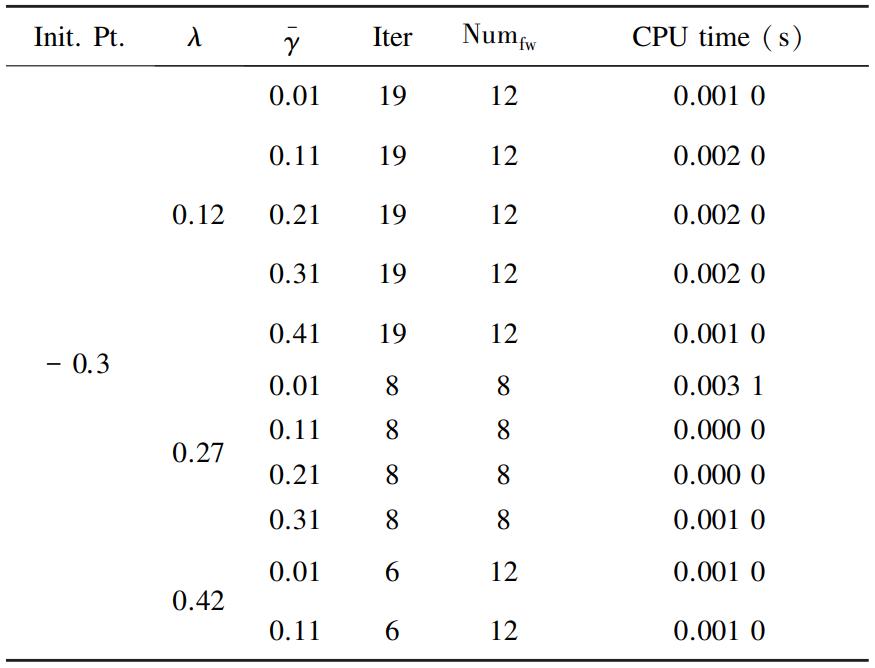
The algorithm parameters are set as follows: The termination criterion is defined as The inexact projection algorithm is used to solve the problem,and the outcomes of Algorithm 1 under different combinations of the parameters 𝜆 and  are summarized in Table 1. The first column “ Init. Pt.” indicates the initial point,the third column “ Iter” indicates how many iterations the extragradient method required to converge,while the fourth column “ Numfw ” details the cumulative count of linear minimization steps executed by the Frank-Wolfe procedure,and the last column “CPU time(s)” represents the iteration time.Therefore,our algorithm can solve this quasimonotone variational inequality problem.
Table
1
Numerical performance with initial point 𝜉 ₀= - 0.3
Example 2 The examples in Ref. [ 10] are used for discussion in this study. Consider the Hilbert space 𝐻,identified with the classical sequence space 𝑙₂,consisting of all infinite real sequences that meet a specific criterion described below:
Assume that 𝐺 ∶ 𝐻 → 𝐻 is defined by:
where According to Ref.[10],we know that 𝐺 is weakly continuous on 𝐶,and VIP(𝐺,𝐶)={0}. Therefore,𝐺 is 𝐿-Lipschitz continuous,and 𝐿= 11. And the literature proves that 𝐺 is quasimonotone on 𝐶.
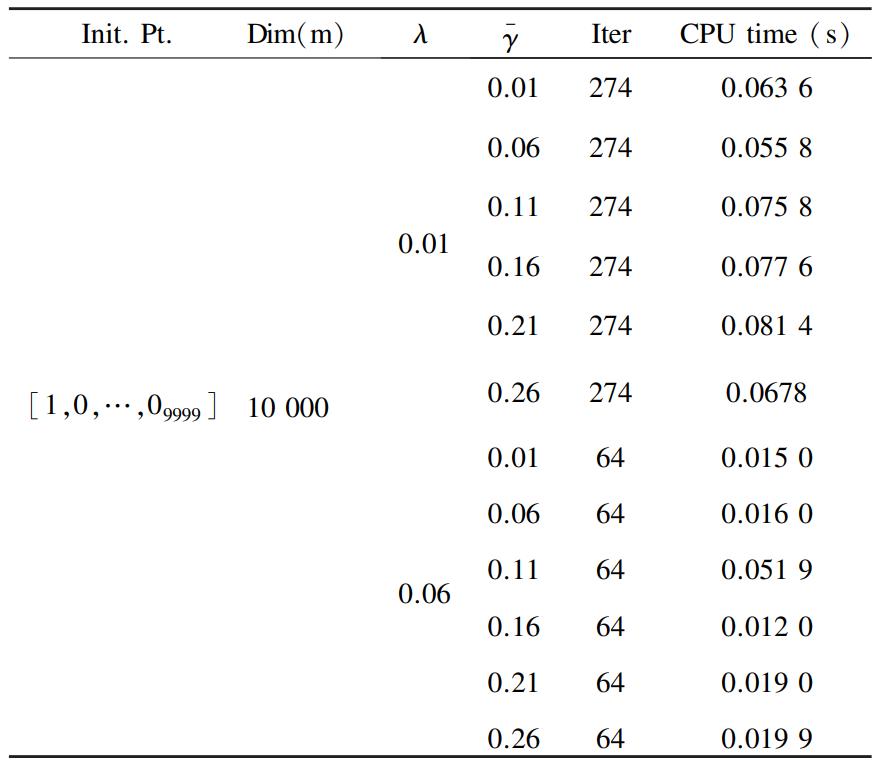
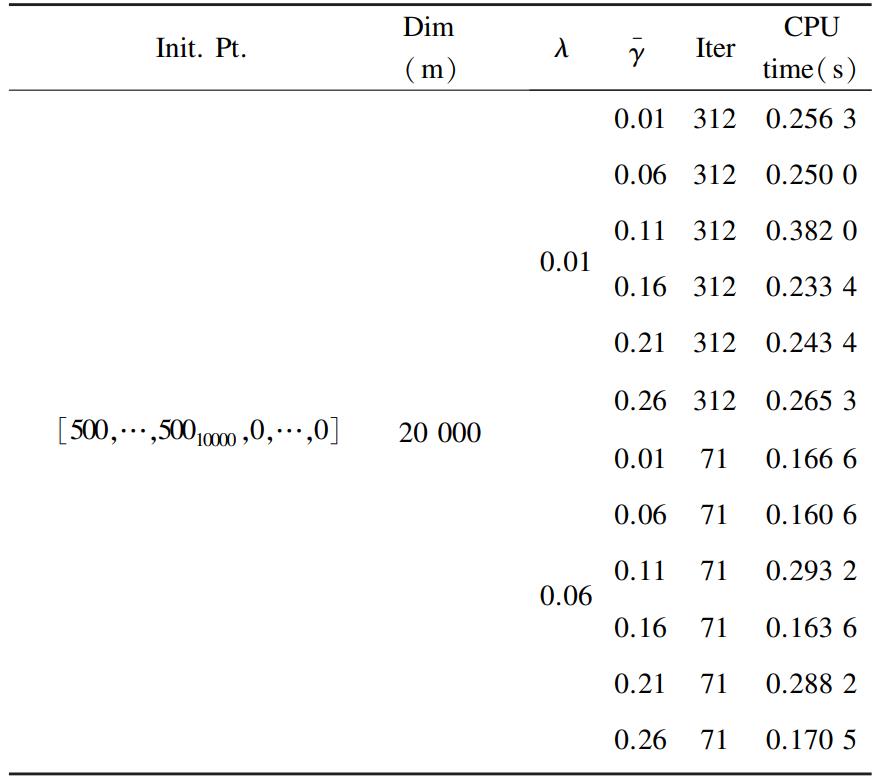
The algorithm parameters are set as follows:𝜀𝑡=(𝑡+ 1)-2.1, The stopping criterion is defined as when The problem can be solved by using the inexact projection algorithm.The results obtained for different initial points and different combinations of the parameters 𝜆 and -are shown in Tables 2 and 3. The first column “Init. Pt.”indicates the initial point,the second column “ Dim(m)” indicates the dimension of the initial point,the fifth column “Iter” indicates how many iterations the external gradient method requires to converge,and the last column “ CPU time(s)” indicates the iteration time. Therefore,our algorithm can effectively solve this high-dimensional quasimonotone variational inequality problem.
Table
2
Numerical performance with initial point 𝜉₀= [1,0,···,09999 ]
Table
3
Numerical performance with initial point 𝜉₀= [500,···,50010000,0,···,0]
4 Conclusions
This study extends an extragradient algorithm with inexact projection to solve quasi-monotone variational inequality problems in infinite-dimensional Hilbert spaces. While preserving the projection-based iterative framework of the classical extragradient method,the proposed approach incorporates an inexact projection operator governed by a relative error criterion,which helps reduce computational burden without sacrificing feasibility. Under mild conditions,it is shown that if the operator is quasimonotone and Lipschitz continuous,the algorithm ensures weak convergence of the generated sequence. Furthermore,strong convergence is established when the operator satisfies δ-strong pseudomonotonicity on the set S over SD. Numerical experiments confirm the effectiveness and practicality of the proposed method,demonstrating its potential for solving large-scale variational inequality problems.
Conflict of Interest
The authors declare no potential conflict of interest.
