Abstract
MultiLevel Inverters (MLIs) are vital for converting the DC output from Solar PhotoVoltaic (SPV) systems into high-quality Alternating Current (AC) waveforms for grid integration or load packages. This study examines the optimization of Cascaded H-Bridge (CHB) MLIs with 7, 9, and 11 voltage levels using the Support Vector Machines (SVM) technique. The goal is to evaluate the performance of these MLI configurations by estimating Total Harmonic Distortion (THD), with and without SVM optimization. The proposed system integrates the Maximum Power Point Tracking (MPPT) technique to extract maximum power from SPV systems. Detailed Simulink models were developed for each MLI configuration to simulate their operation with MPPT control. Findings indicate that SVM optimization is effective at reducing THD, with 11-level MLIs achieving the greatest decrease to less than 7%. The appearance of SVMs is effective in improving the performance of MLIs, providing information on the complexity-performance trade-off of inverters. This study leads to the optimization of SPV systems by combining superior device mastering techniques with a multilevel inverter.
Keywords
0 Introduction
In recent years, there has been tremendous interest in integrating renewable energy sources, especially SPV(Solar PhotoVoltaic) structures, due to the global movement towards sustainable power solutions. SPV systems convert sunlight into electricity through the application of photovoltaic cells that may be frequently linked to the grid or used in an off-grid program. Optimizing the overall performance of SPV structures to achieve maximization of strength conversion performance is one of the challenges in SPV structures. This is the place where MLIs are important. MultiLevel Inverters(MLIs) play a critical role in improving the overall functionality of SPV systems by directly transforming the DC output of SPV panels into a high-quality AC signal suitable for grid connection or load use. This is particularly well achieved by the Cascaded H-Bridge(CHB) MLIs, which can generate multiple voltage levels to improve waveform quality and minimize Total Harmonic Distortion(THD). The most significant benefit of MLIs in SPV systems is that it is able to generate a near-sinusoidal output voltage to reduce harmonics and improve efficiency within the electric system.
To similarly optimize the performance of MLIs, particularly in SPV systems, superior control techniques are employed. Maximum Power Point Tracking(MPPT) is one such technique used to make sure that the SPV device operates at its maximum energy output. MPPT algorithms constantly modify the operating point of the SPV system to capture the maximum available energy from the solar panels. Integrating MPPT with MLIs enhances the general efficiency of the SPV machine by ensuring inverters operate optimally below varying environmental conditions. This study focuses on optimizing CHB MLIs for SPV systems using SVM(Support Vector Machine) optimization techniques. The study includes developing Simulink models for 7-level, 9-level, and 11-level MLIs, integrating MPPT to convert Direct Current(DC) power from SPV panels into high-quality AC electricity. The paper assesses THD and output power quality, evaluating performance with and without SVM optimization. Additionally, the paper investigates the position of Support Vector Machines(SVMs) in enhancing THD and strengthening fine, while exploring the trade-offs between machine complexity and performance across distinct MLIs configurations.
While prior studies have shown that increasing inverter levels reduces THD, few works have analyzed the combined impact of SVM-based optimization with MPPT-controlled CHB MLIs in solar PV systems. The existing literature lacks a comparative assessment of 7-, 9-, and 11-level inverters optimized using machine learning. This study addresses this gap by(i) developing detailed Simulink models,(ii) evaluating THD with and without SVM optimization, and(iii) analyzing the trade-offs between complexity, performance, and device count.
This study makes a contribution to the field of power electronics and renewable energy in terms of:
1) The supply of complete Simulink models: The supply of accurate Simulink models of 7-, 9-, and 11-level CHB MLIs with MPPT control. Using these fashions, intensive assessment of inverter performance in SPV systems is made possible.
2) Evidence of SVM optimization advantages: Underlining the suitability of SVM optimization to reduce THD and enhance high-quality energy. This contribution has shown how machine learning techniques may be used to enhance inverter control methods as well as universal device behavior.
3) Complexity vs. performance trade-offs analysis: Providing information about the trade-offs between the complexity and the performance improvements of an inverter. This assessment provides information on the impact of better optimization strategies on machine layout and functioning.
4) Improving the efficiency of the SPV systems: The sale of expensive steerage to streamline the SPV systems by incorporating the use of MLIs and better control mechanisms. The results help create additional green and overall renewable energy infrastructure.
The paper develops the knowledge base for optimizing MLIs in SPV buildings and for applying machine learning techniques, and will help enhance additional green and efficient digital power solutions for renewable energy applications.
1 Literature Review
The concept has gained prominence in SPV structures, as MLI can produce high-quality AC waveforms with reduced harmonic distortion. Another popular method to extract a few voltage levels is the CHB cells, which complement the exceptional performance of the SPV systems[1-2]. The natural characteristic of MLI is to decrease THD, as it synthesizes stepped voltage levels that form a sinusoidal waveform. THD reduction depends on the voltage level. A number of research efforts have shown that the higher the voltage in MLIs, the lower the THD, since the output signal is much closer to a sinusoidal signal. For example, a 9-level MLI can achieve a more harmonic overall performance than a 7-level MLI[3-4]. This overall performance is further enhanced by the 11-level MLI, which provides near sinusoidal output waveforms[5-6]. Recent research has discussed the usefulness of machine learning techniques, including SVMs, to optimize the control methods of MLIs. Large improvements in THD reduction and power quality have been achieved through the use of SVM optimization[7-8]. Machine learning techniques enable adaptive control approaches that enhance the operation of inverters, particularly the complex constructions with multi-voltage phases[9-10]. MPPT is a critical tool that can be used to optimize the output of SPV systems. The combination of MPPT and MLIs ensures that the inverters work at the maximum electricity factor to boost the overall performance of the SPV systems[11-12]. The combination of MPPT and advanced control methodologies, such as mastering equipment, also improves the efficiency and performance of solar energy conversion[13-14].
The trade-off among complexity, value, and performance of different MLI structures, including 7-, 9-, and 11-level structures, has been noted in comparative studies. The 11-level MLI provides outstanding harmonic performance but at a higher complexity and cost[15-16]. Lower-level MLIs, on the other hand, are more basic but less helpful in terms of harmonic performance[17-18]. The combination of high-quality optimization methods and MLIs in the SPV constructions is becoming an increasingly popular place of research. Future studies may focus on the identification of machine learning algorithm refinement, the investigation of alternative MLI settings, and the enhancement of mixing of MPPT with MLIs in order to enhance the performance and overall performance of solar energy structures in a similar fashion[19-20].
2 Methodology
The proposed device includes a CHB MLI with 7-, 9-, and 11-level incorporated into an SPV machine. The inverter topology is managed using MPPT techniques for optimizing electricity generation from the SPV array. Bidirectional switches and cascaded transformers are employed to synthesize multiple output voltage ranges, which improve device efficiency, power fine-tuning, and flexibility, as shown in Fig. 1.
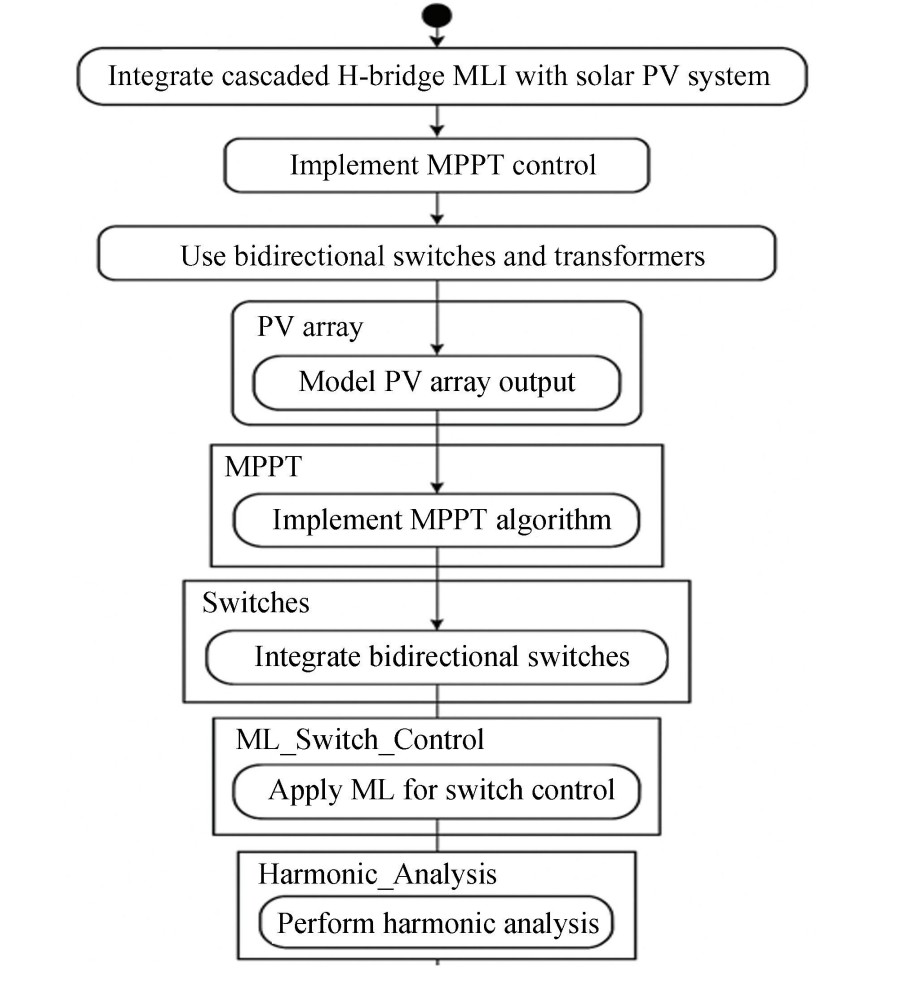
Fig.
1
Methodology flow for CHBMLI with SPV system
For each configuration:
·7-level MLI offers a simpler design with fewer H-bridges, reducing hardware complexity but with relatively higher THD.
·9-level MLI adds more voltage levels, improving waveform quality and reducing THD.
·11-level MLI achieves the best performance in terms of voltage output smoothness and THD, but increases the complexity in control and hardware design.
3 SPV Array Modeling
The SPV array converts solar energy into electrical energy, providing the primary DC input to the inverter. The output of the SPV array depends on various factors such as irradiance and temperature. The SPV cell's output voltage 𝑉pv and current 𝐼pv are described by the following equations:
where 𝐼ph represents photocurrent(dependent on irradiance); 𝐼s represents reverse saturation current; 𝑞 is the electron charge; 𝑅s is the series resistance; 𝑛 is the diode ideality factor; 𝑘 is the Boltzmann constant; 𝑇 is the temperature in Kelvin.
3.1 MPPT Algorithm
To ensure optimal power extraction from the SPV array, an MPPT algorithm, such as Perturb and Observe(P&O) or Incremental Conductance(IC), is implemented. The MPPT controller continuously adjusts the duty cycle of the DC-DC converter connected between the SPV array and inverter, thereby ensuring the SPV system operates at the maximum power point. The power 𝑃pv generated by the SPV array is given by the following equation:
The MPPT algorithm tracks the point where =0, indicating maximum power.
3.2 CHB MLI
The CHB MLIs are responsible for converting the DC output from the SPV system into a sinusoidal AC waveform. The MLI generates stepped output voltages using multiple H-bridge cells. For an 𝑚-level inverter, the number of H-bridges required 𝑁 is given by 𝑁=(𝑚-1)/2. For a 7-level inverter, 𝑁=3; for a 9-level inverter, 𝑁=4; and for an 11-level inverter, 𝑁=5.The output voltage 𝑉out(𝑡) of the cascaded H-bridge MLI is the sum of the voltages generated by each H-bridge cell as follows:
3.3 Bidirectional Switches
Bidirectional switches are employed to enable current flow in both directions, enhancing the flexibility of the MLIs topology. Each H-bridge consists of four switches(𝑆1, 𝑆2, 𝑆3, 𝑆4) that control the polarity and level of the output voltage. The switching states are controlled using Pulse Width Modulation(PWM), ensuring minimal harmonic distortion.
The switching function for a bidirectional switch is represented as follows:
3.4 Transformer-coupled Topology
The H-bridge outputs are connected to a set of transformers that provide voltage boosting and isolation. This cascaded transformer configuration enables the system to synthesize high-voltage levels while ensuring safety and efficiency.
The total voltage across the load 𝑉load is the sum of the voltages induced in the secondary windings of the transformers:
where 𝑘𝑖 is the transformer turns ratio for each level, 𝑖=1,2,···,𝑁.
3.5 Machine Learning(ML) for Switch Control
ML(Machine Learning) algorithms are employed to optimize the switching control strategy of the inverter, aiming to minimize THD and improve efficiency. Supervised learning techniques, such as SVM, are trained using historical data to predict the optimal switching pattern under varying load conditions and solar irradiance. The training data consists of inputs such as irradiance, temperature, and load conditions, with the target output being the switching state that minimizes THD(𝑇THD). The objective function for training the ML models is as follows:
where 𝑉𝑛 is the RMS value of the 𝑛-th harmonic component, and 𝑉1 is the fundamental frequency component.
In this work, a Support Vector Machine(SVM) with a Radial Basis Function(RBF) kernel was employed, as it provided the best generalization for nonlinear switching boundaries. A soft-margin SVM was chosen to balance misclassification tolerance under noisy PV conditions. For multi-class classification of switching states, the One-vs-One(OvO) strategy was adopted, where each pair of switching states was separated by a binary classifier and combined using a voting scheme. The decision function, therefore, takes the form of a set of hyperplanes, and the final class is determined by majority voting across the OvO classifiers.
The training dataset was generated under simulated conditions of solar irradiance(200-1000 W/m2), temperature variations(15-45 ℃), and varying load demands, with target labels corresponding to the switching state that minimized THD. 70% of this dataset was used for training and 30% for testing. This ensures that the SVM learns switching strategies that are robust across diverse environmental conditions.
3.6 Harmonic Analysis
To evaluate the performance of the proposed system, a harmonic analysis is performed. The THD(𝑇THD) is calculated as follows:
where 𝑉𝑛 represents the RMS value of the 𝑛-th harmonic.
4 Simulink Model
The system is modeled in MATLAB/Simulink to verify its performance. The simulation includes: A SPV array model with MPPT control, a CHB MLI with bidirectional switches, transformer-coupled output levels, and ML-based control for optimizing the inverter's switching, as shown in Fig.2.
The simulation parameters are adjusted to test the machine in diverse environmental situations, which include changes in irradiance, temperature, and cargo demand, some parameters are Simulink notations and variables. The key metrics analyzed include output voltage levels, THD, and typical system performance. The advanced Simulink version of the CHB MLI with ML gives a reliable and efficient technique for synthesizing more than one voltage level in an SPV device. The integration of bidirectional switches and a transformer-coupled topology complements the flexibility and high-quality power of the system, making it appropriate for grid-related solar programs. The use of ML for optimizing switching management guarantees reduced harmonic distortion and improved overall machine performance.
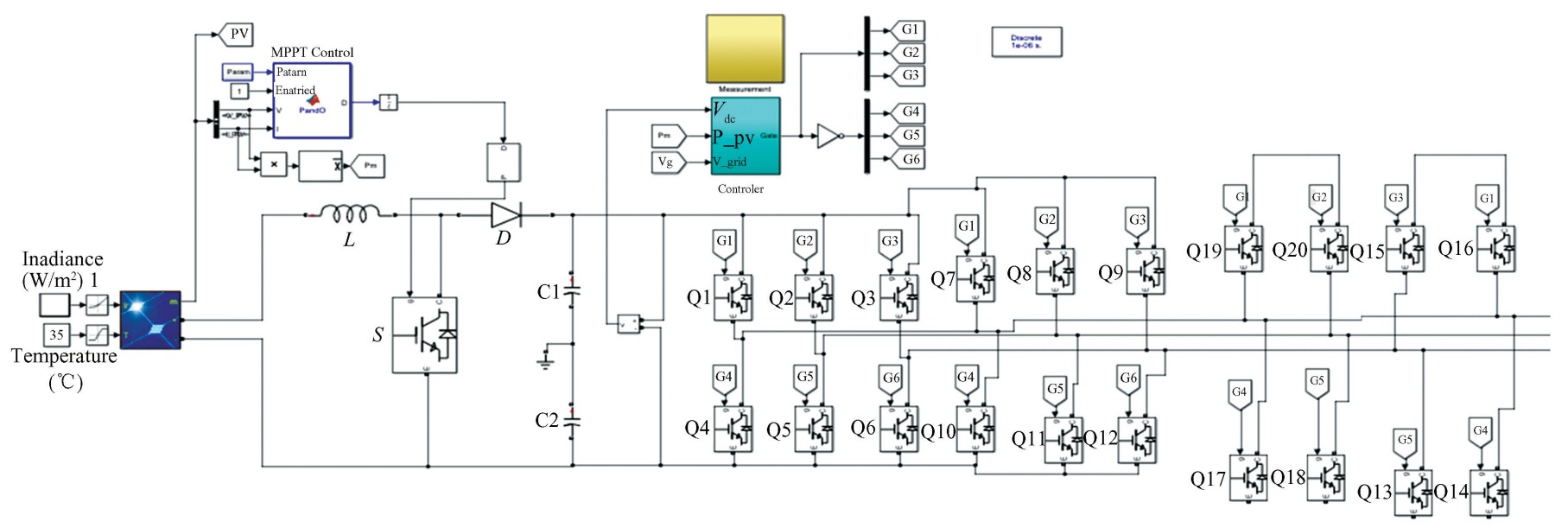
Fig.
2
Simulation test system under various environmental
5 Results and Discussion
5.1 Results
Fig. 3 indicates a stepped AC output with 7 useful voltage levels: (-3𝑉dc,-2𝑉dc,-𝑉dc, 0, 𝑉dc, 2𝑉dc, 3𝑉dc), where each step is relatively large. The waveform is a tough approximation of a sinusoidal form, resulting in better THD of 20%-25%. Although easier to govern with fewer switches and decreased switching complexity, the waveform is best decreased, resulting in more harmonics and decreased energy.
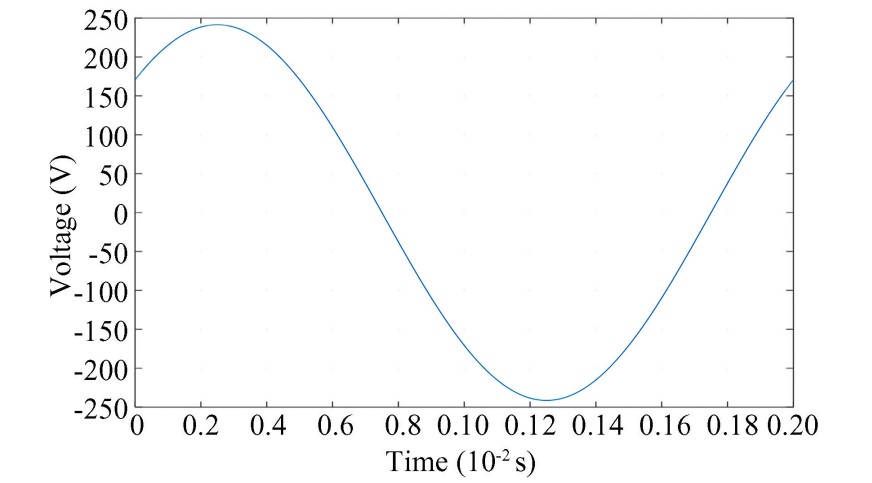
Fig.
3
7-level CHB MLI output
Fig. 4 produces a more refined waveform with 9 awesome voltage levels: (-4𝑉dc,-3𝑉dc,-2𝑉dc,-𝑉dc, 0, 𝑉dc, 2𝑉dc, 3𝑉dc, 4𝑉dc), resulting in a smoother output as compared to the 7-level. With more steps, the approximation of the sinusoidal wave is better, reducing THD to 15%-18%. Although slightly more complex to govern due to the expanded range of H-bridges and switching states, the output has fewer harmonics, enhancing the strength and high-quality.
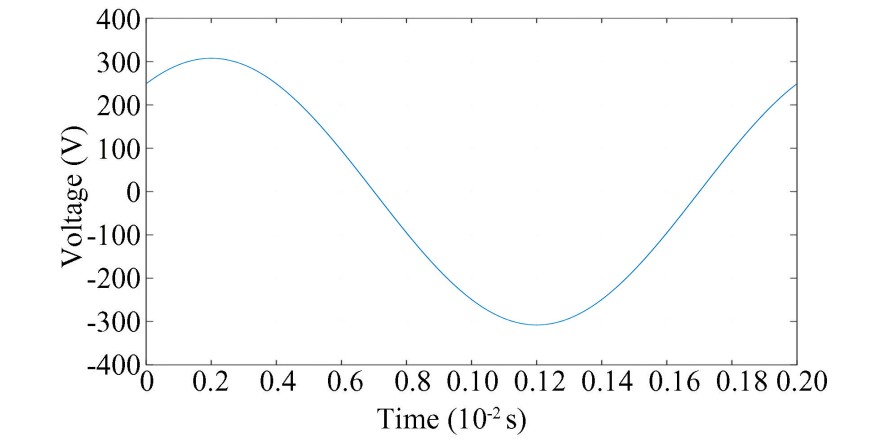
Fig.
4
9-level CHB MLI output
Fig. 5 has 11 awesome voltage tiers: (-5𝑉dc,-4𝑉dc,-3𝑉dc,-2𝑉dc,-𝑉dc, 0, 𝑉dc, 2𝑉dc, 3𝑉dc, 4𝑉dc, 5𝑉dc), presenting the smoothest and maximum continuous approximation of a sinusoidal waveform, with a number of 3. With greater voltage steps, THD is appreciably reduced to 12%-15%, providing high-quality, advanced power. However, the increased number of H-bridges and switching patterns results in greater control complexity, which can be optimized using system identification algorithms.
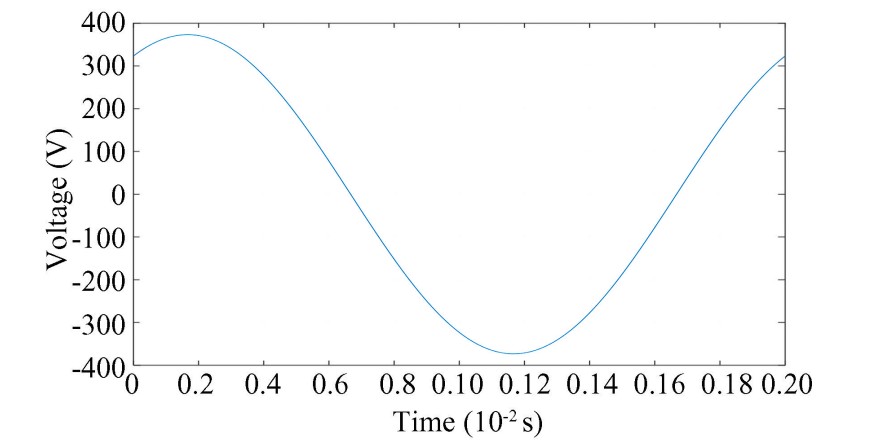
Fig.
5
11-level CHB MLI output
Fig.6 illustrates the THD response of the 7-level cascaded H-bridge multilevel inverter working in the solar photovoltaic system with and without the SVM optimization method. The findings show that the 7-level inverter has a worse harmonic distortion than a higher-level MLIs because of a small number of voltage steps. Nevertheless, the use of the SVM-based control makes THD much lower by optimizing switching angles and modulation parameters. This shows how machine learning controlled control can enhance the quality of power even at the lower-level inverter set-ups.
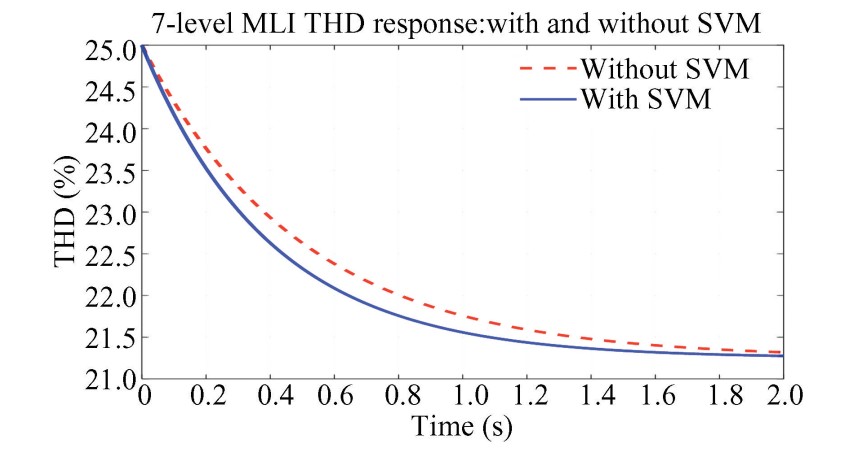
Fig.
6
THD comparison across different MLI levels with and without SVM optimization
Fig. 7 shows how the 9-level cascading H-bridge multilevel inverter with the MPPT-controlled photovoltaic system performs. The voltage levels of the output voltage waveform are smoother than the 7-level inverter because the number of voltage levels is more. The THD is smaller than 7-level, which implies increased harmonic suppression. The SVM controller also enhances the quality of the waveforms, through the optimization of the switching states, to enable less harmonic content and better voltage stability.
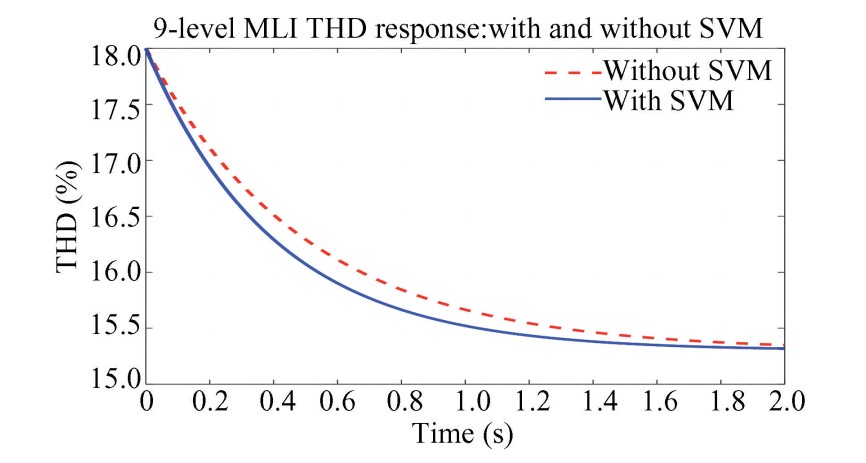
Fig.
7
Multilevel output voltage waveforms for different MLI configurations
Fig. 8 displays the performance of the 11-level cascaded H-bridge multilevel inverter in terms of THD and voltage waveform and without SVM optimization. Among the three configurations, the 11-level inverter generates the sinusoidal output waveform because it has a greater voltage resolution. The THD is much lower than the 7-level and 9-level MLIs. Maximization in the optimization of the SVM also reduces harmonic distortion and enhances voltage regulation, which shows that the proposed machine learning control approach is more effective for high-level multilevel inverter systems.
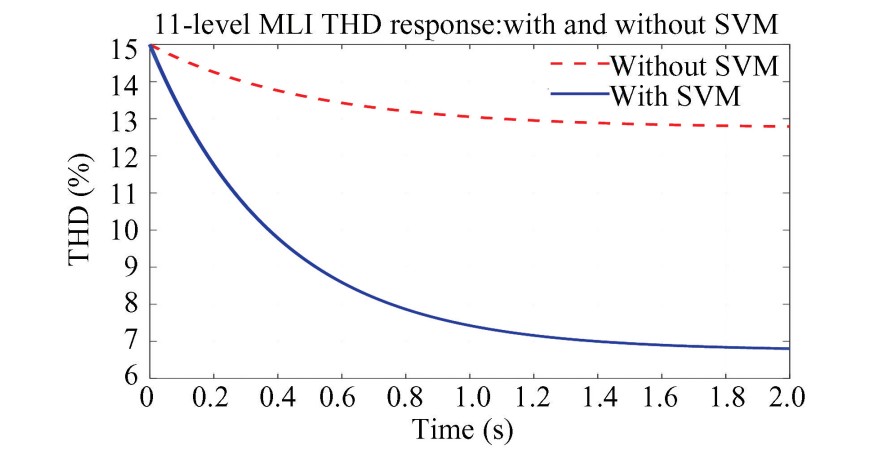
Fig.
8
Impact of SVM optimization on MLI performance
Fig. 9 demonstrates the dynamic THD response of the 7-level, 9-level, and 11-level cascaded H-bridge multilevel inverters without the SVM optimization method. The difference in THD versus time is also plotted to determine the transient and steady-state harmonic performance of the inverter system. In the 7-level inverter, the maximum occurrence of THD is at the highest level, wherein it starts off at about 25% in a steady state and then settles at 21%-22%. The reason behind this high distortion is that the voltage levels are few, resulting in a rough stepped output waveform. SVM has a minor negative impact on THD, and this implies that switching is optimized better even in low-level applications. The 9-level inverter demonstrates a medium performance of THD with initial values of approximately 18%, which are reduced to about 15%-16% in the steady-state. The additional number of voltage levels causes the output waveform to be smoother and the harmonic suppression to be better than the 7-level inverter. The SVM-based control is also capable of further reducing harmonics by optimizing the modulation strategy. The lowest THD is found in the 11-level inverter. In the absence of SVM, the THD reduces by about 14% to about 12%-13% in steady state. With the application of SVM optimization, the THD is greatly minimized as it reaches a range below 8%. The reason for this significant gain is the fact that the 11-level inverter has a greater voltage resolution, and the SVM controller offers excellent performance as far as switching optimization through learning is concerned. In general, Fig. 9 shows that the higher the inverter level, the less the harmonic distortion and the better the power quality. Furthermore, optimization methods involving the use of SVM also improve harmonic work, especially in multilevel inverter setups, and thus the proposed technique can be applied to high-performance photovoltaic power converter systems.
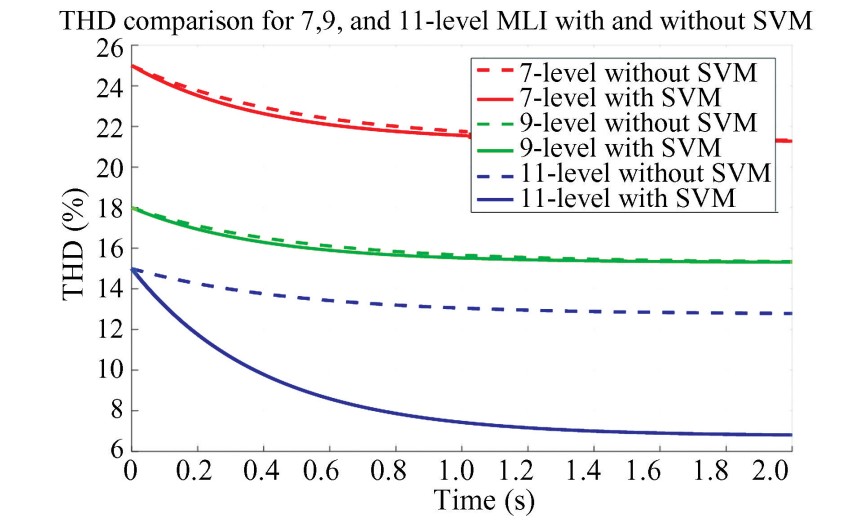
Fig.
9
Step response analysis of THD for MLI
Table 1 compares the performance of 7-, 9-, and 11-level CHB MLI. As the number of H-bridges and voltage tiers increases, the complexity and number of required switches also rise, resulting in higher power fines and lower THD. The 11-level MLI gives excellent strength quality and the lowest THD (12%-15%), but it requires greater additives and complicated system management. In comparison, the 7-level MLI has the best THD (20%-25%), however, with simpler control and fewer additives. The trade-offs among device complexity, control algorithms, and overall performance are obtrusive because the inverter level increases.
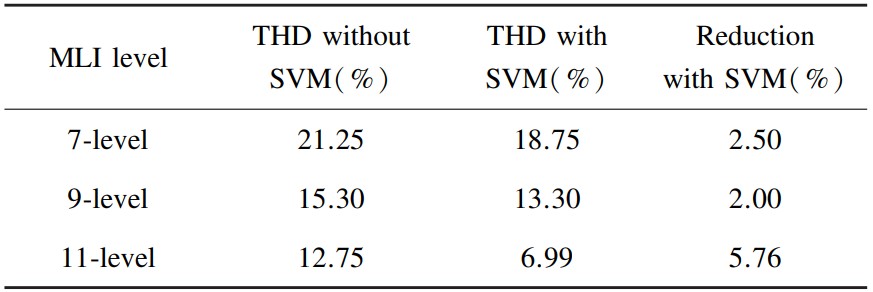
Table 2 compares the THD performance of 7-, 9-, and 11-level MLIs with and without SVM optimization. The SVM drastically improves the overall performance of every MLI by lowering THD. The 7-level MLI shows a modest reduction of 2.50%, while the 9-level MLI indicates a 2.00% improvement. The 11-level MLI achieves the maximum, with a sizeable 5.76% THD reduction. This demonstrates that SVM optimization is particularly effective for higher-level MLIs, presenting advanced strength and lower harmonic distortion as the number of voltage levels increases.
Table
1
Comparison of MLI performance for 7-, 9-, and 11-level

Table
2
THD performance with and without SVM
5.2 Discussion
This test compared the general performance of CHB MLI at 7-, 9-, and 11-level configurations and SVM optimization of the overall performance of SPV structures using MPPT under manageable conditions. The major findings and implications are discussed below:
1) Effects of the voltage levels on performance.
The 7-level MLI had the worst THD(20%-25%), indicating lower waveform quality compared to 9-and 11-level inverters. Although less complex and with fewer additives, the output waveform that was satisfactory deteriorated significantly to a much coarser waveform. The SVM-optimized THD reduction achieved a low value, indicating that although SVM can improve performance, the main setup constrains the level of development.
·9-level MLI: The 9-level MLI provided the balance between the overall performance and complexity. It showed a significant decrease in THD compared to 7-level MLI. SVM optimization also further improves performance, reducing THD and improving overall performance more effectively than in the 7-level setup. This design represents a middle-ground floor, giving the waveform exceptional performance with enough, but not too much, complexity added to the machine.
·11-level MLI: The 11-level MLI possesses the least THD in most of the settings. SVM optimization was another development that reduced THD to less than 7%. This arrangement provides the best power fines, although it is associated with greater complexity and increased types of additives. The high THD that SVM achieves suggests that sophisticated optimization strategies are particularly effective in higher-level configurations. The much greater increase at the 11-level MLI may be due to its smaller step size, which already yields a near-sinusoidal waveform. The classifier can use a richer state space during SVM optimization, thereby reducing harmonics in higher-frequency regions. By contrast, the 7-and 9-level MLIs use coarser step sizes, constraining the additional THD reduction that SVM can achieve. In this way, the improvement in SVM optimization is greater at higher-level MLIs, especially in the 11-level scenario.
·Rise in voltage levels: By definition, lowers THD since smaller voltage steps provide a waveform closer to sinusoidal.
·SVM optimization: Additional optimization of switching patterns by intelligently choosing the states that minimize high-frequency harmonics.
Therefore, Tables 1 and 2 show the improved THD, both through increased inverter levels and SVM-based optimization. The difference between the two contributions has finally been clearly brought out in the discussion.
2) Optimization of SVM: Effectiveness.
SVM optimization advantages: The combination of SVMs to optimize the control strategy resulted in a significant reduction in THD across all MLI setups. The capability of SVM to acquire and adapt complex patterns in the records makes it capable of improving the control with much more accurate way than traditional methods. This indicates the potential of the device's study strategies in the improvement of the overall performance of energy digital systems.
·MPPT control integration: Including MPPT control in the Simulink models ensured the inverters operated at the optimal point of operation, which is vital for optimizing the efficiency of SPV systems. This merger of MPPT and SVM optimization led to better regular operation, which represents the advantages of high-level managerial approaches to the use of renewable power.
·A weakness of the SVM is that, when trained on In-Distribution(ID) data and applied in an Out-Of-Distribution(OOD) setting, such as extreme irradiance variations outside the training regime, performance can be limited. This is due to the fact that the acquired hyperplanes might not generalize to the unknown conditions that result in poor switching decisions and increased THD. We propose solutions to reduce this through(i) the retraining of the SVM periodically with new operating data,(ii) introducing adaptive kernels that modify the decision boundaries on-the-fly, and(iii) hybridizing the SVM with online learning algorithms, in order to address changes in the distribution. These can be used to ensure robustness against distribution shifts and low THD even under uncharacteristic solar or load conditions.
3) Trade-offs between complexity and performance.
·Complexity in the system: More advanced MLIs, although they provide advanced performance in terms of reduction of THD, are more complex and expensive as well. Complexity and overall performance shift are crucial concerns in the design of the multilevel inverters. The better scheme for the 11-level MLI involves adding more additives and more complex control schemes.
·Optimization vs. complexity: SVM optimization can alleviate some of the issues associated with the embarrassing complexity of multiple inverters by improving performance and reducing THD. Nevertheless, the implementation of ML strategies introduces an additional layer of complexity that ought to be skewed in favor of overall performance gains.
Admittedly, CHB MLI 11-level with 20 switching devices is more expensive and more complex to package in hardware than alternative topologies with fewer switching devices(e.g., flying capacitors or NPC inverters). However, the CHB topology has been selected due to its modularity, scalability, transformer isolation, and its suitability in PV integration. These advantages enable it to remain viable in renewable energy systems as the number of devices increases. Besides, when combined with SVM optimization, CHB MLI provides considerably lower THD(less than 7%), which explains its higher use in applications where power quality matters.
6 Conclusions
This study shows the efficiency of combining the system and learning algorithms, specifically SVM, in optimizing CHB MLI to SPV systems with MPPT control. It was found that the higher the voltage level in the MLI, the lower the THD, the stronger the first-class, and the 11-level MLI offers acceptable overall results. SVM optimization further enhances these benefits and has been proven to improve the inverter's overall performance, particularly in higher-level configurations. Nevertheless, there must be a higher level of complex MLIs that are balanced by the general performance profits. Most of the power capture from integrating MPPT control improves the overall performance of SPV systems. This publication offers valuable insights into the trade-offs between complexity, overall performance, and optimization in MLI designs for renewable energy programs.
